
BOOKS
Published
Read Time
8 min read
Our Rating
4
Horus Rising is a confident, thoughtful launch to The Horus Heresy series — Abnett balances military action with genuine ideological weight, though readers seeking standalone closure or literary prose may find it wanting.
Reviewed by
LuvemBooks
Share This Review
Horus Rising by Dan Abnett Review: The Heresy Begins
Our Rating
4
Horus Rising is a confident, thoughtful launch to The Horus Heresy series — Abnett balances military action with genuine ideological weight, though readers seeking standalone closure or literary prose may find it wanting.
In This Review
- What Works & What Doesn't
- Warmaster, Myth, and the Weight of Conquest
- Dan Abnett's Prose and Pacing in Horus Rising
- Loken, Horus, and the Shape of Tragedy
- Ideology, Empire, and the Limits of Compliance
- Content Considerations and Reading Level
- Where the Foundation Holds — and Where It Strains
- Where to Buy
What Works & What Doesn't
What Works
- Horus is written as a genuinely complex, sympathetic figure — essential for the tragedy to work
- Abnett builds Warhammer lore accessibly without requiring prior knowledge
- The ideological tension between conquest and civilization gives the story intellectual depth
- Military culture and hierarchy feel authentically rendered and specific
- Loken is a compelling POV character whose earnestness anchors the narrative
What Doesn't
- Extended battle sequences can blur together and lose distinctiveness
- The novel ends more as a series setup than a satisfying standalone
- Several supporting characters function as thematic types rather than fully realized individuals
- The density of proper nouns in early chapters creates an initial accessibility barrier
Is Horus Rising worth reading for Warhammer newcomers — or is it locked behind years of tabletop lore? Published in 2006, Dan Abnett's novel launches one of the most ambitious projects in licensed fiction: a multi-author series dramatizing the catastrophic civil war that defines the Warhammer 40,000 universe. This Horus Rising book review argues that the result functions both as grand mythology and as grounded military fiction — and it largely succeeds on both fronts. Readers who enjoy Iain M. Banks's Culture novels or Joe Abercrombie's morally complex warriors may find familiar rhythms here, even if the aesthetic is distinctly Games Workshop.
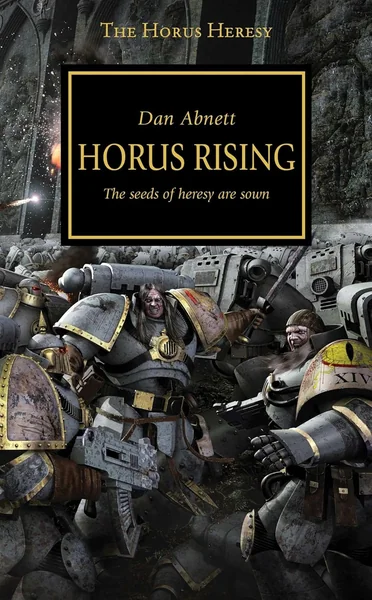
The cover signals exactly what readers are walking into. Bold, baroque, and unapologetically martial, the imagery of armored warriors against a cosmic backdrop captures the novel's tone perfectly: epic in scale, brutal in detail, and shot through with a sense of impending doom.
Warmaster, Myth, and the Weight of Conquest
The novel follows Loken, a captain in the Luna Wolves Space Marine Legion, as he rises through the ranks during humanity's Great Crusade — a vast military campaign to bring the galaxy's worlds under the Imperium's control. Horus, the Warmaster and favored son of the Emperor of Terra, commands this crusade with a combination of martial brilliance and surprising humanity.
What distinguishes Dan Abnett's approach is his refusal to treat the Space Marines as simple instruments of war. These are posthuman soldiers engineered for combat, yet the novel insists on exploring their inner lives, their doubts, and their capacity for loyalty or betrayal. The central tension is not action — it is the question of what it means to serve an empire that calls its expansion "compliance" and its violence "liberation."
The world designated Sixty-Three-Nineteen and the brutal campaign in the Whisperhead Mountains serve as the novel's primary proving grounds. Here, Abnett tests his characters against environments that are physically and philosophically hostile, and the results reveal cracks that will eventually split the galaxy in two.
Dan Abnett's Prose and Pacing in Horus Rising
Dan Abnett has written extensively across the Warhammer universe, and his craft shows. The prose is functional rather than lyrical, built for propulsion. Sentences tend to be tight and action-oriented, which suits the material. The pacing moves confidently through large-scale battles and quieter political scenes alike, never letting either mode overstay its welcome.
Where Abnett genuinely excels is in the texture of military culture. The rituals, hierarchies, and camaraderies of the Luna Wolves feel earned rather than decorative. Kyril Sindermann, a scholar known as an iterator, provides an outsider perspective on the crusade's ideological contradictions, and these scenes offer some of the book's most interesting intellectual territory. The interplay between military pragmatism and political philosophy gives the story a depth that many similar licensed novels lack.
That said, the prose occasionally defaults to genre shorthand. Descriptions of combat, while kinetic, can blur together when sustained over long passages. Readers who prefer prose with more literary ambition — in the vein of Gene Wolfe's Book of the New Sun — may find Abnett's style workmanlike rather than revelatory.
Loken, Horus, and the Shape of Tragedy
Loken is an effective protagonist precisely because he is earnest in a story building toward betrayal. His faith in Horus and in the Imperium is not naive — it is the product of everything he has been made to be. Watching that faith navigate its first real complications is what gives the novel its dramatic engine.
Horus himself is rendered with considerable care. Rather than a cartoonish villain in waiting, he is charismatic, conflicted, and genuinely admirable for much of the book. This is a deliberate structural choice: the tragedy of the Horus Heresy only functions if readers understand what is being lost. Dan Abnett makes that loss feel real.
The supporting cast is populated with warriors and thinkers who exist to test Loken's worldview from different directions. Some feel fully realized; others function more as thematic placeholders. This is a limitation of ensemble military fiction — not every voice can receive equal development in a single volume.
Ideology, Empire, and the Limits of Compliance
The themes in Horus Rising extend well beyond battlefield spectacle. The novel is genuinely interested in the ideology of empire: what it costs to build one, who pays that cost, and whether the builders ever truly reckon with it. The Imperium's rhetoric of unity and progress sits in constant, productive tension with the reality of conquest.
This is not subtle — the book uses terms like "iterators" for propagandists quite transparently — but it does not need to be. The Warhammer universe has always been a satirical amplification of real-world imperial dynamics, and Abnett leans into that tradition. The Whisperhead Mountains campaign, in particular, raises questions about counterinsurgency and civilian cost that the narrative does not conveniently resolve.
Readers approaching this as pure escapism will find plenty. Those willing to engage with its ideological dimensions will find a richer text than the cover suggests.
Content Considerations and Reading Level
Horus Rising content considerations are worth noting for readers buying on behalf of others. The novel contains sustained military violence, including descriptions of large-scale battle casualties, close-quarters combat, and body horror elements consistent with the Warhammer aesthetic. There is no explicit sexual content. The language is intense but not gratuitously profane.
In terms of reading level, the text assumes basic familiarity with science fiction conventions but does not require prior Warhammer knowledge. Dan Abnett constructs his world-building carefully enough that newcomers can orient themselves. That said, the density of proper nouns — legions, titles, factions — can feel overwhelming in early sections. New readers should expect a learning curve in the opening chapters before the narrative fully clicks.
The book is generally appropriate for older teenagers and adults. Younger readers who are comfortable with war fiction and dark themes will likely manage it, but parental discretion is reasonable given the violence levels.
Where the Foundation Holds — and Where It Strains
No first entry in a fifty-plus-book series can be entirely self-contained, and Horus Rising occasionally shows that constraint. Several plot threads are introduced and left deliberately unresolved — this is by design, but it means the novel's ending feels more like a chapter break than a conclusion. Readers who prefer standalone satisfaction may find this frustrating.
The novel's greatest strength is also a mild weakness: its commitment to Loken's perspective limits the reader's view of larger events. What Horus is experiencing internally during the novel's pivotal later sections remains largely opaque, and that restraint, while artistically defensible, creates occasional dramatic distance at precisely the moments when intensity should be highest.
The bottom line is that this military science fiction novel does exactly what a series-opener should do. Horus Rising builds a world worth inhabiting, introduces characters worth following, and raises questions it has no intention of answering cheaply. Whether that justifies committing to a series of this scope depends entirely on the reader.
Where to Buy
If you want military science fiction that earns its mythology — and you're willing to sign on for a longer journey — Horus Rising is the right place to start; the Amazon link in the sidebar has the current price.