

8 min read
4.7
· 206 Amazon ratingsShare This Review
Guards! Guards! by Terry Pratchett Review: Sharp Discworld Comedy with Real Bite
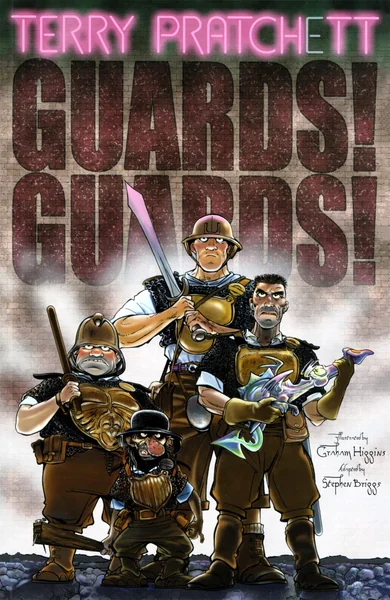
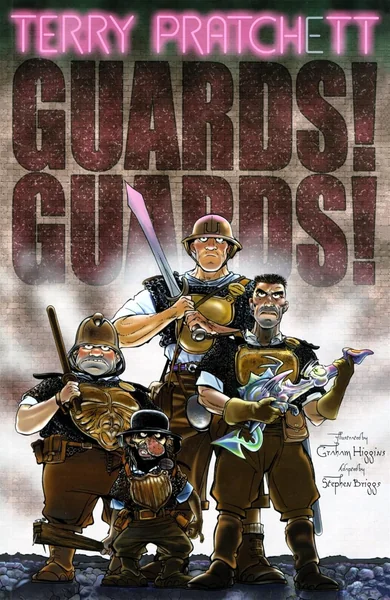
Guards! Guards! — adapted for the graphic novel format by Stephen Briggs and illustrated by Graham Higgins — is the comic fantasy novel by Terry Pratchett that launched the beloved City Watch strand of the Discworld series, following the hapless Night Watch of Ankh-Morpork as a secret brotherhood's dragon-summoning scheme spirals magnificently out of control.
LuvemBooks Verdict
Best for
Readers new to Discworld — particularly those drawn to the graphic novel medium — who want an accessible, visually driven entry into the City Watch strand of the series, with its blend of underdog comedy and sharp political satire.
Worth it if
You want a Discworld starting point that delivers fully realised characters alongside genuine satirical substance, and you're open to a compressed, illustrated retelling of a novel widely regarded as one of the series' strongest foundations.
Skip if
You're hoping for the full density and texture of Pratchett's prose — at 122 pages, this graphic novel adaptation necessarily compresses the original, and readers who already love the novel may find the condensed format a pale substitute.
What readers & critics say
Wikipedia's reception summary records that John Clute, writing in Interzone in 1990, acknowledged that "Pratchett writes with something like genius" while arguing that the book's more philosophically serious passages — particularly Lord Vetinari's monologue — risked damaging Discworld's comedic potential. Reader reviews retrieved from blogs such as The Book Smugglers and SFF Book Review describe it as a standout in Pratchett's evolution as a writer, praising its observational wit and increasingly assured craft.
Sources: Wikipedia – Guards! Guards!, The Book Smugglers, SFF Book ReviewAsk LuvemBooks
Was this helpful?
- Is it worth reading?
- Guards! Guards! earns its reputation as a landmark Discworld entry: it introduces Sam Vimes and Carrot Ironfoundersson — characters who anchor an entire strand of the series — and combines genuine comedy with substantive political satire on manufactured legitimacy and power. NPR has cited it as a natural entry point for new readers, and reader commentary widely reflects that view. The graphic novel format extends that accessibility to the visual medium, though readers seeking the full texture of Pratchett's prose will want to seek out the original novel alongside or instead of this adaptation. The one genuine tension, as critic John Clute noted in Interzone, is that Lord Vetinari's philosophically weighted monologue on evil can feel at odds with the book's comic register — whether that reads as a flaw or a strength tends to define which camp of Discworld reader you fall into.
- Similar books
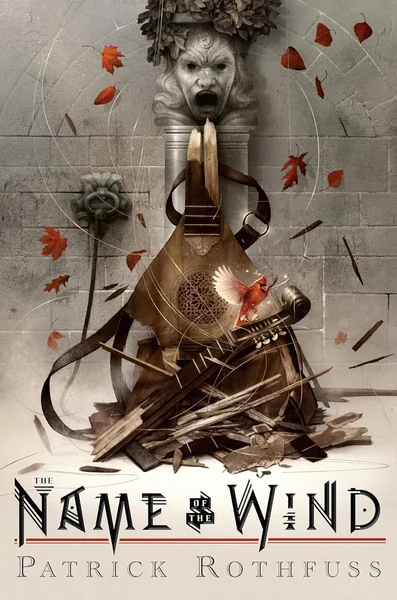
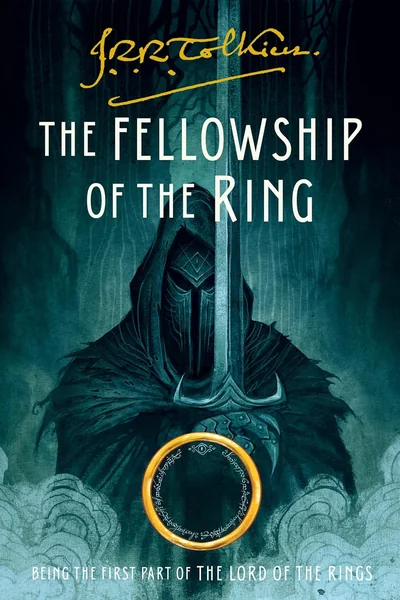
- Readers who enjoy Guards! Guards! tend to gravitate toward other works that blend comic energy with serious worldbuilding or satirical intent. Terry Pratchett's own Mort — also reviewed by LuvemBooks — offers a similarly sharp comedic lens applied to Death and Discworld's moral architecture, and is another frequently recommended entry point to the series. For epic fantasy with rich world-construction, J.R.R. Tolkien's The Fellowship of the Ring provides the genre bedrock that Pratchett is consciously subverting, while Patrick Rothfuss's The Name of the Wind offers immersive, character-driven fantasy for readers who respond to Vimes and Carrot as focal characters. Good Omens, co-written by Pratchett with Neil Gaiman, channels a similarly irreverent satirical spirit for readers who want more of Pratchett's comic-theological wit.
- Who should read this?
- This graphic novel adaptation is best suited to two overlapping groups: readers new to Discworld who prefer the visual medium as an entry point, and existing Pratchett fans curious to see the Guards! Guards! story rendered in panels by Stephen Briggs and Graham Higgins. It is also a natural pick for fantasy readers who enjoy comedy with genuine satirical substance — the dragon conspiracy works as both an adventure plot and a pointed examination of political manipulation. Readers who want the full prose density of Pratchett's original, or who prefer Discworld at its most purely playful, may find the adaptation's 122-page compression and Vetinari's heavier philosophical passages a mismatch for their expectations.
- About Terry Pratchett
- Terry Pratchett was a beloved British fantasy author best known for the Discworld series, celebrated for his satirical wit and having sold over 85 million books worldwide.
- How does this compare to other Pratchett books?
- Within the Discworld series, Guards! Guards! holds a distinctive position as the book that introduced Sam Vimes and the City Watch — characters who would anchor what most accounts regard as Pratchett's most sustained and satirically consistent strand of novels. Compared to The Colour of Magic and The Light Fantastic — the series' earliest entries, also reviewed by LuvemBooks — Guards! Guards! is generally seen as a step-change in character depth and satirical ambition. Against Mort, another LuvemBooks-reviewed entry point, Guards! Guards! trades that book's Death-focused comic philosophy for a harder-edged political satire, with John Clute noting in Interzone that Pratchett here 'writes with something like genius' even as the book's tonal range divides opinion.
- What is the graphic novel adaptation like?
- The Gollancz graphic novel adaptation pairs Stephen Briggs's script with Graham Higgins's illustrations, compressing Guards! Guards! into 122 pages of panel-driven storytelling. Briggs, a longtime Discworld adapter, structures the narrative to preserve the dragon conspiracy plot and the core City Watch characters, while Higgins's art gives Ankh-Morpork — described in the review as grimy, chaotic, and oddly liveable — a visible, immediate character. The format makes the story accessible to readers drawn to the visual medium, though the compression necessarily trades the full density of Pratchett's prose for pace and visual impact. Reader commentary, including a note from Deviant Art, praised the humour and themes as remaining strong in the adaptation, with Carrot and Lady Sybil Ramkin quickly becoming favourites even in this condensed form.
Summarize this book
Follow up
Synthesized from verified book data & published reviews · How we review
Press Enter to ask. Answers come from our editorial Q&A — start typing to see related questions.
Age & Reading Level
Recommended age
Adult
Reading level
Adult
2 content notes · who it suits
Content to know about
Skip if you want the full prose density and texture of Pratchett's original novel rather than a condensed graphic adaptation
Our Review
What the Story Actually Is
Place in the Discworld and in Fantasy
Strengths: Humour, Character, and Social Texture
A Genuine Critical Tension
Who This Edition Is For
Sources & Further Reading
The key facts and claims in this review are grounded in the retrieved, verified sources listed below.
- Cited in this review
- 1
othemts.wordpress.com
- 2
- 3
thebooksmugglers.com
- Further reading
- 4
Terry Pratchett, Wikipedia
- 5
Books like Guards! Guards!
Curated picks for readers who enjoyed Guards! Guards!, with our reasoning for each match.
More by Terry Pratchett
If you liked Guards! Guards!
Why It’s Trending
Guards! Guards! Gets the Graphic Novel Treatment from Stephen Briggs and Graham Higgins
The classic Discworld novel that introduced Sam Vimes and the Ankh-Morpork Night Watch has been adapted into a graphic novel by Stephen Briggs and illustrated by Graham Higgins. If you've been curious about Discworld but weren't sure where to start, this could be your in.