BOOKS
Published

Read Time

9 min read

Reader rating

4.8

· 9,027 Amazon ratings
reader ratings, not a LuvemBooks score
Curated & edited by

LuvemBooks Editorial

How we create our reviews →
Share This Review

Going Postal by Terry Pratchett Review: Comic Fantasy at Its Sharpest

Terry Pratchett's Going Postal — the 33rd Discworld novel and first Moist von Lipwig book — sends a condemned con man to resurrect Ankh-Morpork's dead Post Office and take on a rapacious telecom monopoly. One of Pratchett's most acclaimed satires, heard here in Stephen Briggs's unabridged narration.

LuvemBooks Verdict

Best for

Fantasy-curious newcomers who want a single, standalone door into Discworld — a fresh protagonist, no prior series knowledge required, and satire aimed at real targets like monopoly and privatisation.

Worth it if

Worth it if you want comic fantasy where the jokes ride on genuine anger about what happens to public services when profit becomes the only measure.

Skip if

Skip it if Pratchett's relentless density of puns, footnotes, and layered absurdity exhausts rather than delights you — or if you want the satire's corporate targets to feel less early-2000s.

Retrieved reception is strongly positive: BookBrowse's indexed trade reviews praise Pratchett's satire of the modern telecom business as "sharp-edged" and "wonderfully executed," while blogger Aconite Cafe recounts bouncing off The Colour of Magic before finding Going Postal the starting point that made Discworld click. Fellow bloggers Vacuous Wastrel and Curled Up With a Good Book are similarly enthusiastic about its wit and craft.

Sources: BookBrowse, Aconite Cafe, Vacuous Wastrel, Curled Up With a Good Book
4.8from 9,027 Amazon ratings— reader ratings, not a LuvemBooks score
Buy on Amazon

Age & Reading Level

Recommended age

Adult

Reading level

Adult

Content to know about

execution and capital punishment played for comedy
con artistry and fraud as the protagonist's profession

Skip if you find relentless puns, footnotes, and jokes operating on several levels at once exhausting rather than delightful — Pratchett offers no relief from that density here.

In This Review
  • What Works & What Doesn't
  • What the Book Actually Is
  • Satire with Real Teeth
  • An Unusually Good Door into Discworld
  • The Audio Edition in Scope
  • Limitations and the Right Reader

What Works & What Doesn't

What Works
  • First-rate entry point to Discworld: a fresh protagonist, standalone plot, and the publisher's confirmation that the series can be read in any order
  • Pointed, still-relevant satire of monopoly and privatised telecom, described by critical coverage (as indexed in book-trade listings) as a satisfying comedy satirising the modern telecom business
  • Unusually propulsive structure for an adult Pratchett novel, with chapter divisions he had previously reserved for his children's books
  • Brought Pratchett his first major award shortlisting and would have added a Hugo nomination had he not withdrawn it
  • Unabridged audio read by Stephen Briggs, the narrator most closely associated with Discworld
What Doesn't
  • The relentless density of puns, footnotes and layered jokes is Pratchett's signature but exhausts readers who don't take to it
  • As the 33rd series entry, recurring figures such as Vetinari land harder for readers with prior Discworld experience
  • Some of the satire's specific corporate targets belong to its early-2000s moment
  • At over eleven hours, the audio edition is a substantial time commitment rather than a quick listen
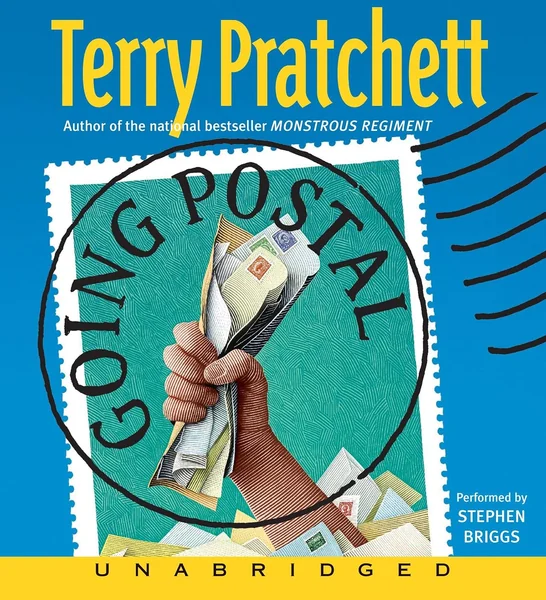
A con man, a dead post office, and a corporate monopoly walk into Ankh-Morpork — the result is one of the sharpest and most accessible of Terry Pratchett's Discworld novels, here in Stephen Briggs's unabridged audio performance.
Going Postal: A Novel of Discworld by Terry Pratchett front cover

What the Book Actually Is

Going Postal opens with a hanging that doesn't quite take. Moist von Lipwig, a career fraudster finally caught after years of swindling, survives his own execution and is offered a choice by Ankh-Morpork's Patrician, Lord Vetinari: take over the city's moribund Post Office, or die for real. Moist chooses the mail, and inherits a building stuffed with decades of undelivered letters and a workforce reduced to almost nothing. The novel, originally published in the United Kingdom in September 2004, is the 33rd of Pratchett's 41 Discworld books and the first of the Moist von Lipwig sequence within it. This edition is the unabridged Harper audiobook, narrated by Stephen Briggs with a listening length of 11 hours and 23 minutes, released in January 2005. The novel sends Moist up against the Grand Trunk, the semaphore "clacks" company that has monopolised long-distance communication across the Disc under the direction of the piratical Reacher Gilt — culminating in an outrageous public wager that Moist can carry a message to Genua, some 2,000 miles away, faster than the Grand Trunk's own towers can.

Satire with Real Teeth

What lifts Going Postal above a simple underdog comedy is its target. This is a book about monopoly, privatisation, and the way essential public services decay when they stop being profitable — the Post Office starved and abandoned while a rapacious private network squeezes its customers and cooks its books. Critical coverage, as indexed in book-trade listings, described it as a satire of the modern telecom business in a satisfying comedy of a man sent to a fate worse than death, and that framing captures the book's double life: the jokes are constant, but the anger underneath them is genuine. Pratchett's official site frames his method as holding up a distorting mirror to our own world, and Going Postal is among the clearest demonstrations of that principle. The invention of postage stamps, the obsessions of collectors, and the subculture of clacks operators — including a hacker crew styling itself "The Smoking Gnu" — give the satire texture and specificity rather than leaving it as allegory.

An Unusually Good Door into Discworld

For newcomers, the practical question with any 33rd-in-series book is where to start, and Going Postal has a strong claim as an answer. It introduces a fresh protagonist rather than continuing an established character's arc, and the publisher's own site notes that the Discworld novels can be read in any order. Reader commentary echoes this: one blogger's review recounts bouncing off Pratchett's first Discworld novel, The Colour of Magic, before being steered to Going Postal as a starting point and finding it the book that finally made the series click. Formally, it is also unusual among Pratchett's adult novels in being divided into chapters — a structure he had previously reserved for his children's books and the Science of Discworld titles — which gives the plot a propulsive, cliffhanger-driven rhythm. Its standing in Pratchett's body of work is reflected in its award recognition: it brought his first major genre-award shortlisting and would have added a Hugo Award nomination for Best Novel had Pratchett not withdrawn it rather than let the stress of the award overshadow his enjoyment of the Worldcon.

The Audio Edition in Scope

A note on what this review can and cannot cover: the assessment here draws on the book's documented content and published reception, not on hands-on listening, so no verdict is offered on the performance itself. What is verifiable is the edition's pedigree. Stephen Briggs is the narrator most closely associated with Discworld in audio — the longtime voice of the unabridged recordings — and his connection to Pratchett's work extends well beyond the booth, including stage adaptations of the novels. The recording is unabridged, so nothing of the text, including Pratchett's trademark footnotes, is trimmed for the format. At over eleven hours, it is a substantial listen rather than a quick one, and the book's cultural afterlife extends past the page: Sky One adapted it as a two-part television film in 2010, and after Pratchett's death a plot device from this very novel inspired websites to honour him through a hidden line in their HTTP headers — a tribute with few parallels for any fantasy author.

Limitations and the Right Reader

Honest reservations apply mostly to taste. Pratchett's comic method — puns, footnotes, escalating absurdity, jokes operating on three levels at once — is relentless by design, and readers who find that density exhausting rather than delightful will find no relief here. Although the novel stands alone, it is still the 33rd book in a long-running series, and background figures like Vetinari carry more weight for readers who have met them before. And while the telecom satire remains strikingly relevant, some of its specific targets belong to the early-2000s corporate moment in which it was written. None of this dents the book's reputation: it remains one of the most recommended entry points to Discworld and a benchmark for comic fantasy with something on its mind.

Sources & Further Reading

The key facts and claims in this review are grounded in the retrieved, verified sources listed below.

  1. Cited in this review
  2. 1

    en.wikipedia.org

  3. 2
  4. 3
  5. Further reading
  6. 4

    Terry Pratchett, Wikipedia

  7. 5

    terrypratchettbooks.com

  8. 6
  9. 7
  10. 8