Skip to content
Reviewed

Read Time

8 min read

Reader rating

4.6

· 113,834 Amazon ratings, as of Oct 2026
reader ratings, not a LuvemBooks score
Curated & edited by

LuvemBooks Editorial

How we create our reviews →
Share This Review
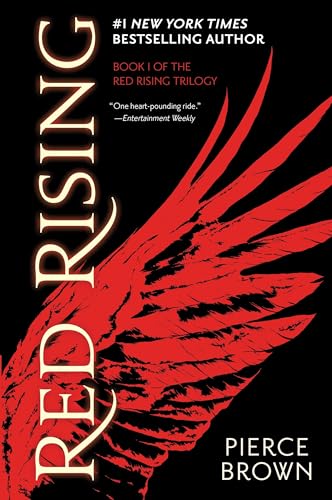
Front cover of Red Rising

Our review

Red Rising

Red Rising by Pierce Brown Review: A Gripping Dystopian Debut on Mars

Red Rising is a 2014 dystopian science fiction novel by Pierce Brown in which sixteen-year-old Red miner Darrow, radicalized by the execution of his wife Eo, is surgically transformed into a Gold and sent to infiltrate the Society's ruling elite. It reached #20 on the New York Times Best Seller list and earned a devoted fanbase for its breakneck pacing and high-stakes class warfare premise.

Ages 16+graphic violence and brutal combat · state-sanctioned execution of a major character

LuvemBooks Verdict

Best for

Readers who want a grimdark class-uprising story with a morally pressured protagonist and a detailed, internally consistent social architecture — and who are willing to push through a middle section that several reviewers find noticeably slower before a payoff that even mixed-verdict critics call compelling.

Worth it if

Worth reading if you are drawn to science fiction driven by systemic oppression and political world-building rather than stylistic experimentation, and can accept that the Institute stretch divides reviewers sharply on whether it sustains momentum or loses it.

Skip if

Skip it if you have little patience for survival-competition structures that reviewers — including Roro Reads and Luke Harkness — describe as dragging across a long middle section, or if a protagonist some readers find arrogant will pull you out of an otherwise propulsive story.

Where reviewers agree and split

Readers rate it 4.6 on Amazon. The reviews we read that discuss it in depth disagree here:

Of the 4 reviews we read that discuss its pacing, 1 finds it relentless and propulsive throughout, but 3 find the middle section drags noticeably.

  • Pacing

    1 finds it relentless and propulsive throughout · 3 find the middle section drags noticeably

  • World-building

    2 find the caste system genuinely compelling · 1 finds parts of the world hard to picture

  • Characters

    1 praises the emotional pull of Darrow and key cast · 2 find secondary characters flat or underdeveloped

  • Prose

    1 finds the writing compelling and sharp · 1 finds the style blunt and lacking nuance

Pacing

Praise

“Brown's story is relentless and well put together, with plenty of circles within circles and moral ambiguity to consider.”

— Grimdark Magazine · Book blog
Criticism

“There are slow lesser interesting moments in the middle and then the last fifth of the book or so is absolutely brilliant”

— Luke Harkness · Book blog
Criticism

Act 3 pacing slows down noticeably

— Mike (Mike's Book Reviews) · BookTube (our note on their video)
Criticism

Severe structural imbalance and jarring pacing shift

· BookTube (our note on their video)

World-building

Praise

“The world-building, the sheer work that went into putting together the detail of Pierce Brown's solar system-wide society, is breathtaking.”

— Claire Huston · Book blog
Praise

“What we see of the society is genuinely compelling, particularly some of the more subtle control methods”

— Fantasy Book Review · Book blog
Criticism

“I think there are still parts of the world I'm struggling to picture. I don't know what a terraformed Mars looks like because the planet is red.”

— Shelf Reflection · Book blog

Characters

Praise

“From the outset, Pierce Brown forces you to give a damn about the people you're reading about.”

— Luke Harkness · Book blog
Criticism

“His characters tend to either be great or flat. This two-dimensionality even extends at times to the main character, Darrow.”

— Claire Huston · Book blog
Criticism

Underdeveloped side characters and unearned relationship dynamics

· BookTube (our note on their video)

Prose

Praise

They found the writing style compelling and recommend diving in without reading too much synopsis beforehand

— Natasha (Tashapolis) · BookTube (our note on their video)
Criticism

Blunt writing style lacking nuance or subtext

· BookTube (our note on their video)
8 reviews weigh in (5 book blogs, 3 BookTube videos); counts are per topic. A review counts only where we can quote it.

Wikipedia's overview records that Red Rising received generally positive reviews and reached #20 on the New York Times Best Seller list; Kirkus Reviews called it "a fine novel for those who like to immerse themselves in alternative worlds," while Grimdark Magazine found Brown's story "relentless and well put together, with plenty of circles within circles and moral ambiguity to consider."

“A fine novel for those who like to immerse themselves in alternative worlds.”

— Kirkus Reviews
Sources: Wikipedia, Kirkus Reviews, Grimdark Magazine
4.6from 113,834 Amazon ratings, as of Oct 2026— reader ratings, not a LuvemBooks score

Ask LuvemBooks

Was this helpful?

Red Rising is a 2014 dystopian science fiction novel set on a future Mars where sixteen-year-old Darrow, a Red caste miner radicalized by his wife Eo's execution, is surgically transformed into a Gold to infiltrate and dismantle the Society from within. Readers drawn to class-uprising narratives with morally pressured protagonists and a detailed, internally consistent caste architecture will find Brown's debut squarely in their territory — though the Institute sequences draw close enough comparisons to The Hunger Games, Ender's Game, and Lord of the Flies that readers already steeped in those works may find the middle stretch familiar and, as most reviewers who discuss pacing note, noticeably uneven. The novel opens a multi-book series and functions as a complete first act, establishing Darrow's mission without resolving the broader revolution.
Is it worth reading?
Red Rising delivers on its core promise — a charged class-warfare premise, a grief-driven protagonist in Darrow whose motivations stay legible even as the plot grows complex, and a Color-based hierarchy detailed enough to give the Institute's house politics genuine geopolitical texture. The caveat is real, though: reviewers are divided on whether the novel sustains that momentum. While some call the story relentless and well put together, most reviews that discuss pacing — including those from the Roro Reads channel — find the Institute stretch noticeably uneven and the middle slower. The novel is worth the commitment for readers who prize world-building rooted in social structure and can push through a middle section that divides opinion; readers who want tight, consistent pacing throughout may find the trade-off harder to accept.
Similar books
Readers who enjoy Red Rising most often point to a cluster of books that share its DNA. The Hunger Games and Ender's Game are the closest structural parallels — Brown's Institute sequences draw on both, and the publisher itself has made that comparison. Lord of the Flies surfaces in the house-warfare dynamics of the Institute. For a more recent analogue with a similar appetite for brutal systems and military conflict, R.F. Kuang's The Poppy War explores culturally grounded class and racial warfare with comparable darkness. Golden Son, the direct sequel, continues Darrow's story into the broader Society. For readers drawn to the dystopian social-control angle, George Orwell's 1984 and Brandon Sanderson's Skyward sit nearby on the shelf, the former for its systemic deception and the latter for its mix of YA adventure and military hierarchy.
Who should read this?
Red Rising is best suited to readers who want a grimdark class-uprising story anchored by a morally pressured protagonist and a richly detailed, internally consistent social architecture. Fans of military science fiction who find standard YA dystopian fare too thin will likely find the Color-based hierarchy and the Institute's geopolitical house politics more satisfying than the genre comparisons suggest. It is less well-matched to readers who want stylistic experimentation or consistently propulsive pacing — most reviews that discuss the novel's structure find the Institute stretch uneven, and readers with low tolerance for survival-competition templates that echo familiar predecessors may find the middle stretch frustrating.
What age is it for?
Best for readers 16 and up. Red Rising's Institute sequences involve sustained, brutal interpersonal violence and a morally compromised survival-competition structure that is more intense than standard YA fare. The political complexity of the fourteen-Color caste system and Darrow's double-identity arc also suit older teen and adult readers better than younger audiences. There is no significant sexual content, but the grimdark tone is the primary reason for the higher age floor.
Is there a film or TV adaptation?
Universal bought the screen rights in 2014, but they lapsed and that version stalled. As of October 2026, Paramount has the film rights, with Francis Lawrence — who directed the later Hunger Games films — set to direct an adaptation of this first book, according to The Hollywood Reporter (16 October 2026).
About Pierce Brown
Pierce Brown is an American science fiction author who writes the Red Rising series. The series currently consists of six novels: Red Rising (2014), Golden Son (2015), Morning Star (2016), Iron Gold (2018), Dark Age (2019), and Light Bringer (2023).
Summarize this book

Summarize this book

Red Rising is set on a future Mars governed by the Society, a caste system dividing citizens into fourteen color-coded tiers. Darrow, a sixteen-year-old Red miner, discovers that the Reds' supposed mission of terraforming Mars is a centuries-old lie — Mars has long been habitable, and the Reds are kept underground through deliberate deception. After his wife Eo is hanged by ArchGovernor Nero Augustus for singing an illegal protest song, Darrow is recruited by the Sons of Ares rebel group and surgically carved into a Gold, entering the Institute under the false identity Darrow au Andromedus to bring down the ruling elite from within. The novel is the opening volume of the Red Rising series; the broader revolution Darrow ignites extends across subsequent books.

Follow up

How many books are in the series?
Does this book work as a standalone?
What's the overall tone?

Synthesized from verified book data & published reviews · How we review

Ask LuvemBooks

What would you like to know about Red Rising?

Answers come from our editorial notes on this book. If we haven't covered something, we'll say so.

Readers often ask

Our Review

We review the evidence: published critics, reader verdicts and BookTube reviews, gathered and weighed with AI assistance and edited by LuvemBooks, rather than one reader's first-hand take.

Red Rising is a New York Times bestseller that opens a series set in a rigidly stratified future Solar System — and it earns that attention on the strength of an unusually charged premise and a fast opening, though reviews that discuss its pacing are divided, with some finding it consistently strong and others finding the middle slower.

The World and the Premise

Pierce Brown's debut is set on a future Mars where the Solar System is governed by the Society, a caste system in which citizens are born into one of fourteen "Colors" that determine their physical traits and social roles. At the bottom are the Reds, underground laborers who mine Helium-3 fuel under the promise that their toil is terraforming Mars for future humanity.
The novel's central reveal — that Mars has in fact been terraformed for centuries, and the Reds are kept underground through deliberate deception — arrives early and functions as the engine for everything that follows. It is a world-building choice that gives the class conflict genuine moral weight rather than leaving it as backdrop.

Plot and Stakes

Darrow, sixteen years old and newly married to Eo, is the novel's protagonist. When ArchGovernor Nero Augustus has Eo publicly hanged for singing an illegal protest song, Darrow's grief sets the plot in motion.
Rescued by the Sons of Ares rebel group and its leader Dancer, Darrow undergoes a black-market physical transformation — a "carving" — to pass as a Gold. Under the fabricated identity "Darrow au Andromedus," he gains entry to the Institute, Mars's elite Gold academy, where twelve Houses compete in brutal trials.
The Institute's Passage ritual and the house warfare that follows form the bulk of the novel's second and third acts, drawing comparisons to The Hunger Games and Ender's Game — a parallel the publisher itself has drawn, and one that USA Today echoed when the outlet declared that Red Rising "ascends above a crowded dystopian field."

Reception and Significance

The novel's reception was broadly positive. Wikipedia's reception summary notes that critical response was generally favorable, and the book reached #20 on the New York Times Best Seller list.
Entertainment Weekly and BuzzFeed named it among the best books of its year. The fanbase, who call themselves "Howlers" after characters in the novels, has become a notable presence in science fiction fandom.
Not all coverage was celebratory: some reviewers offered a dissenting view, writing that Brown "offers a Hollywood-ready story with plenty of action and thrills but painfully little originality or plausibility" — a critique that points to the novel's acknowledged debt to its predecessors in the young-adult dystopian genre. That tension, between propulsive entertainment and genre familiarity, is the most honest frame for evaluating what Red Rising achieves.
Interior page with a decorative bracket and a synopsis excerpt about a protagonist's struggle for justice and survival.

Strengths on the Page

Brown has described his approach to building the novel around Darrow first and the world second, and the result is a protagonist whose motivations — grief, loyalty to Eo's dream of freedom — remain legible even as the plot grows more complex. The Color-based hierarchy is detailed and internally consistent, giving the Institute's house politics a geopolitical texture that some readers of military science fiction will find more satisfying than the YA comparisons suggest.
Reviewers split on the pacing. Grim Dark Magazine calls the story "relentless and well put together", but most reviews that discuss it, including Luke Harkness and the Roro Reads YouTube channel, find the middle section noticeably slower and the Institute stretch structurally uneven.

Who It Is For and Where It Fits

Red Rising is the opening volume of a series and functions as a complete act within a larger story — it establishes Darrow's mission and the Society's contradictions, but the arc of the broader revolution extends well beyond this book. Readers who find the YA dystopian genre overly familiar may feel the Institute sequences echo Lord of the Flies and Ender's Game closely enough to blunt surprise; those comparisons surface in independent reader commentary and in Publishers Weekly's critique.
Readers drawn to class-uprising narratives with genuine stakes, morally compromised protagonists, and science fiction world-building rooted in social structure will find the novel squarely in their territory. It is a debut that announces a large ambition, and the series it opens has sustained a substantial readership on that foundation.

Andy from Roro Reads reviews Red Rising

Andy shares a spoiler-free review and critique of Pierce Brown's Red Rising.

A BookTube review by Roro Reads, 2023 · 4.8K views · 9.7K subscribers · Watch on YouTube

Their views, not ours. The points are our AI summary of what they say, each playing from where they say it.

Another view · loved it
Natasha thoroughly enjoyed Red Rising, awarding it a full five out of five stars despite having previously grown tired of the dystopian genre. They loved the grand scale, relentless brutality, and mature themes that elevated it beyond standard young adult comparisons like The Hunger Games. Although they acknowledge that the first 50 to 100 pages require patience due to dense world-building and unfamiliar vocabulary, they found the writing style compelling and recommend diving in without reading too much synopsis beforehand. Tashapolis on YouTube

Tonal Clash Between YA and Adult Elements

Andy noticed an awkward contrast between the young adult writing style and the explicit, graphic violence and mature themes.

Accessible Color-Coded Hierarchy

Andy praised the color caste system and world-building, viewing it as an engaging way to illustrate power dynamics and societal inequality.

Frustrations with the Protagonist

Andy found Darrow somewhat annoying and arrogant, noting that his chosen-one mentality made him difficult to like as a lead character.

Severe Pacing and Structural Imbalance

Andy criticized how rapidly the book shifted from high-speed momentum to an abruptly slow, drawn-out tournament that dominated the rest of the story.

Blunt Prose and Rushed Character Relationships

Andy felt the prose lacked subtext and that the pacing prevented secondary characters from forming genuine emotional connections with the reader.

Sources & Further Reading

The key facts and claims in this review are grounded in the retrieved, verified sources listed below.

  1. Cited in this review
  2. 1
  3. 2
  4. 3
  5. Further reading
  6. 4

    Pierce Brown, LuvemBooks

  7. 5

    en.wikipedia.org

  8. 6
  9. 7
  10. 8
  11. 9
  12. 10
  13. 11
  14. 12
  15. 13
  16. 14
  17. 15

Age & Reading Level

Recommended age

Ages 16+

Reading level

Older teens & adults

Tropes

morally greyrevengechosen onefound familyredemption arc

From how readers describe it, not our own reading.

Content to know about

graphic violence and brutal combat
state-sanctioned execution of a major character
systemic oppression and manufactured subjugation of a lower caste

Best for: Ages 16 and up — sustained brutal violence in the Institute sequences and a grimdark political tone suit older teen and adult readers; the moral complexity of Darrow's double-identity arc and the caste-oppression themes demand stronger reading maturity than standard YA.

Skip if You have little patience for survival-competition structures with familiar echoes of The Hunger Games, Ender's Game, and Lord of the Flies, or you want a self-contained story that resolves its central conflict within a single volume.

Pierce Brown on Red Rising

Pierce Brown answers reader questions about his writing process and the initial inspiration for Red Rising.

Uploaded by Penguin Random House, 2023 · Watch on YouTube

More from this interview on Pierce Brown's page →

Inspiration for Red Rising

Brown conceived the idea for Red Rising while hiking in the Pacific Northwest in heavy crampon boots after reading Antigone, wishing for lower Martian gravity. He went straight home and wrote the novel's opening line about the Martian flower.

From our readers

Reader reviews

Be one of the first readers to answer.

Read it? Was it right for you?

Books like Red Rising

Curated picks for readers who enjoyed Red Rising, with our reasoning for each match.