BOOKS
Published

Read Time

3 min read

Curated & edited by

LuvemBooks Editorial

How we create our reviews →
Share This Review

The Rainbow Fish by Marcus Pfister Review: A Beloved but Morally Debated Classic

The Rainbow Fish is a children's picture book by Swiss author and illustrator Marcus Pfister, originally published in German in 1992 and translated into English by J. Alison James. It is best known for its distinctive holographic foil scales and its collectivist moral, and it has gone on to launch a New York Times bestselling series — though the central lesson has attracted substantive criticism from some commentators.

LuvemBooks Verdict

Best for

Parents, grandparents, and educators of children aged one to five who want a visually tactile read-aloud experience that doubles as a springboard for genuine conversation about generosity, belonging, and individuality.

Worth it if

You want a physically distinctive picture book — the holographic foil scales are a production innovation unlike anything in standard illustration — and you're prepared to engage actively with its contested moral rather than accept it at face value.

Skip if

You're looking for an uncomplicated, straightforwardly positive lesson on sharing, or you find the idea that social acceptance is conditional on giving up something materially valuable a troubling message to present to young children without discussion.

What readers & critics say

Wikipedia notes the book has been criticized by Reason magazine for "promot[ing] socialism" and "collectivist" values, with critics arguing the Rainbow Fish "only gets truly ostracized because he won't hand over his body parts on demand, in the name of equality." Publishers Weekly, whose review is surfaced via publishersweekly.com, found the plot predictable and noted that the English translation does not strengthen the original German story.

Glittery scales are the only thing to recommend this newest entry in the series.

kirkusreviews.com
Sources: Wikipedia, Publishers Weekly
4.9from 12,434 Amazon ratings— reader ratings, not a LuvemBooks score

Look inside the book

Preview the actual pages, via Google Books
Trending Now
Controversy/Discussion

The Rainbow Fish by Marcus Pfister is Trending

The Rainbow Fish Faces Banning in the United States

The Rainbow Fish has landed on banned books lists in the U.S., sparking fresh debate about the beloved children's classic. Any time a widely-read picture book gets flagged for removal, parents and readers take notice — and start talking.

According to a report from Banned Books just days ago, The Rainbow Fish by Marcus Pfister has been banned in the United States, adding it to a growing list of children's titles facing censorship challenges. The specific reasons cited fall under 'other' grounds, meaning it doesn't fit the more common removal categories like language or explicit content — which has only made people more curious about what the objection actually is.

This comes at a moment when book banning is already a hot-button issue across the country, with schools and libraries under intense scrutiny over what's on their shelves. When a gentle, glittery picture book about a fish learning to share suddenly becomes controversial, it naturally draws attention from parents, educators, and anyone who grew up with it in their classroom. The book has also been popping up on TikTok recently, with nostalgic 90s-kid content reminding a whole generation why they loved it in the first place.

If you're a parent or teacher wondering whether to keep this one in your collection, it's worth knowing the conversation is active right now. The book's core message about sharing and friendship hasn't changed — but its place in the current cultural debate around children's literature clearly has.

Read more
Updated Jun 17, 2026
In This Review
  • What Works & What Doesn't
  • What the Book Is and What It Contains
  • Signature Feature: The Holographic Foil Scales
  • Cultural Reach and Series Standing
  • The Moral Debate: A Real and Substantive Critique
  • Who This Book Is For — and How to Approach It

What Works & What Doesn't

What Works
  • The signature holographic foil scales — Pfister's own innovation from the original 1992 publication — give the book a distinctive visual identity that standard illustration cannot replicate.
  • Launched a New York Times bestselling series, reflecting decades of sustained readership and cultural staying power.
  • At 32 pages, the format is well-suited to a single read-aloud session with very young children.
  • The story's contested moral gives adults and children a genuine talking point about generosity, individuality, and social belonging.
  • Available in a wide range of editions and formats, making it accessible across different needs and budgets.
What Doesn't
  • Reason magazine has specifically criticized the book's moral as promoting collectivist values, a critique that has gained traction among some parents and educators.
  • Publishers Weekly found the plot predictable and noted that J. Alison James's English translation does not strengthen the original German story.
A beloved and genuinely contested children's picture book, The Rainbow Fish rewards thoughtful conversation between adults and young readers precisely because it is not a simple story.

What the Book Is and What It Contains

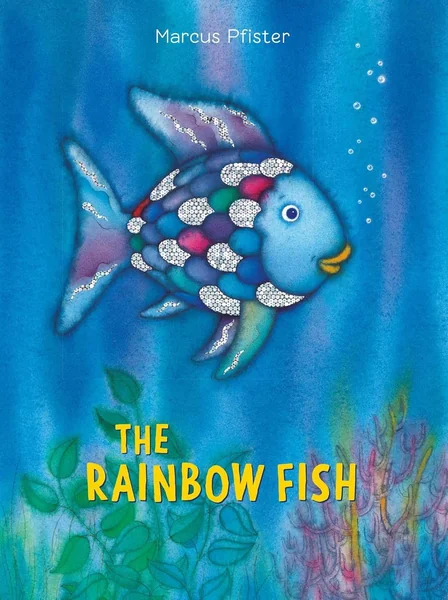
The Rainbow Fish by Marcus Pfister front cover
The Rainbow Fish tells the story of a dazzling fish who possesses multi-colored scales — blue, green, violet, pink — along with distinctive shiny silver ones that set him apart from every other creature in the ocean. When a small bluefish asks for one of those gleaming scales, the Rainbow Fish refuses, and refuses rudely. The bluefish spreads word of this harshness, and the Rainbow Fish soon finds himself without companions. His sole remaining friend, a starfish, directs him to seek out the wise octopus, who lives in a sea cave. The octopus tells the Rainbow Fish that sharing his scales — even at the cost of his singular beauty — is the path to happiness. The Rainbow Fish eventually relents, gives the bluefish a silver scale, and finds that the joy it brings him far outweighs the loss. He then distributes his remaining shiny scales to the other fish, and community replaces isolation. The English translation is the work of J. Alison James, rendering Pfister's original German text for anglophone audiences.

Signature Feature: The Holographic Foil Scales

What has made this picture book physically iconic since its original 1992 German publication is a production detail that Pfister himself championed: holographic foil inlaid into the illustrations to represent the Rainbow Fish's shimmering scales. According to Wikipedia, Pfister suggested using holographic foil at the time of the original NordSüd Verlag publication, and that decision became the book's visual calling card. The foil scales are not merely decorative — they are thematically load-bearing, making the fish's beauty tangible to young readers in a way that standard printing could not. The book's reputation as a visual object rests substantially on this innovation, and it remains the feature most consistently cited when the title is discussed.

Cultural Reach and Series Standing

The Rainbow Fish has expanded well beyond a single volume. Simon & Schuster identifies it as the first book in a New York Times bestselling series, a designation that reflects the franchise's durability across decades. Decode Entertainment adapted the story into an animated television series that aired on HBO Family in the United States and Teletoon in Canada from 1999 to 2000, demonstrating the property's crossover appeal. The book has appeared in numerous editions and formats — hardcover, board book, paperback, library binding — attesting to sustained demand across different readerships and age ranges. That kind of longevity in a crowded children's publishing market is not incidental; it reflects the book's hold on parents, educators, and gift-givers across generations.

The Moral Debate: A Real and Substantive Critique

The Rainbow Fish is not without genuine controversy, and any honest account of it must engage with that. Reason magazine has criticized the book for what it characterizes as promoting "socialism" and "collectivist" values, arguing that the Rainbow Fish "only gets truly ostracized because he won't hand over his body parts on demand, in the name of equality." That is a pointed critique, and it has found an audience. Publishers Weekly, in its own notice of the book, observed that the plot is predictable and that the English translation "doesn't enhance the story." Some readers and educators read the book's resolution — in which social acceptance is conditional on giving up something materially valuable — as a muddled or troubling message about individuality, peer pressure, and what sharing actually means. These are not fringe objections; they reflect a legitimate tension in the text that adults sharing the book with children may want to be prepared to address.

Who This Book Is For — and How to Approach It

The publisher recommends the book for children aged one through five, and at 32 pages it is sized for a single read-aloud session. For families and educators who want a springboard for conversations about friendship, generosity, and belonging, the book provides a concrete and visually engaging starting point. The foil-scale production makes it a tactile as well as narrative experience for very young readers. Those who find the collectivist framing troubling, or who want a more nuanced treatment of individuality, may prefer to use it as a discussion text rather than a straightforward moral lesson — the controversy around the book's message is itself a reason to engage with it actively rather than passively. As the first entry in a New York Times bestselling series, it also opens a door to a larger body of Pfister's work for readers who connect with the characters and the ocean setting.

Sources & Further Reading

The key facts and claims in this review are grounded in the retrieved, verified sources listed below.

  1. Cited in this review
  2. 1
  3. 2
  4. Further reading
  5. 3

    Marcus Pfister, Wikipedia

  6. 4
  7. 5
  8. 6
  9. 7
  10. 8
  11. 9
  12. 10