BOOKS
Published

Read Time

8 min read

Reader rating

4.7

· 244 Amazon ratings
reader ratings, not a LuvemBooks score
Curated & edited by

LuvemBooks Editorial

How we create our reviews →
Share This Review

Get Scalable by Ryan Deiss Review: A Practical Operating System for Founders

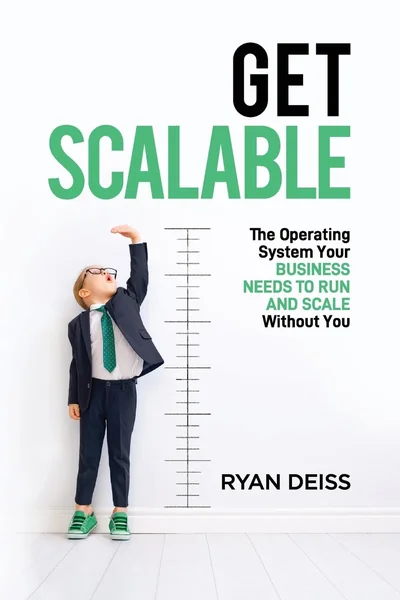
Get Scalable: The Operating System Your Business Needs To Run and Scale Without You is a business how-to book by Ryan Deiss, published by Scalable Company in December 2023, that lays out a step-by-step framework for replacing founder-dependent operations with a structured, repeatable "Scalable OS" — reviewed here on the basis of its content and published reception, not hands-on application.
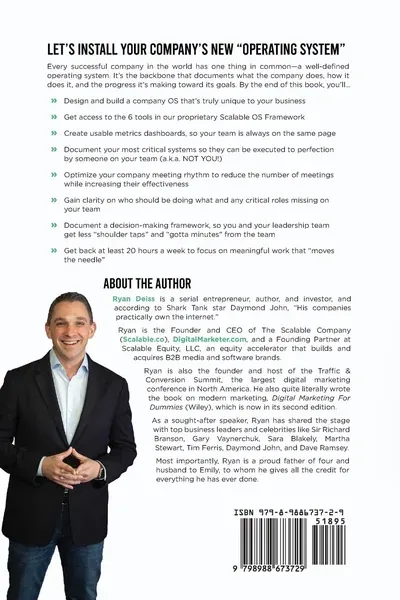
Back cover with author photo, biography, ISBN barcode, and book synopsis about business operating systems.Tap to enlarge

LuvemBooks Verdict

Best for

Founders and small-to-midsize business owners who feel trapped by operational dependency — people who launched a company for wealth and freedom but now find themselves the single point of failure for every decision.

Worth it if

You're a founder ready to move beyond vague delegation advice and want a named, step-by-step framework — the "Scalable OS" — designed to produce a documented operating system by the time you finish the book.

Skip if

Skip it if you're an enterprise executive, a functional manager inside a large organisation, or someone seeking framework-agnostic systems thinking or academically rigorous management theory — the methodology is proprietary to the Scalable Company ecosystem and narrowly scoped to owner-led businesses.

Retailer and bookseller descriptions retrieved from sources including Porchlight Books and Warwick's characterise the book as a practical, tangible alternative to "vague advice and buzzwords," centred on swapping a founder-centric "YouOS" for a documented "Scalable OS." The book summary site sobrief.com notes the book's core argument that "good people don't fix broken systems" and that systems — not sheer effort — drive results at scale; no independent third-party editorial review from a major business outlet appears in the available record.

Sources: Porchlight Books, Warwick's, sobrief.com, goplacesdigital.com
4.7from 244 Amazon ratings— reader ratings, not a LuvemBooks score

Age & Reading Level

Recommended age

Adult

Reading level

Adult

Skip if you are an enterprise executive, functional manager inside a large organization, or seeking framework-agnostic or academically rigorous systems thinking rather than a proprietary step-by-step methodology.

In This Review
  • What Works & What Doesn't
  • What the Book Actually Argues
  • The Framework and How It's Structured
  • Deiss's Credibility and Author Background
  • Reception and Reader Outcomes
  • Who This Book Is For — and Where It Has Limits

What Works & What Doesn't

What Works
  • Addresses a specific, well-defined founder pain point — operational dependency — with a named, step-by-step framework rather than vague advice
  • Author's background as a working entrepreneur and CEO of multiple companies lends practitioner credibility to the prescriptions
  • Designed to produce a concrete deliverable — a documented operating system — by the book's end, giving it a clear structural purpose
  • Uses real-world examples alongside strategic frameworks, per the publisher's description, to ground abstract concepts in practice
What Doesn't
  • Narrowly targeted at founders and small-to-midsize business owners; readers in other roles or at enterprise scale may find limited direct applicability
  • The framework is proprietary to the Scalable Company methodology, which may not suit readers seeking framework-agnostic or academically rigorous systems thinking
Get Scalable is reviewed here on the basis of its content, structure, and published reception — not hands-on use or application of its methods.

What the Book Actually Argues

At the heart of Get Scalable is a diagnosis Ryan Deiss calls the "Founder's Curse": the condition in which a business owner becomes the single point of failure for their own company. Team members wait to be told what to do, decisions stall without the founder's input, and the entrepreneurial dream of freedom quietly inverts into a self-made trap. Deiss frames the remedy not as hiring a COO, working longer hours, or chasing faster growth, but as installing what he terms a "Scalable OS" — a business operating system that encodes what the company does, how it does it, and how it tracks progress toward its goals. The book's central argument is direct: good people cannot fix broken systems, and systems — not sheer individual effort — are what drive results at scale.
one of the greatest things I could have done.

The Framework and How It's Structured

The book's method involves trading out what Deiss labels the "YouOS" — an informal, founder-centric operating model that lives in the owner's head — for a documented, delegable alternative. According to the publisher's description, this is presented as a tangible, step-by-step plan rather than an abstract philosophy. Deiss walks readers through the whole process using real-world examples and what the synopsis describes as "lightbulb-moment insights" and "straightforward strategies." The goal, as stated in the book's design, is that by the final pages, a reader will have the architecture of a new operating system in place — one that allows the business to run, grow, and scale whether or not the founder is present.

Deiss's Credibility and Author Background

Ryan Deiss brings verifiable operational experience to the subject. He is the Founder and CEO of The Scalable Company (Scalable.co) and DigitalMarketer.com, and a Founding Partner at Scalable Equity, LLC, an equity accelerator focused on B2B media and software brands. Shark Tank's Daymond John has been quoted describing Deiss's companies as entities that "practically own the internet" — a characterization that speaks to Deiss's standing in the digital business world. That practitioner background grounds the book's prescriptions in a real portfolio of companies rather than purely theoretical frameworks, which is a meaningful distinction in a genre crowded with academic or consulting-derived advice.
Back cover with author photo, biography, ISBN barcode, and book synopsis about business operating systems.

Reception and Reader Outcomes

Testimonials surfaced in the book's promotional materials describe substantive operational results: one business owner cited 218% year-over-year growth and record profits as a direct reflection of the strategies and operating system installed through Deiss's methods; another described setting — and achieving — the goal of leaving the business for two months, calling it "one of the greatest things I could have done." A third cited genuine clarity around offers and how the operating system should support them. These are promotional testimonials, not independent critical reviews, and should be read in that context; no third-party editorial review from a major business outlet appears in the available record. The book is also available in an unabridged audio edition, reflecting that it has been formatted for readers across multiple platforms.

Who This Book Is For — and Where It Has Limits

Get Scalable is explicitly aimed at founders and small-to-midsize business owners who feel trapped by their own success — people who started a company for wealth, freedom, and impact, and find themselves working harder than ever for diminishing returns. The book's arguments are structured around this specific profile, and readers outside it — enterprise executives, functional managers inside large organizations, or those seeking a broader survey of business strategy — may find the framework narrower than they need. Additionally, because Deiss's methodology is proprietary to the Scalable Company ecosystem, founders seeking framework-agnostic systems thinking or academic rigor in the tradition of, say, management science literature may find the approach more prescriptive than exploratory. The book's value is inherently tied to implementation, and whether its specific framework translates cleanly to every business model or industry is a question individual readers will need to answer for themselves.

Sources & Further Reading

The key facts and claims in this review are grounded in the retrieved, verified sources listed below.

  1. Cited in this review
  2. 1
  3. 2
  4. Further reading
  5. 3
  6. 4
  7. 5
  8. 6
  9. 7
  10. 8