8 min read
4.8
· 6,551 Amazon ratingsShare This Review

Our review
Women in Science
Women in Science: 50 Fearless Pioneers Who Changed the World by Rachel Ignotofsky Review: A Richly Illustrated STEM Tribute
Published by Ten Speed Press in July 2016, Rachel Ignotofsky's Women in Science is a New York Times bestselling illustrated collection profiling fifty trailblazing women in STEM — from ancient philosopher and mathematician Hypatia to primatologist Jane Goodall and NASA mathematician Katherine Johnson — paired with infographics and a scientific glossary. Critics called it a "wittily illustrated [and] accessible volume," and InStyle named it "the must-read, girl-power STEM book." It is a well-received educational gift book designed for readers from upper elementary through high school, and it stands as a landmark title in the wave of illustrated non-fiction celebrating women's contributions to science, technology, engineering, and mathematics.


 Tap to enlarge
LuvemBooks Verdict
Best for
Students in grades 5–12, educators, and gift-givers looking for a visually rich, panoramic introduction to the history of women in STEM — from ancient mathematician Hypatia to modern figures like Katherine Johnson and Jane Goodall.
Worth it if
The illustrated collection format suits you — you want inspiring, accessibly written biographical snapshots paired with striking art and data-driven infographics, rather than deep single-subject biography.
Skip if
Skip it if you're hoping for granular detail on any one scientist's life, systemic obstacles, or the underlying science — the few-pages-per-profile format and celebratory tone leave that depth to dedicated single-subject works.
What readers & critics say
critics (as quoted on penguinrandomhouse.com) called it a "wittily illustrated [and] accessible volume," while Chemistry World praised the book as "a celebration of her art" and "as delightful as the rest of her work," noting Ignotofsky's bold, eye-catching illustrations. The University of Alberta's Deakin Review (journals.library.ualberta.ca) described it as a "fabulous" illustrated survey that left readers with "an overwhelming sense of the remarkable discoveries by women in science."
Sources: Penguin Random House, Chemistry World, University of Alberta Deakin ReviewPreview the book

Ask LuvemBooks
Was this helpful?
- Is it worth reading?
- For its intended audience — students, educators, gift-givers, and anyone seeking an engaging entry point into the history of women in STEM — Women in Science delivers exceptional value. The Wall Street Journal praised it as a 'wittily illustrated [and] accessible volume,' geologist and author Hope Jahren called it 'a great addition to the shelf of any student, of any age,' and Eileen Pollack, author of The Only Woman in the Room, wrote that Ignotofsky 'provides young women with the courage and confidence to follow the exciting paths these pioneers have blazed before them.' The key caveat is format: with fifty profiles across roughly 128 pages, each woman receives only a few pages at most, so readers hoping for the depth of a full single-subject biography — the granular obstacles Marie Curie or Katherine Johnson faced, for instance — will need to seek out dedicated works to supplement it.
- Similar books
- Readers who enjoy Women in Science will find natural companions among Ignotofsky's own follow-up titles: Women in Art: 50 Fearless Creatives Who Inspired the World and Women in Sports: 50 Fearless Athletes Who Played to Win apply the same illustrated-profile format to the worlds of art and athletics. For a deeper narrative account of women in STEM — particularly the overlooked Black mathematicians at NASA — Margot Lee Shetterly's Hidden Figures is the essential companion read, and Katherine Johnson's story overlaps directly with profiles in Ignotofsky's book. Kate Schatz's Rad Women Worldwide offers a similarly accessible, illustrated celebration of trailblazing women across fields, while Diane Stanley's Ada Lovelace, Poet of Science: The First Computer Programmer provides the kind of single-subject depth on one of Women in Science's featured figures that the collection format cannot accommodate. Rachel Ignotofsky's The Wondrous Workings of Planet Earth brings her distinctive illustrated style to earth science for readers who want more of her visual non-fiction work.
- Who should read this?
- Women in Science is an ideal read for students in grades 5 through 12, educators building STEM or history curricula, librarians seeking a high-impact shelf staple, and anyone shopping for a gift with lasting educational value. Its visual richness and self-contained profile format make it accessible to younger readers experiencing it with an adult, while the infographics on current STEM gender statistics and the scientific glossary give older students and teenagers genuine reference material. Adults with an interest in the history of science or in illustrated non-fiction will also find it rewarding. Readers seeking a rigorous sociological or biographical deep-dive on any single scientist — rather than an inspiring, panoramic overview — will want to look beyond it.
- What age is it for?
- Best for readers ages 10 and up (grades 5–12), as the publisher indicates, though its appeal demonstrably extends in both directions. Younger children can experience it as a read-aloud with an adult, while the infographics on STEM gender statistics, the scientific glossary, and the historical scope of the profiles provide substantive material for teenagers and high schoolers. Hope Jahren described it as suited to 'any student, of any age,' and adult readers are well served by its visual and historical dimensions.
- About Rachel Ignotofsky
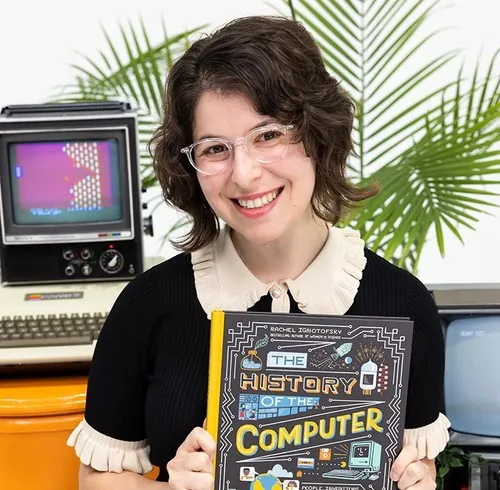
- Rachel Ignotofsky is a New York Times bestselling author and illustrator based in California. She is known for creating illustrated books that highlight women throughout history and explore science and technology, and has described herself as an illustrator and designer. Her works include The History of the Computer, which was inspired in part by her own early experience with computers at age seven.
- Where should I start with Ignotofsky?
- Women in Science is the title that established Rachel Ignotofsky's reputation and anchored her series of illustrated non-fiction collections — it's the natural starting point for new readers. Those drawn specifically to her visual style and the illustrated-collection format can then follow with Women in Art: 50 Fearless Creatives Who Inspired the World or Women in Sports: 50 Fearless Athletes Who Played to Win, while readers interested in her science-focused work beyond biography might explore The Wondrous Workings of Planet Earth.
- What are the main themes?
- The central themes of Women in Science are the recovery of overlooked history, representation in STEM, and the persistence required to work — and excel — in fields that historically excluded women. By spanning from Hypatia in ancient Greece to Katherine Johnson and Jane Goodall in the twentieth century, the book frames women's contributions to science not as exceptions but as a continuous, cross-cultural tradition. The infographics on current STEM gender statistics give those historical themes a present-day urgency, showing readers where representation gaps still stand. The collection's tone is celebratory and accessible rather than analytically rigorous — readers seeking a deeper treatment of the systemic and social barriers these women faced will need to look to supplementary works.
Summarize this book
Follow up
Synthesized from verified book data & published reviews · How we review
What would you like to know about Women in Science?
Answers come from our editorial notes on this book. If we haven't covered something, we'll say so.
Readers often ask
Our Review
What the Book Contains and How It Is Structured
Significance and Place in Its Genre
Strengths: Breadth, Visual Design, and Supplementary Content
Genuine Limitations and Who May Want More
Who This Book Is For
Sources & Further Reading
The key facts and claims in this review are grounded in the retrieved, verified sources listed below.
- Cited in this review
- 1
- 2
- 3
penguinrandomhouse.com
- Further reading
- 4
- 5
introvertedreader.com
- 6
geekforhireinc.com
- 7
- 8
- 9
Age & Reading Level
Recommended age
Ages 10–18
Reading level
Middle grade
who it suits
Best for: Ages 10+ — the biographical text, infographics, and scientific glossary are best suited to confident readers at a grade 5 level and above, though younger children can engage with it as a read-aloud.
Skip if you're looking for in-depth, single-subject biography with rigorous analysis of the systemic barriers each scientist faced.
Reader reviews
Be one of the first readers to answer.
Read it? Was it right for you?
Books like Women in Science
Curated picks for readers who enjoyed Women in Science, with our reasoning for each match.
More by Rachel Ignotofsky


If you liked Women in Science