BOOKS
Published

Read Time

8 min read

Reader rating

4.6

· 737 Amazon ratings
reader ratings, not a LuvemBooks score
Curated & edited by

LuvemBooks Editorial

How we create our reviews →
Share This Review

Eliza Hamilton: The Extraordinary Life by Tilar J. Mazzeo Review: A Worthy Subject, Unevenly Served

Tilar J. Mazzeo's biography of Eliza Schuyler Hamilton — originally published in September 2018 and reissued by Gallery Books in 2019 — makes a compelling case for Eliza's place among the unsung heroes of America's founding era, and offers a genuinely provocative central argument about the Maria Reynolds affair. Publishers Weekly called it an expertly told story certain to captivate Hamilton fans, while Kirkus Reviews found it a middling biography of a worthy subject — a split that fairly captures the book's real strengths and real limitations.
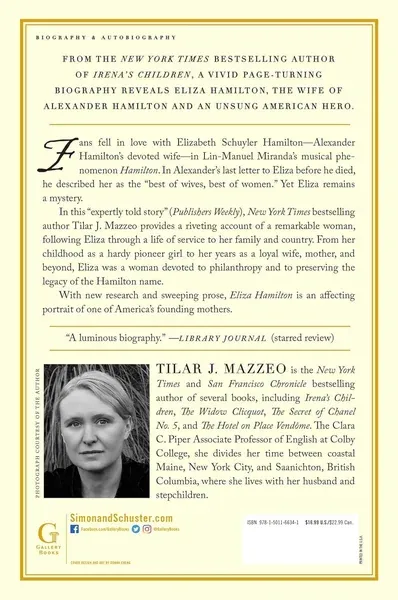
Back cover with biography synopsis, author photo, credentials, and review quote from Library Journal.Tap to enlarge

LuvemBooks Verdict

Best for

Readers already captivated by the Hamilton cultural moment who want a serious, argument-driven biography that repositions Eliza Schuyler Hamilton as a strategically minded actor rather than a historical footnote to her famous husband.

Worth it if

You come primarily for the central intellectual puzzle — Mazzeo's compellingly sourced case that the Reynolds "affair" was a cover story for financial misconduct — and for a first-ever cradle-to-grave account that takes Eliza's agency seriously.

Skip if

You want a thorough account of Eliza's nearly fifty years of independent life after Alexander's death — her philanthropic leadership of New York's Orphan Asylum Society and her own considerable legacy — or sustained engagement with the Schuyler family's use of enslaved labor; on both counts, the book is thinner than the subject warrants.

Kirkus Reviews called it "a middling biography of a worthy subject," noting uneven prose and insufficient attention to Eliza's widowhood, while acknowledging Mazzeo argues the Reynolds controversy compellingly. Publishers Weekly was more enthusiastic, praising the impressive breadth of sources and calling it a satisfying cradle-to-grave narrative certain to captivate Hamilton fans and anyone interested in early American history.

A middling biography of a worthy subject — Mazzeo's Eliza appears stoic, loyal, and canny.

Kirkus Reviews

Drawing from an impressive breadth of sources, Mazzeo shows what made Eliza, in Alexander's words, the 'best of wives, best of women.'

Publishers Weekly
Sources: Kirkus Reviews, Publishers Weekly
4.6from 737 Amazon ratings— reader ratings, not a LuvemBooks score

Look inside the book

Preview the actual pages, via Google Books
In This Review
  • What Works & What Doesn't
  • What the Book Is and What It Argues
  • Significance and Cultural Context
  • Strengths: Research, Argument, and the Marriage at Its Center
  • Limitations: Prose, Proportion, and Silences
  • Who Will Find It Most Rewarding

What Works & What Doesn't

What Works
  • Makes a genuinely provocative and well-sourced central argument — that the Reynolds affair was a fabricated cover for financial misconduct — which both Kirkus Reviews and Publishers Weekly credit as compelling
  • The first sustained cradle-to-grave biography of Eliza Schuyler Hamilton, filling a real gap in the historical record of the Founding era
  • Publishers Weekly praised the impressive breadth of sources Mazzeo draws from, lending the biography scholarly grounding
  • Positions Eliza as an active, strategically minded figure rather than a passive bystander, reframing her loyalty as a deliberate and calculated choice
What Doesn't
  • Kirkus Reviews found the prose uneven — shifting between flat vignettes and breathless narration — and rated the book overall as middling
  • Both Publishers Weekly and Kirkus flagged a significant structural imbalance: Eliza's nearly fifty years of widowhood, including her philanthropic leadership of New York's Orphan Asylum Society, receives disproportionately little attention
  • Kirkus noted that the Schuyler family's use of enslaved labor is mentioned only in passing — less space than is given to a wedding cake — a meaningful gap in a biography of this period
A biography that makes a strong central argument but leaves too much of its subject's life in the margins.

What the Book Is and What It Argues

Back cover with biography synopsis, author photo, credentials, and review quote from Library Journal.
Eliza Hamilton: The Extraordinary Life and Times of the Wife of Alexander Hamilton is a cradle-to-grave biography — the first of its kind, according to Publishers Weekly — tracing the life of Eliza Schuyler (1757–1854) from her birth into a prominent New York family, through the American Revolution that shaped her world, and into her long widowhood after Alexander Hamilton's 1804 death in a duel. Mazzeo, a professor of English at Colby College and the author of Irena's Children, draws from what Publishers Weekly describes as an impressive breadth of sources to reconstruct a figure long overshadowed by her famous husband.
one of the unsung heroes of our nation's early days
The biography's animating argument is audacious: Mazzeo contends that Alexander Hamilton's confessed affair with Maria Reynolds was not an adulterous liaison at all, but a fabricated cover story designed to conceal the more politically catastrophic charge that Hamilton, then Secretary of the Treasury, was engaged in insider trading. On this reading, Eliza's famous loyalty was not passive endurance but a calculated act of protection — shielding her family and the Washington administration from a scandal that would have been far more destructive than infidelity. Both Kirkus Reviews and Publishers Weekly credit Mazzeo with making this argument compellingly.

Significance and Cultural Context

Mazzeo's book arrived in the wake of the Hamilton cultural phenomenon, and its intended audience is clearly readers energized by that renewed interest in the Founding era — particularly in the women who lived through it. The biography positions Eliza not merely as "the wife of a dueling Founding Father," in Kirkus's phrase, but as a trailblazing philanthropist and a powerful figure in her own right. The Simon & Schuster marketing describes her as "one of the unsung heroes of our nation's early days," and Mazzeo's framing throughout works to substantiate that claim. As a New York Times bestselling author, Mazzeo brings an established readership to a subject that had not previously received this level of sustained biographical attention.

Strengths: Research, Argument, and the Marriage at Its Center

Where the biography earns its strongest marks is in its treatment of the Hamilton marriage itself and the Reynolds controversy at its center. Publishers Weekly praised Mazzeo's use of sources and found the overall narrative satisfying, noting that she shows what made Eliza, in Alexander's own words, the "best of wives, best of women." The argument that Eliza modeled herself on the sacrifice and loyalty of classical Roman wives — and that this framework is key to understanding both her marriage and her response to the Reynolds affair — gives the book an intellectual through-line that distinguishes it from a straightforward chronicle. Kirkus, even in a measured review, acknowledged that Mazzeo argues this case compellingly.

Limitations: Prose, Proportion, and Silences

The book's weaknesses are specific and worth naming. Kirkus found the prose uneven — at turns flat in its vignette-style scenes and elsewhere breathless in ways that undercut the biography's seriousness. More substantively, both major trade reviewers flagged a structural imbalance: despite Eliza's living nearly fifty years after Alexander's death — years in which she led efforts with New York's Orphan Asylum Society and pursued her own considerable legacy — Mazzeo devotes only a comparatively slim portion of the book to that half-century. Publishers Weekly called this "disappointing," and Kirkus noted that readers may wish for a more detailed treatment of Eliza's widowhood and philanthropic work.
There is also a notable omission of a different kind. Kirkus observed that when Mazzeo describes the Hamilton wedding, she mentions in passing that enslaved family members were present unwrapping a wedding cake, but gives far more attention to the cake itself than to the Schuyler family's use of enslaved labor — a gap that sits uncomfortably in a biography otherwise attentive to the moral complexity of its subject's world.

Who Will Find It Most Rewarding

Eliza Hamilton works best as an introduction to a figure who deserves fuller treatment, and as a lively entry point for readers already drawn to the Hamilton era. Publishers Weekly described it as a story certain to captivate Hamilton fans and to intrigue anyone with an interest in early American history — an assessment that reflects both the book's genuine appeal and its scope. Readers looking for an exhaustive account of Eliza's decades of independent action after 1804, or for deep engagement with the Schuylers' enslaved household, will find the book thinner than the subject warrants. But those who come to it for the central mystery of the Reynolds affair and for a biography that takes Eliza seriously as an actor rather than a footnote will find Mazzeo's argument rewarding and the narrative, at its best, genuinely propulsive.

Sources & Further Reading

The key facts and claims in this review are grounded in the retrieved, verified sources listed below.

  1. Cited in this review
  2. 1
  3. 2
  4. 3
  5. Further reading
  6. 4

    Tilar J. Mazzeo, Wikipedia

  7. 5
  8. 6
  9. 7
  10. 8