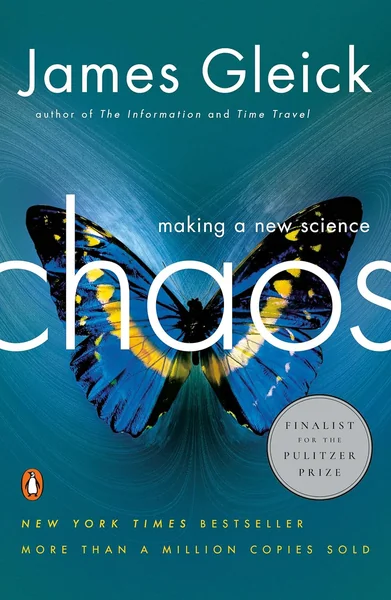
Is Chaos: Making a New Science worth reading? Nearly four decades after its publication, James Gleick's groundbreaking work remains the gold standard for making complex scientific concepts accessible to general readers. This isn't just another dry academic text—it's the book that introduced chaos theory to the world and fundamentally changed how we think about predictability, patterns, and the hidden order within apparent randomness.
Gleick's achievement lies in transforming mathematical abstractions into compelling human stories. Like A Brief History of Time did for cosmology, Chaos takes intimidating scientific concepts and renders them not just understandable, but fascinating. The book follows the pioneering scientists who discovered that simple systems could produce wildly unpredictable results—a revelation that shattered centuries of Newtonian certainty.
The Birth of a Revolutionary Science
Chaos chronicles the emergence of chaos theory through the experiences of the mathematicians and scientists who developed it. Rather than presenting dry equations, James Gleick weaves together the personal stories of researchers like Edward Lorenz, who stumbled upon the butterfly effect while studying weather patterns, and Mitchell J. Feigenbaum, whose work on universality revealed deep patterns hidden within chaos.
The narrative spans multiple disciplines, from meteorology to biology to physics, showing how chaos theory emerged simultaneously across different fields. Gleick demonstrates remarkable skill in explaining how a meteorologist's computer glitch led to revolutionary insights about weather prediction, and how a population biologist's simple equation revealed the complex dynamics underlying species fluctuations.
Each chapter builds upon previous concepts while introducing new layers of complexity. The progression feels natural rather than overwhelming, though readers should expect to engage actively with the material. This isn't light reading, but James Gleick's prose makes even the most abstract mathematical concepts feel tangible.
Gleick's Masterful Science Communication
The author's background as a science journalist serves him exceptionally well here. Gleick possesses that rare ability to translate technical jargon into vivid, memorable language without dumbing down the concepts. His descriptions of mathematical phenomena often read like poetry—the way he explains how tiny changes cascade into massive effects feels both precise and lyrical.
The writing style strikes an ideal balance between accessibility and intellectual rigor. James Gleick never condescends to his readers, but he also doesn't assume advanced mathematical training. He uses analogies effectively, comparing chaotic systems to familiar experiences while maintaining scientific accuracy. The pacing allows readers to absorb complex ideas before moving to the next level of complexity.
One of Gleick's greatest strengths lies in his ability to convey the excitement of scientific discovery. He captures the "aha!" moments when researchers realized they were witnessing something entirely new, making readers feel like witnesses to revolutionary breakthroughs.
The Scientists Behind the Revolution
The human element distinguishes Chaos from typical science books. Gleick presents Edward Lorenz not as a distant genius but as a curious researcher whose accidental discovery changed everything. Lorenz's work on weather systems revealed that tiny variations—the famous butterfly wing flap—could completely alter long-term predictions, demolishing the dream of perfect weather forecasting.
Mitchell J. Feigenbaum emerges as an equally compelling figure, a mathematician whose obsessive pursuit of universal patterns within chaos led to profound insights about how complex systems behave. Gleick shows how Feigenbaum's work revealed that certain mathematical constants appear across wildly different chaotic systems, suggesting deep underlying principles.
Benoit Mandelbrot's contributions to fractal geometry receive thorough treatment, with Gleick explaining how these infinitely complex patterns revolutionized our understanding of natural forms. The author makes these mathematical pioneers feel like real people with genuine passions and struggles, not just names attached to equations.
Where Science Meets Philosophy
The book's greatest achievement may be its exploration of chaos theory's broader implications. Gleick doesn't just explain the mathematics; he examines what chaos theory means for our understanding of prediction, control, and the nature of reality itself. The discovery that simple, deterministic systems can produce unpredictable behavior challenged fundamental assumptions about causality and scientific method.
These philosophical dimensions never feel forced or pretentious. Gleick lets the implications emerge naturally from the science itself, showing how chaos theory influenced fields ranging from economics to medicine. The book demonstrates that this wasn't just another mathematical curiosity but a paradigm shift comparable to quantum mechanics or relativity.
The discussion of fractals proves particularly compelling, as Gleick shows how these mathematical objects better describe natural phenomena than traditional Euclidean geometry. Mountains, coastlines, and cloud formations all exhibit fractal properties, suggesting that chaos theory provides tools for understanding nature's true complexity.
The Few Rough Edges
Where the book occasionally stumbles is in its treatment of some technical concepts that may challenge readers without strong mathematical backgrounds. While James Gleick generally excels at explanation, certain sections discussing strange attractors and phase space require significant mental effort to fully grasp. These passages, though necessary for completeness, can slow the narrative momentum.
The James Gleick book also shows its age in certain technological references that feel dated to contemporary readers. Some discussions of computer capabilities reflect 1980s limitations rather than current reality, though this doesn't undermine the core scientific content.
Occasionally, Gleick's enthusiasm for his subject leads to slightly overwrought prose. While generally avoiding hyperbole, he sometimes presents chaos theory's implications in terms that may oversell its revolutionary impact, particularly in the final chapters.
A Classic That Endures
Chaos remains highly recommended for anyone interested in understanding how science actually works and how revolutionary ideas emerge. It's perfect for readers who want to grasp complex scientific concepts without wading through technical papers, yet substantial enough to satisfy those with deeper scientific curiosity.
The book works especially well for readers of popular science who enjoyed works like Gödel, Escher, Bach or The Elegant Universe. It requires more intellectual engagement than typical science writing but rewards that effort with genuine understanding of profound ideas.
Nearly four decades later, Chaos stands as a masterpiece of science communication that fundamentally changed how we think about complexity, predictability, and the hidden patterns underlying apparent randomness.