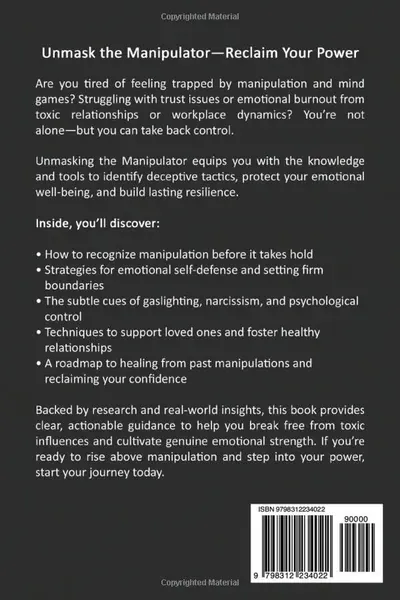
Red's Methodical Approach to Manipulation Defense
Shaler Red structures this work around practical recognition techniques rather than theoretical frameworks. The author's approach emphasizes observable behavioral patterns and communication strategies that readers can implement immediately. Unlike academic treatments of psychological manipulation, this guide prioritizes accessibility and immediate application over comprehensive research citations.
The writing maintains a direct, instructional tone throughout, with concepts presented in digestible segments. Red avoids overly clinical language while still providing substantive analysis of manipulative tactics. Each major concept receives dedicated attention with clear explanations of both the psychology behind manipulative behavior and specific countermeasures.
The book's strength lies in its practical orientation—Red consistently connects abstract psychological concepts to concrete situations readers might encounter. Rather than simply cataloging manipulative behaviors, the guide provides step-by-step approaches for recognizing, responding to, and ultimately protecting oneself from psychological manipulation.
Core Strategies for Building Emotional Resilience
The emotional resilience component represents perhaps the most valuable aspect of Red's approach. Rather than focusing solely on defensive tactics, significant portions of the work address internal strength-building and boundary establishment. These sections offer actionable frameworks for developing the psychological fortitude necessary to resist manipulation attempts.
Red's treatment of gaslighting deserves particular attention, as this phenomenon has gained increased recognition in recent years. The author provides concrete examples of gaslighting behaviors and systematic approaches for documenting and responding to such tactics. The practical exercises for reality-testing and self-validation prove especially valuable for readers who may have experienced prolonged exposure to manipulative relationships.
The path to inner harmony, as outlined in the final portions of the work, connects psychological defense with broader personal development goals. Red argues convincingly that true protection against manipulation requires not just recognition skills but fundamental emotional stability and self-awareness.
Identifying Patterns Across Relationship Types
One of the guide's notable strengths involves its recognition that manipulative behavior transcends specific relationship categories. Red addresses workplace manipulation, family dynamics, romantic relationships, and social situations with equal attention. This comprehensive scope makes the book particularly valuable for readers dealing with multiple sources of psychological pressure.
The author's analysis of institutional and systematic manipulation extends beyond individual relationships to examine broader social and professional contexts. These sections provide insight into how manipulative tactics operate within hierarchical structures and group dynamics, offering readers tools for navigating complex organizational environments.
However, the broad scope occasionally dilutes the depth of analysis in specific areas. While the comprehensive approach serves most readers well, those dealing with particular forms of manipulation might benefit from more specialized resources alongside this general framework.
Where the Framework Shows Limitations
Despite its practical orientation, Dark Psychology Unlocked suffers from several notable weaknesses. The book's treatment of complex psychological concepts sometimes oversimplifies nuanced situations, potentially leading readers to misinterpret legitimate conflict or disagreement as manipulation. The lack of substantial research citations undermines the credibility of certain claims, particularly those involving psychological mechanisms and therapeutic approaches.
Red's writing, while accessible, occasionally veers toward sensationalism when describing manipulative behaviors. The dramatic framing may appeal to readers seeking validation for difficult experiences, but it can also promote hypervigilance and defensive thinking patterns that prove counterproductive in healthy relationships.
The book's emphasis on self-protection, while understandable, sometimes lacks balance regarding personal responsibility in relationship dynamics. Complex interpersonal situations rarely involve clear perpetrators and victims, yet Red's framework occasionally presents manipulation in overly binary terms.
Practical Value Versus Professional Guidance
For readers seeking initial awareness and basic protective strategies, Dark Psychology Unlocked provides substantial value. The systematic approach to recognizing manipulation attempts serves as an effective starting point for individuals who may lack experience identifying such behaviors. The guide works best as an educational foundation rather than a comprehensive solution for serious psychological abuse situations.
However, readers dealing with severe manipulation, trauma, or abusive relationships will likely require professional therapeutic support beyond what any self-help guide can provide. Red's work complements but cannot replace qualified mental health intervention for complex psychological situations.
The book's accessibility makes it appropriate for general audiences, though readers should approach its recommendations with appropriate context and professional consultation when dealing with serious relationship difficulties or mental health concerns.