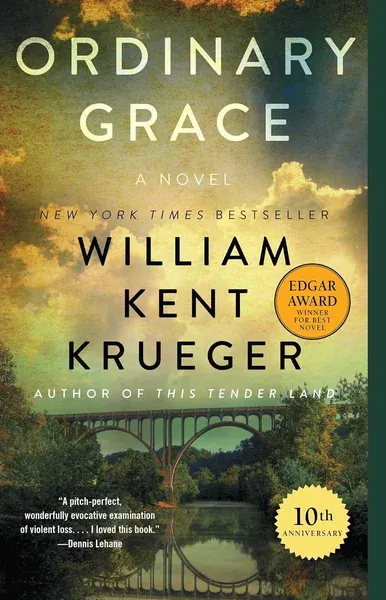
A Small Town's Dark Summer
Krueger establishes New Bremen as more than mere setting—it becomes a character itself, complete with the suffocating intimacy and buried secrets that define small-town life. The year 1961 provides crucial context, as America teeters between post-war optimism and the social upheavals of the coming decade. Frank's father serves as the town's Methodist minister, positioning the family at the community's moral center while making them privy to its darkest confessions.
The narrative unfolds through Frank's adult perspective looking back, allowing Krueger to layer childhood observations with mature insight. This dual perspective creates emotional depth without sacrificing the authenticity of a thirteen-year-old's voice. For readers who appreciate character-driven mysteries, this approach offers rewards that purely plot-focused novels cannot match.
The author's Minnesota roots show in his portrayal of the landscape and community dynamics. The descriptions of summer heat, prairie storms, and river bottoms feel lived-in rather than researched. This authenticity extends to the social tensions simmering beneath the town's placid surface.
Characters That Breathe
Frank Drum anchors the narrative with a voice that captures adolescent confusion without resorting to stereotypes. His relationship with his younger sister Grace provides some of the novel's most tender moments, while his struggles with his father's faith create genuine internal conflict. Krueger avoids the trap of making Frank too wise beyond his years while still allowing him moments of profound insight.
Grace herself emerges as more than the typical "little sister" character. Her piano playing and quiet observations often reveal truths that escape the adults around her. The dynamics between Frank and Grace feel authentic to siblings who genuinely care for each other despite typical childhood friction.
The supporting cast breathes with small-town complexity. Frank's parents, Reverend Nathan Drum and Ruth, navigate their own crises of faith as tragedy strikes close to home. Neither becomes a caricature of the stern preacher or long-suffering wife. Instead, Krueger shows how even those who counsel others struggle when their own foundations shake.
The townspeople themselves avoid stereotype. The local sheriff, the town's wealthy family, and various neighbors all possess the mixture of nobility and pettiness that characterizes real communities under stress.
Faith Under Fire
Where Ordinary Grace truly excels is in its exploration of religious faith without preaching or easy answers. Frank's father represents institutional Christianity, while Frank himself grapples with doubt in ways that feel genuine rather than manufactured for dramatic effect. The novel asks hard questions about divine justice, human suffering, and the nature of grace itself.
Krueger doesn't provide pat theological answers. Instead, he shows how different characters find meaning—or fail to find it—in the face of loss. Some turn toward faith, others away from it, and still others discover that faith itself must evolve to survive life's blows. This nuanced approach makes the book accessible to readers across the religious spectrum.
The title itself becomes a central question: what constitutes "ordinary" grace, and how does it differ from the miraculous kind? Through Frank's journey, Krueger suggests that grace often appears in small acts of human kindness rather than dramatic divine interventions.
Prose That Serves the Story
Krueger's writing style matches his subject matter—understated but powerful, like the Minnesota landscape he describes. He avoids flowery descriptions that would feel false in Frank's voice, opting instead for clean, precise prose that builds emotional impact through accumulation rather than pyrotechnics.
The pacing reflects the rhythm of small-town life, building tension gradually rather than through breathless plot twists. Some readers expecting a conventional mystery might find the deliberate pace challenging, but for those willing to invest in character development, the payoff proves substantial.
Dialogue feels natural without becoming overly colloquial. Krueger captures the speech patterns of 1961 Minnesota without making them feel forced or distracting. The conversations between family members ring especially true, showing how shared history and unspoken understanding shape communication.
Where It Stumbles
The novel's main weakness lies in occasional heavy-handedness with its themes. Some symbolic elements—particularly those involving music and nature—feel overstated rather than organic to the story. Krueger sometimes explains emotional beats that would work better if left implicit.
The mystery elements, while well-integrated into the character study, don't always satisfy readers looking for intricate plotting. The resolution feels somewhat inevitable rather than surprising, though this may be intentional given the novel's focus on character growth over puzzle-solving.
Certain secondary characters receive less development than they deserve, particularly some of the townspeople whose secrets drive the plot. While the main family feels fully realized, some supporting players remain more functional than human.
A Coming-of-Age Classic
Ordinary Grace succeeds because it understands that the most profound mysteries aren't about who committed which crime, but about how people survive loss and find meaning in suffering. Frank's journey from innocence to experience feels earned rather than manipulated, and the lessons he learns resist easy summarization.
This novel works best for readers who appreciate literary fiction with mystery elements rather than straightforward procedurals. Those seeking rapid-fire plot developments might find it slow, while readers drawn to character studies will discover a rich, rewarding experience.
The book's exploration of faith and doubt makes it particularly valuable for readers grappling with their own spiritual questions. However, the story's emotional truth transcends religious boundaries, speaking to anyone who has faced loss and wondered about justice, meaning, and grace.
For parents considering this for teenage readers, the novel deals with mature themes including death, violence, and family crisis, but handles them with sensitivity appropriate for thoughtful young adults.