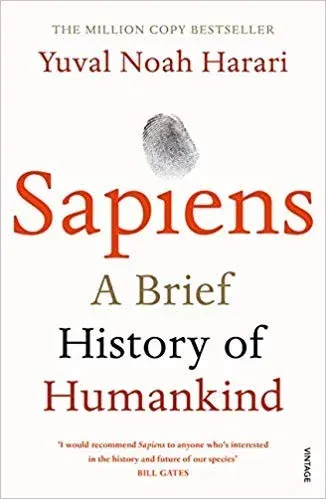
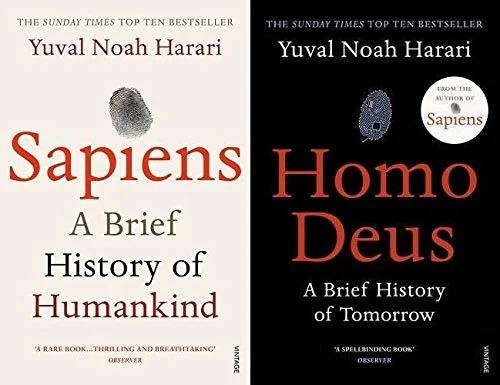
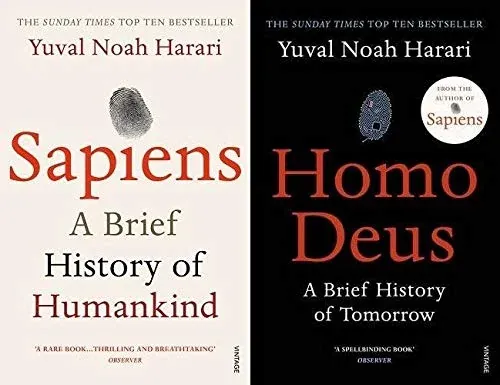
Is Sapiens and Homo Deus worth reading for anyone seeking to understand humanity's past and future? Yuval Noah Harari's twin volumes present an ambitious attempt to chronicle our species' journey from insignificant primates to potential gods. This combined edition offers readers both the sweeping historical narrative of Sapiens and the speculative future-gazing of Homo Deus in one comprehensive package. For readers of Guns, Germs, and Steel or The Better Angels of Our Nature, Harari's work provides a similarly macro-level perspective on human development, though with a distinctly more accessible writing style.
Harari's Grand Narrative Approach
Harari constructs his argument around three major revolutions that shaped humanity: the Cognitive Revolution (70,000 years ago), the Agricultural Revolution (12,000 years ago), and the Scientific Revolution (500 years ago). His approach differs markedly from traditional historical writing by focusing on broad patterns rather than specific events or figures. Harari brings a multidisciplinary perspective, weaving together insights from biology, anthropology, economics, and philosophy to create his overarching thesis.
The strength of this approach lies in its ability to make readers reconsider fundamental assumptions about progress, happiness, and human nature. Harari challenges conventional wisdom about the Agricultural Revolution, arguing it was "history's biggest fraud" that made life harder for most humans while enabling population growth. This provocative framing exemplifies his method throughout both works: taking commonly accepted ideas and examining them from unexpected angles.
The Science Behind the Storytelling
Harari's academic background brings impressive command of contemporary research across multiple fields. He draws extensively on recent findings in cognitive science, evolutionary biology, and neuroscience to support his arguments about human uniqueness and future potential.
In Sapiens, his discussion of how shared myths and stories enabled large-scale cooperation among strangers provides a compelling framework for understanding everything from religions to corporations. The concept that humans succeeded through their ability to believe in collective fictions—money, nations, gods—offers a unifying theory for human social organization.
Homo Deus extends this analysis into speculation about artificial intelligence, genetic engineering, and the potential obsolescence of most humans. While more speculative, Harari grounds his future projections in current technological trends and their logical extensions. His warnings about dataism—the belief that information flow is the supreme value—feel particularly relevant in our algorithm-driven age.
Big Ideas, Broad Brushstrokes
The scope of these works is simultaneously their greatest strength and most significant weakness. Yuval Noah Harari's ability to synthesize vast amounts of information into coherent narratives is genuinely impressive. He makes complex ideas about cognitive evolution, economic systems, and technological change accessible to general readers without oversimplifying.
However, this breadth comes at the cost of depth and nuance. Historians and specialists in various fields have criticized Harari for cherry-picking evidence, making overgeneralized claims, and presenting contested theories as established facts. His treatment of the Agricultural Revolution, for instance, overlooks significant evidence that many early farmers maintained higher living standards than he suggests.
The speculative elements in Homo Deus are even more problematic. While Harari acknowledges uncertainty about the future, he often presents his predictions with the same confidence he uses for historical analysis. His discussions of consciousness, artificial intelligence, and human enhancement sometimes read more like science fiction than serious futurism.
Accessibility Versus Academic Rigor
Harari writes with remarkable clarity and engaging style that makes dense topics digestible for mainstream audiences. His use of contemporary analogies and vivid examples helps readers grasp abstract concepts about human development and technological change. The narrative flow between the two books creates a compelling arc from humanity's origins to its potential futures.
Yet this accessibility sometimes masks oversimplification of complex issues. Academic specialists have noted numerous instances where Harari presents minority viewpoints as consensus, conflates correlation with causation, or makes sweeping generalizations based on limited evidence. Readers seeking rigorous academic treatment of these topics would be better served by works like Steven Pinker's The Better Angels of Our Nature or Jared Diamond's Guns, Germs, and Steel.
Who Should Read These Books
Despite their limitations, both Sapiens and Homo Deus serve valuable purposes for different audiences. General readers seeking an introduction to big-picture thinking about human history and future challenges will find Harari's synthesis thought-provoking and accessible. The books excel at encouraging readers to question assumptions and think systematically about long-term trends.
Students and professionals in relevant fields should approach these works as popular synthesis rather than authoritative scholarship. They're valuable for understanding how complex academic ideas get translated for mainstream audiences and for identifying areas worthy of deeper investigation.
The combined format of this edition offers good value for readers committed to engaging with both works, though the repetition of certain themes and arguments becomes more apparent when reading them consecutively. Each book can stand alone, but together they provide Harari's complete vision of humanity's trajectory.
Where to Buy
You can find By Yuval Noah Harari A Brief History Of Humankind Sapiens & Homo Deus: A Brief History Of Tomorrowpaperback at Amazon, Barnes & Noble, or your local bookstore.