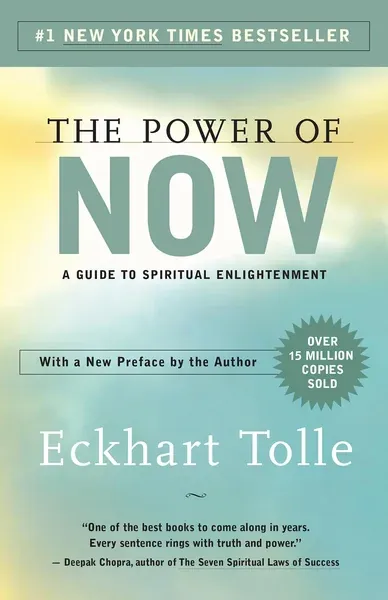
Eckhart Tolle's Core Teaching on Present-Moment Awareness
The central premise of The Power of Now revolves around what Eckhart Tolle identifies as humanity's fundamental problem: our addiction to psychological time. According to his framework, suffering emerges when consciousness becomes trapped in mental narratives about past regrets or future anxieties, losing connection with the immediate reality of the present moment.
Eckhart Tolle argues that this present-moment awareness represents our natural state of being, one that most people have forgotten how to access. His approach combines elements of Eastern philosophy with accessible Western psychology, creating what he presents as a universal path to spiritual awakening. This spiritual book systematically dismantles common misconceptions about thinking, identity, and the nature of consciousness itself.
What distinguishes Tolle's method from traditional meditation practices is its emphasis on practical application during everyday activities rather than formal sitting practice. He presents presence as something that can be cultivated while washing dishes, walking down the street, or engaging in conversation—a democratization of spiritual practice that explains much of this mindfulness book's broad appeal.
Rather than overwhelming readers with complex philosophical concepts, Eckhart Tolle provides specific exercises designed to interrupt habitual thought patterns and cultivate present-moment awareness. These range from simple breath observation to more sophisticated practices involving what he calls "the inner body"—awareness of the subtle energy field within physical form.
The techniques emphasize immediacy over gradual development. Tolle suggests that awakening can happen in any moment through a shift in attention rather than through years of disciplined practice. This approach appeals to Western readers seeking quick results, though it also raises questions about the sustainability of such instant transformations.
One of this self-help book's strengths lies in its practical applicability to common psychological challenges. Eckhart Tolle addresses anxiety, depression, and relationship conflicts through the lens of present-moment awareness, offering readers tools they can implement immediately. However, the simplicity that makes these practices accessible also represents a potential limitation—complex psychological issues may require more nuanced approaches than present-moment awareness alone can provide.
The Philosophy Behind Spiritual Enlightenment
Tolle's philosophical framework draws heavily from non-dual spiritual traditions, particularly Advaita Vedanta and Zen Buddhism, though he rarely acknowledges these influences explicitly. His concept of the "ego" as a false sense of self created by identification with thoughts and mental stories echoes classical teachings about the illusory nature of the separate self.
The spiritual book presents enlightenment not as a distant goal requiring years of spiritual practice, but as recognition of what already exists—the aware presence that underlies all experience. This perspective challenges conventional approaches to spiritual development that emphasize gradual purification or accumulation of spiritual experiences.
Yet this philosophical foundation also reveals some of the work's limitations. Eckhart Tolle's treatment of complex psychological and spiritual concepts often lacks the depth found in traditional teachings. His explanations, while accessible, sometimes oversimplify profound questions about consciousness, suffering, and human nature that have occupied philosophers and spiritual teachers for millennia.
Where Tolle's Approach Falls Short
Despite its popularity and practical value, The Power of Now contains several significant limitations that readers should consider. The book's emphasis on transcending thought can inadvertently create a spiritual bypassing of legitimate psychological work. Complex trauma, deep-seated emotional patterns, and serious mental health conditions may require professional therapeutic intervention beyond present-moment awareness practices.
Eckhart Tolle's presentation often implies that enlightenment represents a permanent state free from psychological suffering, a claim that conflicts with the lived experience of many sincere practitioners. This idealized view can create unrealistic expectations and self-judgment when readers inevitably encounter ongoing psychological challenges despite their practice.
The book also lacks cultural sensitivity in its appropriation of Eastern spiritual concepts. While Tolle's synthesis makes these teachings accessible to Western audiences, his presentation sometimes strips away important cultural and philosophical contexts that provide depth and nuance to traditional practices.
A Valuable but Incomplete Guide
The Power of Now succeeds as an introduction to present-moment awareness and offers genuinely helpful techniques for reducing psychological suffering. Eckhart Tolle's clear writing style and practical approach make complex spiritual concepts accessible to readers who might be intimidated by traditional philosophical texts.
However, this spiritual book works best as one component of a broader spiritual and psychological toolkit rather than a complete path to enlightenment. Readers dealing with serious mental health issues should combine Tolle's practices with appropriate professional support, while those seeking deeper philosophical understanding may need to explore the traditional sources from which his teachings derive.
For readers new to spiritual practice or those seeking relief from anxiety and mental restlessness, The Power of Now provides valuable entry-level guidance. More experienced practitioners may find the concepts familiar but appreciate Eckhart Tolle's unique presentation and practical applications.
You can find The Power of Now at Amazon, your local bookstore, or directly from New World Library.