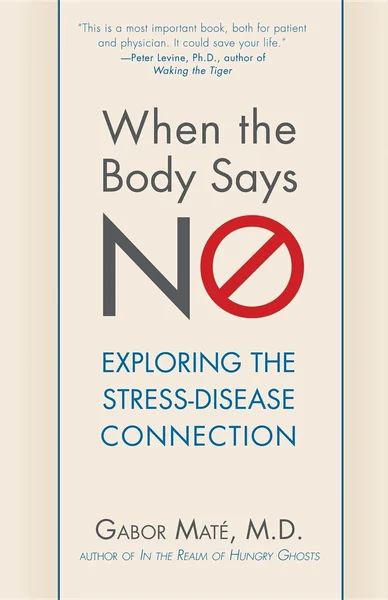
Does stress really cause disease? Gabor Maté's controversial thesis in "When the Body Says No" argues that emotional suppression and chronic stress don't just affect our mood—they can literally make us sick. This isn't feel-good pop psychology but a physician's unflinching examination of how our emotional lives intersect with physical health. Maté challenges conventional medical thinking by proposing that conditions from cancer to autoimmune diseases may have deeper psychological roots than most doctors acknowledge.
The book's striking cover design, featuring bold red typography against clean white space, mirrors its direct approach to a complex topic. Where many health books offer gentle reassurance, Maté presents a more unsettling proposition: that our bodies keep score of emotional wounds in ways that can prove devastating.
The Mind-Body Medicine Revolution
Maté approaches the stress-disease connection through his dual perspective as a physician and addiction specialist. His central argument revolves around psychoneuroimmunology—the study of how psychological processes affect the immune system. Rather than dismissing psychosomatic illness as "all in your head," he presents evidence that emotional suppression creates measurable physiological changes.
The author draws on decades of medical research to build his case, though his interpretations often push beyond mainstream medical consensus. He examines how chronic stress hormones like cortisol can suppress immune function, creating vulnerability to everything from infections to malignancies. What sets this work apart from typical mind-body books is Maté's willingness to make specific, testable claims about disease causation.
Unlike more cautious medical texts, Maté doesn't hedge his conclusions. He argues that personality patterns and emotional habits can be as significant as genetics in determining health outcomes. This bold stance has made the book both influential and controversial within medical circles.
Case Studies and Clinical Evidence
Maté structures his argument around detailed patient histories, examining individuals whose medical conditions seemed to correlate with specific emotional patterns. He explores how people who consistently suppress anger, avoid conflict, or prioritize others' needs over their own may be setting themselves up for immune system dysfunction.
The clinical examples range from cancer patients who never expressed negative emotions to individuals with multiple sclerosis who struggled with perfectionism and people-pleasing. While these case studies provide compelling narratives, the main weakness lies in the challenge of establishing true causation versus correlation in individual cases.
Maté also examines the physiological mechanisms he believes connect emotional states to disease. He discusses how chronic activation of the hypothalamic-pituitary-adrenal axis can disrupt normal immune surveillance, potentially allowing malignant cells to proliferate unchecked. The science is legitimate, though his interpretation of its implications often exceeds what the research definitively supports.
The Emotional Suppression Theory
Central to Maté's thesis is the concept that certain personality traits—particularly the inability to express anger, excessive concern for others, and compulsive self-reliance—create chronic internal stress. He argues these patterns often develop in childhood as survival mechanisms but become health-destroying adaptations in adulthood.
The author challenges readers to examine their own emotional patterns with uncomfortable honesty. Do you struggle to say no? Do you minimize your own needs? Do you avoid conflict at all costs? According to Maté, these seemingly admirable traits might be slowly undermining your immune system.
This psychological framework draws from trauma-informed medicine, a field where Maté has extensive experience. His work with addiction has convinced him that unprocessed emotional pain doesn't simply disappear—it gets stored in the body, potentially manifesting as physical disease years or decades later.
Where the Science Gets Controversial
While psychoneuroimmunology is an established field, Maté's specific claims about disease causation venture into contentious territory. Mainstream oncology, for instance, emphasizes genetic mutations, environmental toxins, and viral infections as primary cancer causes. Maté doesn't dismiss these factors but argues they may be insufficient explanations without considering psychological stress as a co-factor.
The book's most problematic aspect is its potential for victim-blaming. If emotional patterns contribute to serious illness, does that mean patients are somehow responsible for their conditions? Maté attempts to address this concern but doesn't fully resolve the ethical implications of his theory.
Critics also point out that correlation between personality traits and disease doesn't prove causation. People with certain health conditions might develop particular coping patterns as a result of their illness rather than the reverse. Maté acknowledges this chicken-and-egg problem but maintains his position based on clinical observation.
Practical Applications and Limitations
Unlike purely theoretical medical texts, "When the Body Says No" offers concrete suggestions for interrupting harmful stress patterns. Maté advocates for emotional authenticity, boundary-setting, and addressing childhood trauma as health interventions. He suggests that learning to express anger appropriately and prioritize self-care aren't just psychological goals—they're medical necessities for immune system health.
However, the book provides limited guidance on implementation. Readers learn what changes might be beneficial but receive minimal instruction on how to make them. Those seeking practical exercises might find books like "The Body Keeps the Score" by Bessel van der Kolk more actionable, though both works explore similar mind-body connections.
Maté also doesn't adequately address the social and economic factors that make emotional authenticity a luxury many can't afford. His prescriptions for self-care assume a level of personal agency that may not be realistic for everyone struggling with chronic illness or systemic oppression.
Our Take
"When the Body Says No" succeeds as a thought-provoking challenge to purely biomedical approaches to health. Maté's clinical experience and compelling case studies make a persuasive argument that emotional well-being and physical health are more intertwined than conventional medicine acknowledges. The book works best as a starting point for readers interested in exploring mind-body connections rather than as a definitive medical guide.
Not recommended for individuals seeking quick health fixes or those who might blame themselves for their medical conditions. The book requires careful, critical reading and works best alongside conventional medical treatment rather than as a replacement for it.
Highly recommended for healthcare providers, anyone managing chronic illness, and readers interested in trauma-informed approaches to health. The controversial nature of Maté's claims shouldn't discourage engagement—medicine advances through challenging established assumptions, even when those challenges prove incomplete or incorrect.
Where to Buy
You can find When the Body Says No at Amazon, your local bookstore, or directly from most major book retailers both online and in-store.