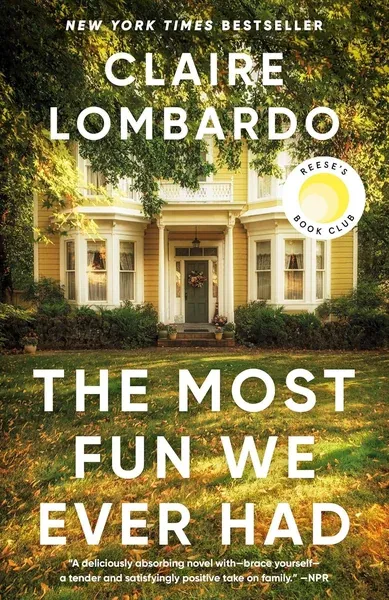
A Love Story That Casts Long Shadows
Lombardo builds her narrative around a central premise: what happens when your parents' marriage is so legendary that it becomes impossible to live up to? David and Marilyn met as teenagers and have maintained an almost mythic devotion to each other for forty years. Their daughters—Wendy, Violet, Liza, and Grace—have grown up in the shadow of this grand romance, each struggling to find their own version of love.
The author's prose strikes a balance between literary ambition and accessibility. She writes with the kind of psychological precision that reveals character through small gestures and half-spoken truths. Her sentences build gradually toward moments of recognition that feel earned rather than manufactured. When family secrets finally surface, they land with the weight of inevitability.
Lombardo demonstrates particular skill in capturing the rhythms of family conversation—the way siblings can wound each other with surgical precision, then pivot to fierce protection when outsiders threaten. Her dialogue feels lived-in, complete with the repetitions and interruptions that mark real family dynamics.
Four Sisters, Four Different Ways of Being Lost
Each Sorenson daughter represents a different response to growing up with impossibly romantic parents. Wendy, the eldest, has built a life of careful control as a successful lawyer married to a reliable but passionless man. Violet channels her artistic temperament into chronic dissatisfaction, cycling through relationships and careers. Liza, the family people-pleaser, struggles with infertility while maintaining her role as everyone's emotional caretaker.
Grace, the youngest, becomes the novel's most compelling figure—a teenager whose impulsive decisions set the plot's central crisis in motion. Lombardo avoids the trap of making her either victim or villain, instead presenting a complex portrait of a young woman whose mistakes have devastating consequences she's too young to fully understand.
The character development unfolds across multiple timelines, allowing readers to see how childhood wounds manifest in adult relationships. Lombardo excels at showing rather than telling how family patterns repeat and evolve across generations. The sisters feel distinct and fully realized, each carrying their own grief and hope.
The Weight of Family Mythology
The novel's central theme explores how family stories can become prison walls. David and Marilyn's epic romance, told and retold like family scripture, creates unrealistic expectations for their daughters. The parents' inability to see their children as separate individuals—rather than extensions of their own love story—drives much of the novel's conflict.
Lombardo examines the particular burden of being raised by parents who are genuinely happy together. While divorce narratives dominate contemporary fiction, this novel asks harder questions about the damage that perfect love can inflict. The Sorenson daughters struggle not with their parents' failures, but with their successes.
The book also grapples with the messiness of unconditional love. David and Marilyn's devotion to their daughters sometimes enables destructive behavior, raising questions about when support becomes complicity. The parents' refusal to set boundaries creates a family dynamic where individual accountability gets lost in collective responsibility.
Where the Narrative Stumbles
The novel's ambitious scope becomes its biggest weakness. At nearly 500 pages, the story sometimes loses momentum under the weight of its own complexity. The multiple timelines, while thematically relevant, can feel scattered. Some subplots receive more attention than their narrative importance justifies, particularly in the middle sections where the pacing drags.
Lombardo occasionally leans too heavily on coincidence to drive plot developments. The convergence of certain storylines feels manufactured rather than organic, undercutting the novel's otherwise careful attention to psychological realism. The ending, while emotionally satisfying, arrives through conveniences that strain credibility.
The novel also suffers from an uneven balance between its four daughter perspectives. While Grace's storyline generates the most compelling tension, some of her sisters' arcs feel underdeveloped in comparison. Violet, in particular, remains somewhat opaque despite significant page time devoted to her struggles.
A Debut with Serious Ambitions
Is The Most Fun We Ever Had worth the emotional investment? For readers who appreciate character-driven literary fiction with genuine psychological depth, absolutely. Lombardo demonstrates remarkable skill at capturing the particular suffocation of loving families and the ways our earliest relationships shape every connection that follows.
The novel works best when it focuses on the small moments that define family life—shared jokes, old resentments, the comfort of familiar routines. Lombardo understands that family love is rarely simple and never entirely safe. Her willingness to explore the darker implications of parental devotion sets this debut apart from more sentimental family sagas.
While the execution doesn't always match the ambition, the novel succeeds as an honest examination of how we inherit both the gifts and wounds of family love. Readers looking for easy resolutions or clear moral lessons should look elsewhere. Those drawn to complex characters navigating the space between love and suffocation will find much to appreciate in Lombardo's thoughtful debut.