

8 min read
4.7
· 121 Amazon ratingsShare This Review
The Wayward Pines Trilogy by Blake Crouch Review: A Genre-Bending Thriller Saga Worth Bingeing
Blake Crouch's Wayward Pines Trilogy — comprising Pines, Wayward, and The Last Town — is a mystery/thriller/science fiction series that follows U.S. Secret Service agent Ethan Burke as he wakes in the remote Idaho town of Wayward Pines after a car accident and discovers a community of residents who cannot leave, cannot speak of their pasts, and are watched at all hours. The series earned strong critical praise for its first installment, a Booklist starred review, a Bloody Disgusting Top 10 of 2012 placement, and an M. Night Shyamalan–produced television adaptation, while critics noted that momentum and characterization become uneven as the trilogy reaches its conclusion. For readers who enjoy boundary-crossing genre fiction rooted in paranoia, isolation, and dystopian revelation, this boxed set offers an immersive start-to-finish experience.
LuvemBooks Verdict
Best for
Readers who enjoy paranoid, high-concept speculative fiction with a horror edge — particularly fans of Stephen King, Twin Peaks-style unsettling Americana, or Blake Crouch's later work (Dark Matter, Recursion) who want to explore where his genre-blending instincts began.
Worth it if
The premise-driven, escalating-mystery structure appeals and you're willing to commit to all three books as one continuous narrative, accepting that the journey to the central revelation is the trilogy's greatest strength.
Skip if
You prioritise psychological character depth and tightly plotted finales over high-concept premise — critical coverage flags The Last Town as hampered by thin characterisations and repetitive action, so readers who need a trilogy to stick the landing may finish disappointed.
What readers & critics say
Reader blog currentlybooked.com describes the series as "impossible to put down" and offers an unambiguous endorsement for anyone considering it. Blogger meinblogland.blogspot.com praises the conclusion as "infinitely better than anything I could have hoped for," specifically commending how the trilogy ties up its loose ends — though both sources reflect reader enthusiasm rather than formal critical assessment.
Sources: currentlybooked.com, meinblogland.blogspot.comAge & Reading Level
Recommended age
Adult
Reading level
Adult
3 content notes · who it suits
Content to know about
Best for: Adults / mature 18+ — the series is explicitly rated for readers 18 and up, combining dystopian horror, paranoia-driven thriller tension, and science fiction elements unsuited to younger readers
Skip if you prioritize grounded realism, gentle pacing, or deeply developed character psychology over high-concept premise and plot mechanics.
In This Review
- What Works & What Doesn't
- What the Series Is and What It Does
- Thematic Ambition and Genre DNA
- Critical Strengths: Where the Trilogy Shines
- Where the Series Falls Short
- The Adaptation and the Audience for This Set
What Works & What Doesn't
What Works
- Booklist awarded Pines a starred review, and Bloody Disgusting named it a Top 10 Novel of 2012 — strong early critical recognition for the series opener
- Ambitious genre-blending across mystery, science fiction, dystopian horror, and thriller — a wider imaginative range than most comparable series
- Structured as one continuous narrative, making the collected set a seamless, binge-ready reading experience
- Inspired an M. Night Shyamalan–produced television adaptation, reflecting the source material's broad commercial and creative appeal
- From a New York Times bestselling author with a proven record in high-concept speculative fiction
What Doesn't
- Critical coverage found The Last Town weakened by thin characterizations and repetitive action, suggesting the finale does not fully match the series' early promise
- Critics noted that Wayward, while genre-blending effectively, does not sustain the sharp suspense that made the first book so compelling — momentum dips mid-trilogy
What the Series Is and What It Does
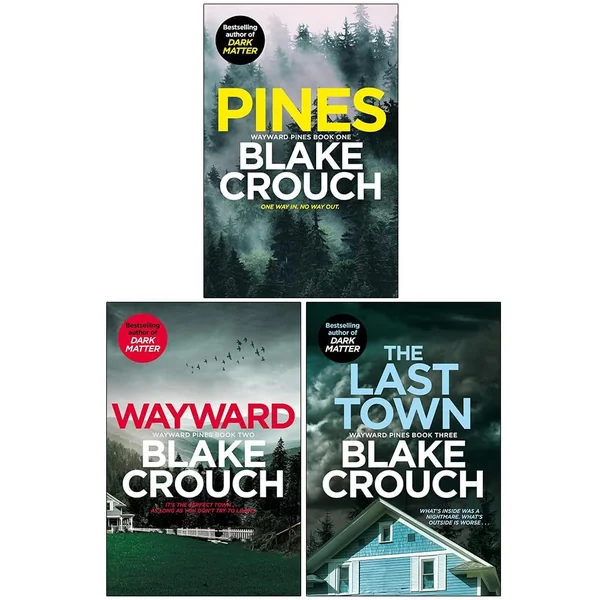
Thematic Ambition and Genre DNA
Critical Strengths: Where the Trilogy Shines
Where the Series Falls Short
The Adaptation and the Audience for This Set
Frequently Asked Questions
Sources & Further Reading
The key facts and claims in this review are grounded in the retrieved, verified sources listed below.
- Cited in this review
- 1
en.wikipedia.org
- 2
penguinrandomhouse.com
- 3
- Further reading
- 4
Blake Crouch, Wikipedia
- 5
- 6
- 7
currentlybooked.com
Related Reviews
Reviews of books we picked for readers who enjoyed The Wayward Pines Trilogy Series 3 Books Set.
Reader Comments
No comments yet
Be the first to share your thoughts!