The Foundation of Modern Economic Thought
The Wealth of Nations presents Smith's revolutionary argument that individual self-interest, when channeled through competitive markets, can produce outcomes beneficial to society as a whole. This concept—later dubbed the "invisible hand"—challenged the prevailing mercantile wisdom of Smith's era, which viewed wealth as a zero-sum game between nations.
Smith's prose style reflects his background as a moral philosopher rather than a technical economist. He builds arguments methodically, using historical examples and logical reasoning rather than mathematical models. The writing can feel verbose by modern standards, but Smith's careful explanations reward patient readers with genuine insights into economic principles that remain relevant today.
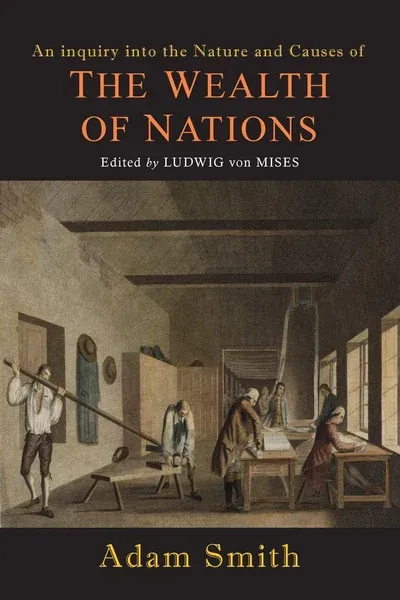
The book's structure moves from foundational concepts like the division of labor to complex discussions of international trade, taxation, and public policy. Smith demonstrates how specialization increases productivity through his famous pin factory example, showing how breaking down manufacturing into discrete tasks dramatically increases output per worker.
Key Concepts That Shaped Capitalism
Smith introduces several concepts that became cornerstones of economic theory. The division of labor, natural price versus market price, and the role of self-interest in promoting social welfare all receive thorough treatment. His analysis of how labor specialization increases wealth remains one of the clearest explanations of this fundamental economic principle.
The author's discussion of international trade challenges the mercantile assumption that exports are inherently good while imports drain national wealth. Smith argues instead that trade benefits all parties when each nation specializes in producing goods where it holds comparative advantages. This insight laid groundwork for modern free trade theory.
Smith also grapples with questions of justice and equity that contemporary economists often sidestep. He acknowledges that market outcomes don't always align with moral outcomes, and he advocates for government intervention in areas like education and public works where private markets fail to serve social needs.
The Man Behind the Theory
Adam Smith wrote The Wealth of Nations as a professor of moral philosophy at the University of Glasgow, bringing philosophical rigor to economic questions that were typically addressed through policy pamphlets or merchant handbooks. His earlier work, The Theory of Moral Sentiments, explored human empathy and social bonds, providing crucial context for understanding his economic arguments.
Smith spent over a decade researching and writing The Wealth of Nations, traveling throughout Europe to observe different economic systems firsthand. His analysis of French physiocrats and Dutch commercial practices enriched his theoretical framework with practical observations about how different societies organize economic activity.
The timing of the book's publication—the same year as American independence—wasn't coincidental. Smith saw the American colonies' economic potential and argued that Britain's mercantile restrictions actually weakened rather than strengthened the empire's overall wealth.
Where Smith's Analysis Shows Its Age
Modern readers will notice gaps in Smith's framework that reflect 18th-century limitations. He couldn't anticipate industrialization's environmental consequences, the rise of large corporations, or the complexity of modern financial markets. His assumption that most economic actors operate as individual entrepreneurs seems quaint in an era of multinational corporations and global supply chains.
Smith's discussion of labor assumes workers can easily switch between occupations and locations—assumptions that ignore the practical constraints most workers face. His optimism about market outcomes also underestimates how power imbalances between employers and employees can distort supposedly free exchanges.
The book's length and repetitive structure present additional challenges. Smith develops similar arguments across multiple sections, and his historical examples, while illuminating, can feel tangential to modern concerns. Readers seeking practical investment advice or contemporary policy analysis will find little direct application.
A Classic That Rewards Persistence
Despite its challenges, The Wealth of Nations offers modern readers something increasingly rare: a systematic attempt to understand how human societies organize economic life. Smith's combination of philosophical depth and practical observation creates a foundation for economic thinking that remains relevant even as specific theories evolve.
The book works best for readers interested in intellectual history, those studying economics formally, or anyone curious about the philosophical underpinnings of market capitalism. Smith's insights into human nature and social organization extend beyond economics into psychology, sociology, and political theory.
For readers daunted by the complete work, quality abridged editions capture Smith's essential arguments without his more repetitive passages. However, the full text rewards careful reading with a nuanced understanding of how Smith balanced his faith in markets with recognition of their limitations.
The Wealth of Nations isn't light reading, but it's essential reading for anyone seeking to understand the intellectual foundations of modern economic life. Smith's work reminds us that economics isn't just about numbers and policies—it's fundamentally about human nature and social cooperation.