5 min read
4.2
A challenging but rewarding exploration of human decision-making that remains highly relevant despite its academic origins and demanding pace.
LuvemBooks
Our Rating
4.2
A challenging but rewarding exploration of human decision-making that remains highly relevant despite its academic origins and demanding pace.
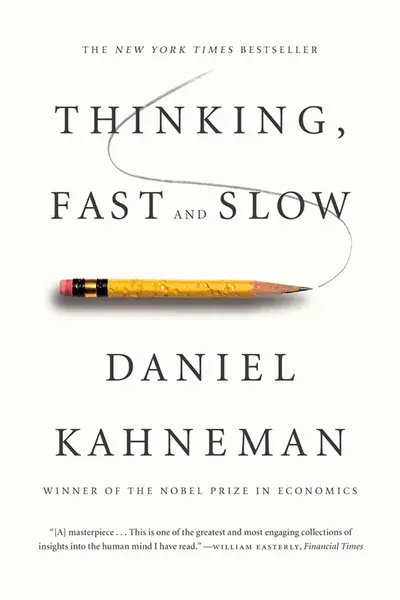
More than a decade after its release, is Thinking, Fast and Slow worth reading in today's information-saturated world? Daniel Kahneman's exploration of human decision-making remains startlingly relevant, perhaps more so as we navigate an era of rapid-fire judgments and algorithmic influence. This isn't just another pop psychology book—it's a Nobel laureate's attempt to translate decades of groundbreaking research into insights that reshape how we understand our own minds.
Kahneman's central thesis divides human thinking into two distinct systems: the lightning-quick, intuitive System 1, and the deliberate, effortful System 2. Where books like Nudge focus on practical applications, Kahneman digs deeper into the psychological mechanisms that make behavioral economics possible. The result is both more challenging and more rewarding than typical business psychology fare.
Kahneman constructs his argument methodically, building from simple optical illusions to complex economic decisions. System 1 operates automatically—it's what makes you duck when a ball flies toward your head or instantly dislike someone based on their tone of voice. System 2 requires conscious effort—it's what you engage when calculating a tip or evaluating a job offer.
The genius lies in Kahneman's demonstration that these systems often conflict, and that System 1's speed comes with systematic biases. We overweight recent events, mistake correlation for causation, and place excessive confidence in our judgments. These aren't character flaws—they're features of human cognition that evolved for different environments than our modern world.
Unlike purely academic treatments, Kahneman bridges laboratory findings with real-world implications. His discussion of prospect theory—the work that earned him the Nobel Prize—explains why people fear losses more than they value equivalent gains. This loss aversion shapes everything from stock market behavior to why we cling to failing relationships.
The book's strength lies in its practical relevance without sacrificing intellectual rigor. Kahneman doesn't offer simple life hacks but rather a framework for recognizing when our intuitive judgments might lead us astray. The concepts apply whether you're a CEO making strategic decisions or a parent choosing schools for your children.
Kahneman writes with the precision of an academic but the clarity of someone who understands his audience extends beyond psychology departments. He guides readers through complex experimental designs without drowning them in statistical methodology. Each concept builds logically on the previous one, creating a comprehensive picture of human judgment that feels both surprising and inevitable.
The pacing can be demanding—this isn't beach reading. Kahneman expects readers to engage actively with the material, to question their own thinking patterns as he exposes them. Some sections require careful attention, particularly when he delves into statistical concepts that challenge common intuitions about probability and risk.
What sets this work apart from self-help psychology is Kahneman's intellectual honesty about the limitations of his insights. He acknowledges that simply knowing about cognitive biases doesn't eliminate them—even experts in the field fall prey to the same mental shortcuts they study. This humility makes the book more trustworthy, not less.
However, the book's academic origins occasionally show. Some examples feel dated, rooted in research from decades past. The writing, while clear, lacks the narrative drive of more recent popular science works. Readers expecting easy prescriptions for better decision-making might find themselves wanting more actionable guidance.
Thinking, Fast and Slow succeeds as both scientific education and practical philosophy. It doesn't promise to make you a perfect decision-maker, but it provides tools for recognizing when your judgment might be compromised. In an age of information overload and polarized thinking, understanding the quirks of human cognition feels increasingly essential.
The book rewards careful reading and benefits from revisiting key concepts. Kahneman's insights into confidence, memory, and happiness challenge common assumptions about what drives human satisfaction. These aren't just academic curiosities—they're insights that can reshape how you evaluate your own life choices and understand others' behavior.
For readers interested in psychology, economics, or simply understanding why smart people make predictable mistakes, this remains essential reading. It's challenging in the best sense—not because the writing is unclear, but because the ideas demand genuine intellectual engagement. More than a decade later, Kahneman's work continues to offer one of the most comprehensive maps to the territory of human judgment we possess.
You can find Thinking, Fast and Slow at Amazon, your local bookstore, or directly from Farrar, Straus and Giroux.