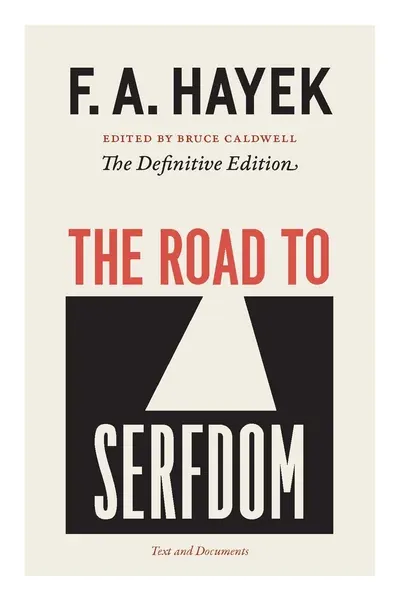
A Warning That Echoes Across Decades
Is The Road to Serfdom still relevant today? In an era of expanding government programs, economic uncertainty, and debates over individual versus collective responsibility, F. A. Hayek's seminal work feels remarkably prescient. This definitive edition presents not just Hayek's original text, but a treasure trove of supplementary documents that illuminate both the book's creation and its lasting impact on political and economic thought.
Written as Britain embraced economic planning, Hayek's argument against central planning seemed almost heretical to many contemporaries. Yet his core thesis about government control and individual freedom has sparked ongoing debates that continue in political and economic discussions worldwide.
The definitive edition format elevates this beyond a simple reprint. Readers familiar with Free to Choose by Milton Friedman or other Austrian economics works will recognize similar themes, but Hayek's approach is more philosophical and historically grounded than purely economic.
Hayek's Intellectual Framework
F. A. Hayek constructs his argument methodically, beginning with the premise that economic freedom and political freedom are inextricably linked. His prose is accessible yet rigorous, avoiding the dense mathematical formulas that characterize much modern economic theory. The Austrian economist writes with the clarity of someone who understands that his ideas must persuade ordinary citizens, not just academic colleagues.
The supplementary documents in this definitive edition reveal Hayek's thought process and the fierce intellectual battles he waged with contemporaries like John Maynard Keynes. These additions transform the reading experience from consuming a single argument to witnessing an entire intellectual ecosystem in action.
What distinguishes Hayek's writing is his historical perspective. Rather than relying solely on theoretical models, he draws extensively from the rise of totalitarian movements in Germany and the Soviet Union to illustrate how economic centralization enables political oppression.
The Core Arguments Unpacked
Hayek's central thesis involves his critique of central planning—the belief that human reason can successfully organize complex economic systems better than spontaneous market forces. He argues that central planners, regardless of their good intentions, lack the distributed knowledge necessary to make optimal economic decisions for millions of individuals.
The book systematically dismantles the notion that socialism represents a middle path between capitalism and fascism. Instead, Hayek contends that both socialism and fascism share the same fundamental flaw: the concentration of economic power in the hands of the state, which inevitably corrupts democratic institutions.
His discussion of the rule of law versus arbitrary government action remains particularly relevant. Hayek distinguishes between general rules that apply equally to all citizens and specific government interventions that pick winners and losers—a distinction that resonates in contemporary debates over everything from tax policy to regulatory capture.
The definitive edition's additional documents show how Hayek refined these arguments over decades, responding to critics and adapting his framework to address new challenges.
Where Hayek's Vision Holds Strong
The book's enduring strength lies in its integration of economic theory with political philosophy and historical analysis. Unlike purely theoretical works, F. A. Hayek grounds his arguments in observable patterns of government behavior and institutional evolution.
His critique of intellectuals who embrace planning despite lacking practical experience in running businesses or organizations feels remarkably contemporary. The phenomenon he describes—educated elites advocating for policies they would never personally implement—continues to drive political tensions across democracies.
The definitive edition's scholarly apparatus enhances rather than detracts from Hayek's core message. The editorial notes and supplementary materials provide context that helps readers understand why certain arguments that seemed abstract when first published proved prophetic in subsequent decades.
Hayek's emphasis on spontaneous order and unintended consequences offers valuable insights for anyone trying to understand complex systems, whether in economics, politics, or social organization.
Limitations and Blind Spots
Despite its insights, The Road to Serfdom reflects the limitations of its era and author. Hayek's faith in market mechanisms sometimes appears overly optimistic, particularly regarding issues like environmental degradation or extreme inequality that markets alone struggle to address effectively.
The book's focus on the choice between pure market capitalism and comprehensive central planning doesn't adequately address the mixed economies that most developed nations eventually adopted. Many successful democracies have found ways to combine market mechanisms with significant government programs without sliding into totalitarianism.
Hayek's treatment of labor unions and collective bargaining reveals a bias that weakens some of his arguments. His tendency to view any collective action outside market mechanisms as potentially dangerous oversimplifies the complex dynamics of modern industrial societies.
The definitive edition's length and scholarly apparatus, while valuable for serious students, may overwhelm casual readers seeking to understand Hayek's core insights.
A Classic Worth Wrestling With
The Road to Serfdom deserves its status as a foundational text in political economy, but not as an infallible guide to policy. F. A. Hayek's warnings about the dangers of unchecked government power remain vital, even if his prescriptions require adaptation to contemporary challenges.
This definitive edition serves multiple audiences effectively. Scholars will appreciate the comprehensive documentation and editorial apparatus. General readers interested in understanding the intellectual foundations of free-market advocacy will find Hayek's arguments clearly presented and historically grounded.
The book's relevance extends beyond economics to anyone interested in the relationship between individual freedom and collective action. In an age of growing government power and declining trust in institutions, Hayek's insights about the unintended consequences of well-intentioned policies deserve serious consideration.
Whether you agree with Hayek's conclusions or not, his framework for thinking about the trade-offs between security and freedom, efficiency and liberty, remains intellectually valuable and practically relevant today.
Where to Buy
You can find The Road to Serfdom: Text and Documents--The Definitive Edition at Amazon, academic bookstores, or directly from University of Chicago Press for the most comprehensive scholarly edition.