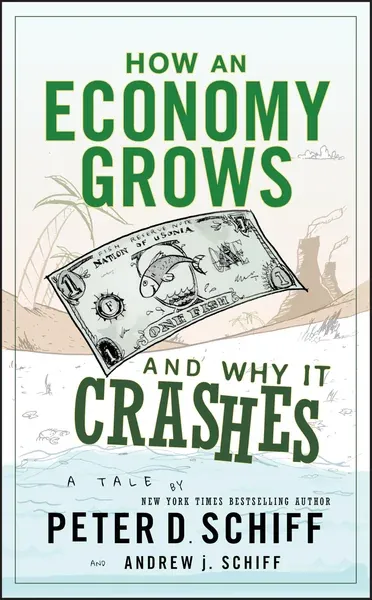
Economics textbooks have a reputation for being dry, abstract, and intimidating. Peter D. Schiff and Andrew J. Schiff attempt to solve this problem in "How an Economy Grows and Why It Crashes" by stripping away jargon and using a simple story about fish, nets, and island life to explain complex economic principles. But does this beginner economics book actually succeed in making the dismal science accessible, or does it sacrifice accuracy for simplicity?
The book's central premise is clever: start with three men on an island who catch fish with their bare hands, then gradually build complexity as they invent nets, save capital, create currency, and develop banking systems. The Schiffs are committed to making abstract economic concepts concrete through their narrative approach.
The Fish Tale That Explains Everything
The Schiffs build their economic universe from the ground up, beginning with the most basic economic activity: production and consumption. Their island dwellers face the fundamental economic problem of scarcity, and every subsequent development—from the first fishing net to complex financial instruments—flows logically from this starting point. The progression feels natural rather than forced, making concepts like capital formation, productivity gains, and comparative advantage intuitive rather than theoretical.
What makes this approach particularly effective is how it demystifies seemingly complex phenomena. When the islanders create their first bank, readers understand exactly why banks exist and how they function in a healthy economy. When government interference disrupts the island's natural economic flow, the consequences feel inevitable rather than politically motivated. The authors successfully show rather than tell, letting readers discover economic principles through narrative rather than assertion.
The Schiffs' Ideological Framework
Peter D. Schiff and Andrew J. Schiff don't hide their free-market perspective, and the book functions as much as an Austrian economics primer as it does a general introduction to economic thinking. Their island society thrives when markets operate freely and suffers when government intervention distorts natural incentives. This ideological consistency gives the book coherence, but it also limits its scope.
Readers seeking a balanced introduction to different economic schools of thought won't find it here. The Schiffs present their Austrian perspective as economic truth rather than one interpretation among many. While their arguments are internally consistent and well-illustrated through their island metaphor, they don't engage seriously with Keynesian or other economic viewpoints that might reach different conclusions about government's role in the economy.
Making Complex Systems Comprehensible
The book's greatest strength lies in its ability to make abstract economic relationships concrete and understandable. Concepts like inflation, deflation, trade deficits, and fiscal policy become clear when viewed through the lens of island life. The progression from simple bartering to complex financial systems feels organic, helping readers understand how modern economies actually developed rather than simply how they currently function.
The visual elements support this pedagogical approach effectively. Simple illustrations complement the narrative, reinforcing key concepts without overwhelming the text. The economics book reads more like an engaging story than a textbook, which will appeal to readers who typically avoid economics but want to understand how markets and governments interact.
Where Simplicity Becomes Problematic
However, the book's commitment to simplicity occasionally becomes its weakness. Real economies are messier than island societies, and some of the Schiffs' conclusions don't account for the complexity of modern financial systems, international trade, or the legitimate roles government might play in addressing market failures. Their island metaphor works beautifully for explaining basic economic principles but strains when applied to more sophisticated economic phenomena.
The book also shows its age in some respects, written during the aftermath of the 2008 financial crisis with that particular moment's concerns and perspectives. While the fundamental economic principles remain relevant, some of the specific applications and predictions feel tied to their historical moment rather than timeless economic truth.
A Valuable Starting Point with Limitations
"How an Economy Grows and Why It Crashes" by Peter D. Schiff and Andrew J. Schiff succeeds admirably at its primary goal: making economic thinking accessible to general readers who might otherwise find the subject intimidating. The Schiffs have created a genuinely engaging introduction that builds understanding systematically and memorably. Readers will come away with a solid grasp of how markets function, why capital formation matters, and how government policies can either support or undermine economic growth.
The book works best as a first step into economic thinking rather than a comprehensive guide. Readers who find themselves engaged by the Schiffs' approach would benefit from exploring works that present alternative economic perspectives.
For absolute beginners seeking to understand basic economic principles through clear, entertaining explanations, this economics book delivers exactly what it promises. Just remember that it's presenting one particular view of how economies work—a compelling and internally consistent view, but not the only valid perspective in economic thinking.
Where to Buy
You can find How an Economy Grows and Why It Crashes at Amazon, Barnes & Noble, your local bookstore, or directly from Crown Publishing.