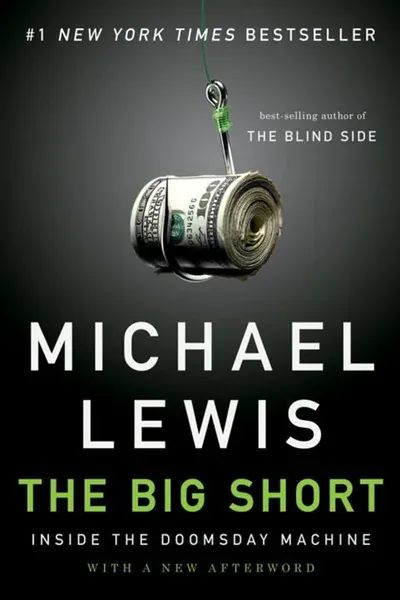
When Wall Street's House of Cards Collapsed
Michael Lewis's The Big Short stands as one of the most accessible yet devastating accounts of the 2008 financial crisis ever written. Published in 2009, this nonfiction masterpiece spent 28 weeks on The New York Times bestseller list and later inspired the Academy Award-winning film. But is The Big Short worth reading in 2026, nearly eighteen years after the crisis it chronicles? The answer depends on your appetite for financial complexity wrapped in storytelling brilliance.
Unlike dry economic textbooks, Lewis transforms the arcane world of mortgage-backed securities and credit default swaps into a gripping narrative about the few who saw disaster coming. Readers familiar with Flash Boys or Moneyball will recognize Lewis's talent for making complex systems both understandable and utterly compelling. The book doesn't just explain what happened—it reveals how a handful of contrarians bet against the entire housing market and won.
Lewis's Narrative Mastery
Michael Lewis possesses a rare gift: the ability to explain financial instruments that baffled Wall Street professionals in terms that engage general readers. His prose crackles with wit and barely contained outrage, transforming what could be a tedious economics lesson into something approaching a thriller. The writing maintains the perfect balance between accessibility and sophistication, never talking down to readers while avoiding unnecessary jargon.
The pacing builds methodically, mirroring the slow-motion catastrophe Lewis describes. He introduces complex concepts gradually, allowing readers to understand collateralized debt obligations and synthetic CDOs without drowning in technicalities. This isn't accidental—Lewis spent months interviewing his subjects and understanding the mechanics himself before crafting this narrative.
The Outsiders Who Saw It Coming
Rather than focusing on Wall Street's titans, Lewis centers his story on the misfits and contrarians who recognized the housing bubble's inevitable collapse. These figures—hedge fund managers, a neurologist-turned-investor, and a small team of garage-based traders—serve as both protagonists and guides through the financial labyrinth.
Each character brings a different perspective to the impending disaster. Some are motivated by pure profit, others by intellectual curiosity about market inefficiencies, and still others by moral outrage at the system's fundamental corruption. Lewis presents them without excessive hero worship, acknowledging both their prescience and their self-interest. Their stories humanize what could otherwise be an abstract economic analysis.
The Machinery of Financial Destruction
The Big Short excels at explaining how the 2008 crisis wasn't simply about bad mortgages—it was about the elaborate financial architecture built on those mortgages. Lewis dissects the incentive structures that encouraged reckless lending, the rating agencies that rubber-stamped toxic securities, and the investment banks that packaged and sold instruments they knew were worthless.
The book's exploration of these themes remains painfully relevant. Lewis demonstrates how short-term thinking, perverse incentives, and regulatory capture created a system designed to privatize profits while socializing losses. His analysis feels prescient given subsequent financial crises and ongoing debates about too-big-to-fail institutions.
Where Complexity Meets Accessibility
While The Big Short succeeds brilliantly at making finance comprehensible, it occasionally struggles with the sheer complexity of its subject matter. Some readers may find themselves lost in the alphabet soup of financial acronyms, despite Lewis's best efforts at explanation. The middle sections, where Lewis delves deepest into the mechanics of synthetic CDOs, can feel dense even for engaged readers.
The book also reflects the limitations of its moment. Written in the immediate aftermath of the crisis, it lacks the longer-term perspective we now have on the regulatory and social consequences. Some of Michael Lewis's predictions about reform and accountability proved overly optimistic, though this hardly diminishes the book's core insights.
A Financial Crisis Primer That Endures
Nearly eighteen years after the events it describes, The Big Short remains essential reading for anyone seeking to understand how modern financial markets actually operate. Lewis's achievement lies not just in explaining what happened, but in revealing the human psychology and institutional failures that made the crisis inevitable.
This Michael Lewis book works on multiple levels: as financial journalism, as social criticism, and as a character study of both the people who saw disaster coming and those who ignored every warning sign. For readers interested in economics, investing, or simply understanding how the modern world works, The Big Short offers insights that extend far beyond the 2008 crisis.
You can find The Big Short at Amazon, your local bookstore, or directly from W. W. Norton & Company.