Best Dr. Seuss Books: Where to Start Your Journey

4 books
Green Eggs and Ham by Dr. Seuss
Oh, the Places You'll Go! by Dr. Seuss
The Cat in the Hat by Dr. Seuss
What Pet Should I Get? (Beginner Books) by Dr. Seuss
Children's Books

Best Dr. Seuss Books: Where to Start Your Journey

Curated recommendations for Parents looking for beloved picture books and early readers to share with children ages 2-8

4 Books
4.9 Avg
Updated Feb 28, 2026

Few authors have shaped childhood reading quite like Theodor Seuss Geisel — better known to the world as Dr. Seuss. With his signature rhyming verse, wonderfully strange creatures, and surprisingly deep life lessons tucked between colorful pages, Seuss created a body of work that has delighted generations of readers young and old. But if you're new to his catalog, knowing where to begin can feel a little overwhelming — after all, the man wrote over 4 books.

This curated list cuts through the noise and highlights four essential titles that showcase the full range of what makes Dr. Seuss so beloved. Whether you're a parent searching for your child's first Seuss experience, a nostalgic adult revisiting a childhood favorite, or simply a curious reader ready to dive in, these books offer the perfect starting point into one of literature's most imaginative universes.

#1
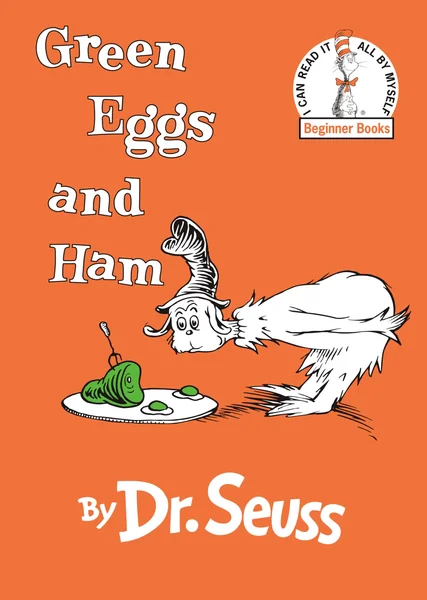
Green Eggs and Ham by Dr. Seuss by Dr. Seuss - book cover
Green Eggs and Ham by Dr. Seuss

by Dr. Seuss

4.9/5

Written on a bet — and won decisively — Green Eggs and Ham is the perfect entry point into Dr. Seuss's world precisely because its constraints are its magic. Editor Bennett Cerf wagered Seuss couldn't write an engaging children's book using only 50 distinct words. The result is Sam-I-am's relentless, cheerfully absurd campaign to get one very stubborn companion to try a single dish — across boats, foxes, goats, and the dark. The book's comic engine is pure Seuss: escalating situations, a character who refuses to quit, and a payoff that earns its lesson without ever lecturing. If you're building a Seuss reading list from scratch, start here. The 50-word constraint means it's genuinely approachable for the youngest readers, but the rhythm and momentum hold up for adults reading aloud. The one honest caveat: if you've heard it read aloud a hundred times already, the repetition is by design — and it still works, whether you want it to or not.
"Born from a $50 wager between Dr. Seuss and his editor Bennett Cerf — a bet that Seuss could not write an engaging children's book using only 50 distinct words."
PreK–Grade 2
Level: Lexile BR50L–100L
#2
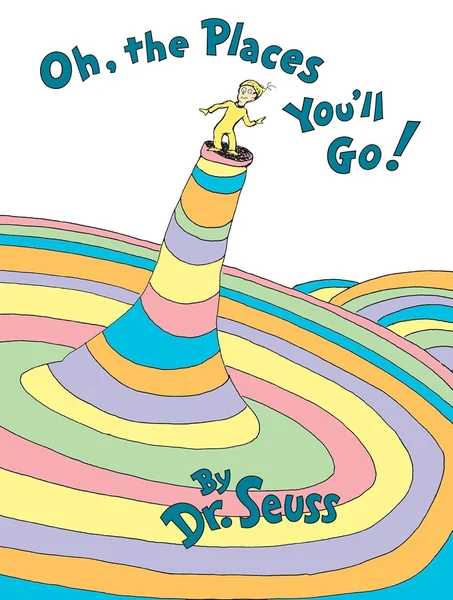
Oh, the Places You'll Go! by Dr. Seuss by Dr. Seuss - book cover
Oh, the Places You'll Go! by Dr. Seuss

by Dr. Seuss

4.9/5

Oh, the Places You'll Go! occupies a strange and singular corner of the Seuss catalog — it's technically a children's picture book, but it's been handed to graduates, retirees, and people navigating major life transitions for over thirty years. That's not an accident. Written in second person, it speaks directly to "you," tracking a nameless protagonist through early confidence, disorientation, stagnation in "The Waiting Place," and eventual renewal. As Seuss's final book published before his death in 1991, it reads almost like a parting note — warm, honest about difficulty, and ultimately forward-looking without being falsely cheerful. For Seuss newcomers, this one is a slightly different experience than the comic absurdism of The Cat in the Hat or Green Eggs and Ham — the tone is more reflective, less raucous. Children will enjoy it, but they may not be the ones who feel it most. Adults in the middle of something uncertain almost certainly will.
"Rather than following a single external conflict, the book tracks the interior arc of a life: early confidence, disorientation, setback, stagnation, and renewal."
Grades K–3 (and adults)
Level: Lexile 570L
#3
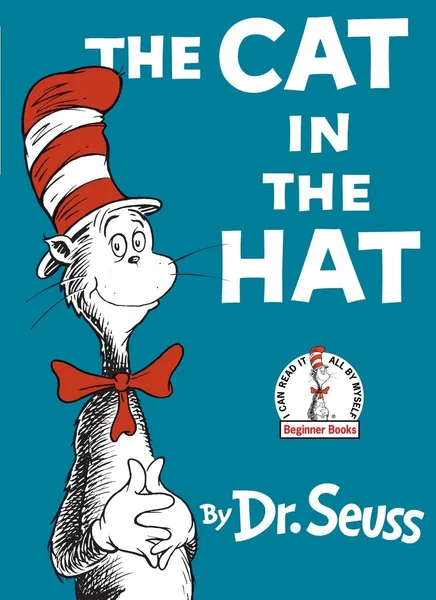
The Cat in the Hat by Dr. Seuss by Dr. Seuss - book cover
The Cat in the Hat by Dr. Seuss

by Dr. Seuss

4.9/5

The Cat in the Hat didn't just become a children's classic — it was engineered to disrupt a broken system. After a 1954 critique called school readers dull and airless, Dr. Seuss was challenged to write something genuinely engaging using a limited vocabulary. What he produced was a story about boredom, temptation, and chaos that still crackles nearly seventy years later. Two kids, a rainy afternoon, a mother who's out, and a very tall Cat with very bad ideas — the setup is deceptively simple, but the tension between the protesting fish (order, conscience, rules) and the Cat (fun, disruption, risk) gives the book a comic architecture that rewards rereading. For anyone mapping Seuss's body of work, this is the essential starting point — the book that proved his method could work at scale and launched the Beginner Books imprint. Not everyone will agree it's the *most* fun Seuss book, but it's the one that explains everything that came after.
"The premise, stripped to its bones, is a story about unsupervised children, temptation, disorder, and the question of who cleans up the mess."
Grades K–2
Level: Lexile 210L
#4
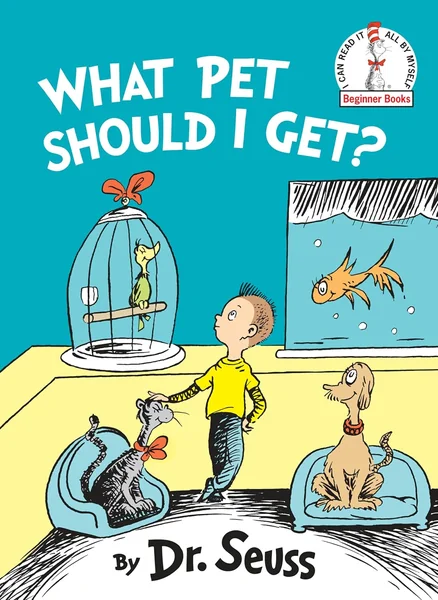
What Pet Should I Get? (Beginner Books) by Dr. Seuss by Dr. Seuss - book cover
What Pet Should I Get? (Beginner Books) by Dr. Seuss

by Dr. Seuss

4.8/5

A genuine discovery from beyond the grave, *What Pet Should I Get?* is one of those publishing stories almost too good to be true — a complete Seuss manuscript, tucked away in a small box for decades, finally reaching the readers it was always meant for. Jay and Kay, familiar faces from *One Fish, Two Fish, Red Fish, Blue Fish*, are back, this time wrestling with the perfectly Seussian predicament of wanting every pet in the store when you're only allowed to pick one. It's a dilemma every child understands instinctively, and Seuss captures that particular agony of choosing with his usual bouncy economy. That said, this is a lesser work in the canon — unfinished at the time of Geisel's death and reconstructed from rediscovered manuscript pages, it lacks the narrative resolution of his best books, ending on a deliberately open note that may frustrate young readers expecting a proper payoff. Think of it less as a polished Seuss classic and more as a charming artifact. For completists and curious newcomers alike, it's a small treasure worth holding.
"A manuscript Seuss himself had labeled 'Noble Failures' — and yet what emerged was anything but."
Ages 3–6
Level: Beginner / Pre-K–K
Final Thoughts

Dr. Seuss built something truly rare — a world where reading feels like an adventure and every page turn brings something new to discover. The four books on this list aren't just great starting points; they're windows into a lifetime of storytelling craft that rewards readers of every age.

Whether you begin with the rebellious fun of The Cat in the Hat, the stubborn charm of Green Eggs and Ham, or the sweeping encouragement of Oh, the Places You'll Go!, you really can't go wrong. Pick one up, read it aloud, and let the rhymes carry you. The Seuss universe is waiting — and it's every bit as magical as you've heard.

Frequently Asked Questions

The Cat in the Hat is widely considered the ideal starting point. It's the book that launched the modern Seuss era, combining a simple vocabulary with an irresistibly mischievous story that hooks readers of all ages immediately.
Not at all. While many titles are written for early readers, books like Oh, the Places You'll Go! carry messages that resonate deeply with teenagers and adults — it's one of the most popular graduation gifts for a reason.
Most Seuss books are designed for children aged 3 to 8 years old, making them ideal for early readers and read-aloud storytime. However, the themes of imagination, perseverance, and kindness give them a timeless appeal well beyond that range.
Yes — What Pet Should I Get? is a fascinating example of a posthumously published Seuss title, originally written between 1958 and 1962 and discovered among his papers after his passing in 1991. It offers a wonderful glimpse into his creative process.
Dr. Seuss was famously intentional about using limited, phonics-friendly vocabulary. Green Eggs and Ham, for instance, was written using just 50 unique words — making it a genuinely powerful tool for building early reading confidence and fluency.
Dr. Seuss wrote and illustrated over 60 books throughout his career, spanning from 1937 to his final lifetime publication, Oh, the Places You'll Go!, in 1990. That rich catalog means there's always another Seuss adventure waiting to be discovered.
Best Dr. Seuss Books: Where to Start Your Journey | LuvemBooks