

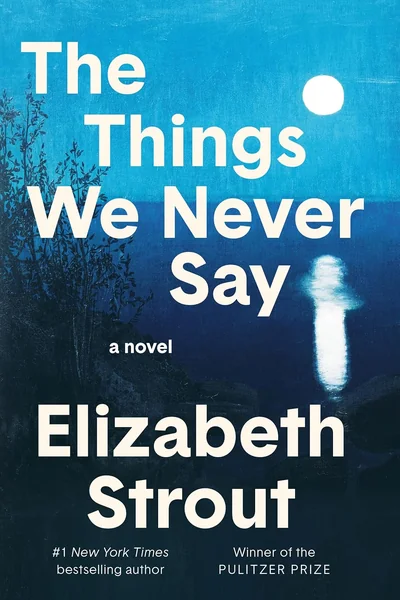
Elizabeth Strout has secured a place on the 2026 Booker Prize shortlist for The Things We Never Say, her eleventh novel, published by Random House in May 2026. As covered in a recent Woman's World feature on the 2026 Booker shortlist, the novel — praised for its 'thought-provoking and unsettling' storytelling — joins a select group of titles competing for one of fiction's most prestigious awards. Wikipedia confirms the September 2026 shortlisting, and NPR's coverage of the announcement notes that Strout is 'back as a finalist for the prize again, this time for The Things We Never Say.' For a novelist who has spent decades accumulating major literary honours, the recognition nonetheless signals something worth noting: this time, she arrives with a book that deliberately breaks from the fictional world that made her famous.
What The Things We Never Say Brings to the Booker Table
The Things We Never Say is a conscious departure from the interconnected Maine universe — Olive Kitteridge, the Lucy Barton series — that has defined Strout's reputation for the better part of two decades. The novel centres on Artie Dam, a 57-year-old high school history teacher living in an unnamed coastal Massachusetts town, navigating secret emotional turmoil, family estrangement, and the weight of things left unsaid. According to Wikipedia's entry on the novel, a near-drowning experience and a revelation about his wife become twin catalysts that force Artie to confront the distance between the life he presents and the one he actually inhabits. The Booker Prize's own library describes Strout's prose as capturing 'the way grief reverberates through decades' and 'the freedom that comes when we break free,' per the Booker Prizes website. That the novel arrived on Barnes & Noble's shelves as a New York Times bestseller before its shortlisting suggests the book had already found a wide audience — the Booker recognition layers a further layer of critical legitimacy onto commercial momentum.
Strout has spoken about the novel's origins with characteristic precision: the character of Artie Dam was sparked by a friend sending her a page of obituaries, where a photograph of an ordinary man with wire-rimmed glasses lodged in her imagination. She later merged that image with a story she had overheard about a man found floating in the water off the Massachusetts coast. It is the kind of quiet, oblique creative process that has long characterised her work — finding large human truths in moments that most writers would overlook entirely.
Strout's Prize History and Why This Shortlisting Carries Weight
To understand what the 2026 Booker shortlisting means, it helps to trace the arc of Strout's career. Her novel Olive Kitteridge won the 2009 Pulitzer Prize for Fiction and was adapted into a multi-Emmy Award-winning miniseries. My Name Is Lucy Barton topped the New York Times bestseller list and drew international critical acclaim. She won the Siegfried Lenz Prize in 2022. In literary terms, Strout is not an emerging voice seeking validation — she is an established titan of American fiction whose work has consistently crossed between critical prestige and mass readership, a balance that remains genuinely rare. The Booker shortlisting, then, is less a discovery than a confirmation: that a novel marking a significant stylistic shift — away from recurring characters and familiar Maine geography toward a new protagonist and a new emotional register — has landed with precisely the weight Strout intended. KQED's coverage of the 2026 shortlist notes the year's selected titles span wide thematic territory, placing Strout's study of male isolation and hidden domestic fracture in pointed conversation with the broader concerns of contemporary literary fiction.
Readers already familiar with Strout's earlier work — particularly Tell Me Everything, her most recent entry in the Lucy Barton series — will find The Things We Never Say an instructive contrast: same emotional precision, entirely new coordinates. For those coming to Strout for the first time via the Booker shortlist, Olive Kitteridge remains the natural entry point to understanding just how long and consistently she has operated at this level. Want the full verdict on The Things We Never Say? Read our review for a close assessment of what the novel achieves and who it will reward most.
Identity
Redemption
Tense
Melancholy
Slow-burn
Grief & loss
Frequently Asked Questions
Is The Things We Never Say by Elizabeth Strout worth buying in 2026?
The Things We Never Say has earned a place on the 2026 Booker Prize shortlist and landed on the New York Times bestseller list following its May 2026 publication — two strong indicators of both critical and commercial merit. Reviewers have praised Strout's 'thought-provoking and unsettling' storytelling and her ability to render grief and hidden lives with exquisite prose. Whether it suits your tastes depends on your appetite for quiet, character-driven literary fiction.
What is The Things We Never Say about?
The Things We Never Say centres on Artie Dam, a 57-year-old high school history teacher in a coastal Massachusetts town who is secretly struggling with isolation, suicidal thoughts, and a growing estrangement from his wife and son. A near-drowning experience and a family revelation force him to reckon with the gap between the life he shows the world and the one he actually lives. The novel is set against the backdrop of the 2024 US presidential election.
How does The Things We Never Say differ from Elizabeth Strout's previous novels?
Unlike much of Strout's celebrated back catalogue — including Olive Kitteridge and the Lucy Barton series — The Things We Never Say introduces an entirely new protagonist and moves away from the interconnected Maine settings that defined those works. It is described as a standalone narrative set in Massachusetts, representing a deliberate departure from the recurring characters and fictional geography Strout's readers know well.
Has Elizabeth Strout won the Booker Prize before?
As of the 2026 shortlisting, Strout has not previously won the Booker Prize, though she has an extensive record of major literary recognition — most notably the 2009 Pulitzer Prize for Fiction for Olive Kitteridge and the 2022 Siegfried Lenz Prize. The 2026 Booker shortlisting for The Things We Never Say marks her appearance as a Booker finalist, per NPR and Wikipedia's confirmed reporting.
Should I read The Things We Never Say or start with an earlier Elizabeth Strout novel?
The Things We Never Say is a standalone novel, so no prior knowledge of Strout's other works is required. However, readers new to Strout may wish to start with Olive Kitteridge — her Pulitzer Prize-winning novel — to understand the scope and precision of her literary voice before approaching this newer, stylistically distinct work. Either entry point is valid depending on your interest.
When was The Things We Never Say published and who published it?
The Things We Never Say was published on May 5, 2026, by Random House. It was shortlisted for the Booker Prize in September 2026, just months after its release, making it one of the faster routes from publication to major prize recognition in recent literary memory.



Reader Discussion
No comments yet
Be the first to share your thoughts!