8 min read
3.7
· 6,667 Amazon ratingsShare This Review
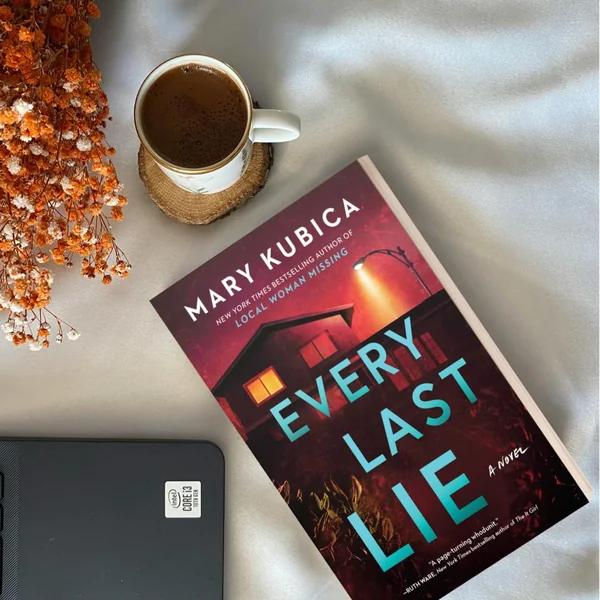
Every Last Lie by Mary Kubica Review: A Grief-Driven Thriller With Caveats
Every Last Lie is a domestic suspense thriller by New York Times bestselling author Mary Kubica, structured around the alternating perspectives of Clara Solberg — a new mother convinced her husband was murdered — and Nick Solberg, whose chapters trace the secrets he kept in the months before his fatal car crash. Critics called it a compelling portrait of grief and coping, while Kirkus Reviews found it overwritten and polarizing; the novel sits squarely in the tradition of psychological domestic thrillers and will appeal most to readers who can invest in an unreliable, grief-consumed narrator.
LuvemBooks Verdict
Best for
Readers drawn to domestic suspense built around dual-timeline architecture and the slow unravelling of a marriage's hidden secrets — particularly those who enjoy unreliable narrators and dramatic irony driven by a widening gap between what the reader knows and what the grieving protagonist can yet see.
Worth it if
Worth picking up if you have patience for a slow-burn structural payoff and are more invested in the mechanics of concealment and grief than in a tidily resolved thriller ending.
Skip if
Skip it if you need a protagonist whose emotional logic stays coherent under pressure, or if overwrought prose and a flat finale — both flagged by Kirkus Reviews — are dealbreakers for you in the thriller genre.
What readers & critics say
Kirkus Reviews called the novel "overwritten and sloppy with an oddly polarizing protagonist," finding Clara's obsession more like denial than grief and judging the ending "flat and forgettable" after a lengthy buildup. Reader bloggers were more generous: mrsbbookreviews.wordpress.com awarded it 4.5 stars, reallyintothis.com burned through it in a single day, and outofthebex.com praised Kubica's "adept understanding into psychological motivations," though drinkreadrepeat.com landed at 3 out of 5 and noted the writing was not quite to their taste.
“Overwritten and sloppy with an oddly polarizing protagonist… the ending falls flat and is forgettable.”
— Kirkus ReviewsAsk LuvemBooks
Was this helpful?
- Is it worth reading?
- For fans of domestic suspense built around unreliable narrators, Every Last Lie offers real structural pleasures: the dual-timeline design creates genuine dramatic irony, and the central mystery — was Nick Solberg's death an accident, a suicide, or a murder? — is designed to keep pages turning. Ruth Ware called it "a page-turning whodunit, and a moving account of grief," and critics praised it as a compelling portrait of grief and coping. However, Kirkus Reviews found the prose overwritten and sloppy, Clara a polarizing and not-very-reliable narrator, and the ending flat after a lengthy buildup — so readers who need tight prose and a knockout resolution may come away disappointed.
- Similar books
- Readers drawn to Every Last Lie's domestic suspense and unreliable-narrator framework will find strong companion reads among the curated titles below. Laura Dave's The Last Thing He Told Me follows a woman uncovering the dangerous secrets her husband kept from her — a close structural parallel. Lisa Jewell's Then She Was Gone is another psychologically driven domestic thriller built around hidden family truths and a mother's obsessive search. Shanora Williams' The Wife Before mines the same territory of a woman discovering her husband's concealed past. The Silent Patient by Alex Michaelides and The Woman in the Window by A.J. Finn round out the cluster for readers who enjoy unreliable perspectives and slow-building twists.
- Who should read this?
- Every Last Lie is best suited to adult readers who enjoy domestic suspense built on unreliable narrators and the gradual unraveling of a marriage's hidden architecture. Fans of Ruth Ware, Lisa Jewell, and the "domestic noir" tradition will be most at home here. Readers who require a protagonist whose emotional logic stays coherent under pressure, or who are sensitive to prose they might find overwrought, should approach with Kirkus Reviews' reservations in mind — particularly if a satisfying, memorable ending is important to them.
- About Mary Kubica
- Mary Kubica is a New York Times and USA Today bestselling author of suspense novels, including The Good Girl, The Other Mrs., and Local Woman Missing. A former high school history teacher, she holds a Bachelor of Arts in History and American Literature from Miami University in Oxford, Ohio. Her books have been translated into over thirty languages and have sold over five million copies worldwide.
- What are the main themes?
- Grief and denial are at the novel's emotional core: Clara's investigation is as much a portrait of a mind struggling to process loss as it is a thriller plot, and her refusal to accept that Nick may have contributed to his own fate reads, per Kirkus, as denial more than deduction. Financial ruin and the secrets spouses keep from each other form the novel's structural backbone — Nick's hidden debts and concealed financial crisis drive his chapters and give the dual timeline its mounting tension. The publisher frames the novel as an exploration of "the dark recesses of a mind plagued by grief" and the possibility that "some secrets might be better left buried."
- Is Clara a reliable narrator?
- Clara is explicitly an unreliable narrator — this is a deliberate structural feature of the novel, not an accident. Kirkus Reviews describes her as someone who "won't earn many points with readers," noting that her obsession curdles into denial as she refuses to consider that Nick could have contributed to his own fate and instead directs suspicion at everyone around her, including family members. Her dishonesty with daughter Maisie compounds the effect. Whether this unreliability reads as psychologically authentic grief or as frustrating narrative obstruction is the central question dividing the book's critical reception.
Summarize this book
Follow up
Synthesized from verified book data & published reviews · How we review
Press Enter to ask. Answers come from our editorial Q&A — start typing to see related questions.
Age & Reading Level
Recommended age
Adult
Reading level
Adult
3 content notes · who it suits
Content to know about
Skip if you need a protagonist whose emotional logic stays coherent and a thriller that delivers a memorable, satisfying resolution.
Our Review
What the Novel Is and What It Does
Place in Mary Kubica's Body of Work
What the Structure Does Well
Where Critics Find Fault
Who This Thriller Is For
Sources & Further Reading
The key facts and claims in this review are grounded in the retrieved, verified sources listed below.
- Cited in this review
- 1
marykubica.com
- 2
publishersweekly.com
- Further reading
- 3
kirkusreviews.com
- 4
pagesplotsandpints.com
- 5
drinkreadrepeat.com
- 6
darksideoftheword.com
- 7
reallyintothis.com
- 8
outofthebex.com
- 9
barnesandnoble.com
Books like Every Last Lie
Curated picks for readers who enjoyed Every Last Lie, with our reasoning for each match.
If you liked Every Last Lie