BOOKS
Published

Read Time

8 min read

Reader rating

4.6

· 28,782 Amazon ratings
reader ratings, not a LuvemBooks score
Curated & edited by

LuvemBooks Editorial

How we create our reviews →
Share This Review

Unfu*k Yourself by Gary John Bishop Review: Blunt, Bestselling Self-Help for the Stuck

Gary John Bishop's Unfu*k Yourself is an instant New York Times bestseller that has sold over two million copies by delivering a no-nonsense, tough-love framework designed to help readers break free from self-sabotage, self-doubt, and stagnation. Built around seven direct assertions, it trades the gentle encouragement of conventional self-help for a sharper, more confrontational approach Bishop calls "urban philosophy." This review covers the book's content, structure, and published reception — not hands-on application.

LuvemBooks Verdict

Best for

Readers who have cycled through gentler self-help approaches — vision boards, affirmations, incremental habit-stacking — and want a blunt, structured framework that demands behavioral change rather than offering comfort.

Worth it if

The confrontational, assertion-led voice is the point for you — you want a short, practical handbook that interrupts self-sabotage with direct accountability rather than nuanced, research-backed persuasion.

Skip if

Skip it if you value evidential depth or research-grounded psychology in your self-help, or if you are already well-versed in accountability-based coaching and are likely to find the core framework familiar beneath its bracing tone.

Manhattan Book Review and San Francisco Book Review both note that the book "doesn't offer anything new, but if you know someone who needs a short, direct take on how to get motivated, this book is a good bet." Libgirlbooks.com describes Bishop as taking "off the kid gloves" with a "no-nonsense in-your-face approach," while playeronefinance.com highlights the seven-assertion structure and its use of assertive language in place of conventional positive self-talk.

Sources: Manhattan Book Review, San Francisco Book Review, libgirlbooks.com, playeronefinance.com
4.6from 28,782 Amazon ratings— reader ratings, not a LuvemBooks score
In This Review
  • What Works & What Doesn't
  • What the Book Actually Is
  • The Central Argument and Design Intent
  • Reach, Reception, and Cultural Impact
  • Where It Succeeds
  • Limitations and Who May Not Connect

What Works & What Doesn't

What Works
  • An instant New York Times bestseller with over two million copies sold, signaling broad and sustained readership
  • Seven-assertion structure gives the book a clear, actionable framework designed for practical engagement
  • Bishop's "urban philosophy" voice is distinctly positioned in the self-help genre — direct, blunt, and BS-free by design
  • Explicitly targets readers who have failed with gentler self-help approaches, giving it a precise and underserved audience
What Doesn't
  • The confrontational, assertion-led style prioritizes momentum over evidential or research-backed depth, which may frustrate readers who want psychology grounded in citations
  • Readers already versed in accountability-based coaching may find the core framework familiar beneath its distinctive tone
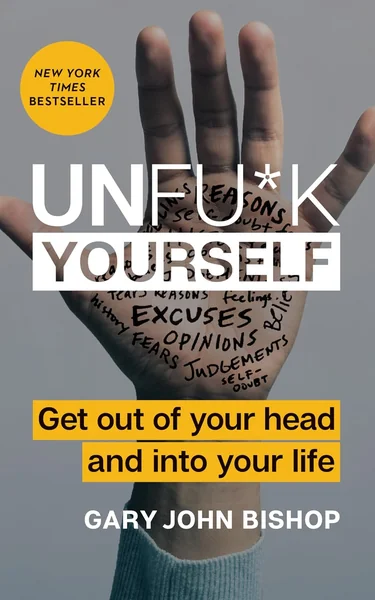
A blunt, action-oriented self-help guide that became an instant New York Times bestseller by rejecting the soft language of conventional personal development in favor of direct, unsparing accountability.
Unfu*k Yourself: Get Out of Your Head and into Your Life – The New York Times Bestselling Tough-Love Self-Help Guide to Stop Self-Sabotage and Boost Resilience (Unfu*k Yourself series, 1) by Gary John Bishop front cover

What the Book Actually Is

Unfuk Yourself: Get Out of Your Head and into Your Life is a self-empowerment guide by Gary John Bishop, a personal development expert whose approach he describes as "urban philosophy." Published by HarperOne in August 2017, it is the first entry in the Unfuk Yourself series, which has since expanded to include Stop Doing that Sht, Do the Work, Wise As Fuk, and Love Unfuked*. The book is structured around seven assertions — direct, declarative statements meant to shift a reader's internal dialogue and then push that shift into action. Rather than offering a philosophy of passive acceptance or gentle reframing, Bishop's framework is designed to move readers from self-imposed paralysis toward concrete behavioral change.
a refreshing, no-nonsense, self-empowerment guide that offers an honest, crystal clear, tough-love approach

The Central Argument and Design Intent

The book's premise, as the publisher describes it, is that the primary obstacle between most people and the lives they want is not circumstance but the internal noise of self-doubt, habitual self-sabotage, and unexamined limiting beliefs. Bishop frames this as a problem of mindset that must be confronted head-on — hence the title and the tone. The seven assertions form the book's backbone, each one intended to serve as a prompt for honest self-examination and redirected action. The scope is broad: the publisher positions it as a guide for readers seeking more secure relationships, new beginnings, resilience in the face of uncertainty, and the confidence to learn from past mistakes. It is, by design, a handbook — structured for practical engagement rather than passive reading.

Reach, Reception, and Cultural Impact

The numbers tell a clear story: Unfuk Yourself* became an instant New York Times bestseller and has sold over two million copies. That commercial performance reflects something beyond marketing — it signals that Bishop's direct, profanity-laced voice landed with a readership that felt underserved by the softer registers of much mainstream self-help. The book is positioned as "BS-free," and that identity has proven sticky. The publisher describes it as "a refreshing, no-nonsense, self-empowerment guide that offers an honest, crystal clear, tough-love approach" — language that has been echoed broadly in how readers and booksellers describe the experience of encountering it. Bishop's series has continued to build on this foundation, suggesting the first book established a genuinely durable audience rather than a passing trend.

Where It Succeeds

The book's primary strength is its clarity of purpose and voice. Bishop does not hedge or soften: the assertions at the center of the book are designed to interrupt the internal monologue that keeps people stuck, not to sympathize with it. For readers who have cycled through more conventional approaches — vision boards, affirmations, incremental habit stacking — and found them insufficient, this harder edge is the point. The publisher frames the guide as suited for those who have "tried 'trusting the process'" and ended up in the same destructive patterns. That specificity of target reader is itself a strength: the book knows who it is for. Bishop's "urban philosophy" branding also gives the work a distinct identity in a crowded genre, positioning it as something other than a repackaging of existing positive-psychology talking points.

Limitations and Who May Not Connect

The same directness that drives the book's appeal is also its most significant limiting factor. Readers who find value in nuance, gradual persuasion, or the integration of research-backed psychology into self-help frameworks may find Bishop's assertion-led structure thin on evidential support. The book's design prioritizes confrontational momentum over academic depth, which is a deliberate trade-off — but it is a trade-off nonetheless. Those already comfortable with accountability-based coaching or who have absorbed similar material from adjacent authors may find the core ideas familiar beneath the bracing tone. The approach is also inherently prescriptive; readers who respond better to exploratory, question-based self-inquiry may find the declarative format less generative than it is intended to be.

Sources & Further Reading

The key facts and claims in this review are grounded in the retrieved, verified sources listed below.

  1. Cited in this review
  2. 1
  3. 2
  4. Further reading
  5. 3