
BOOKS
Published

Read Time

8 min read

Curated & edited by

LuvemBooks Editorial

How we create our reviews →
Share This Review

AdEntity: Advertising, Algorithms, and the Fate of Modern Identity by Ahmad Abu Zannad Review: A Bold Rethinking of Advertising's Civilizational Role

AdEntity is a work of cultural nonfiction in which advertising strategist Ahmad Abu Zannad argues that advertising, branding, and algorithm-driven media have moved far beyond selling products — they have become primary forces in shaping what people value, desire, and ultimately become. Drawing on evolutionary psychology, anthropology, behavioral economics, and sociology, and grounded in more than two decades of strategic advisory work with governments and global brands across the Middle East, the book reframes advertising not as a manipulative commercial instrument but as one of the foundational forces of modern civilization — and positions artificial intelligence and recommendation systems as the next, more consequential frontier of that influence. This review is based on the book's stated content, design, and available published commentary, not hands-on use.

LuvemBooks Verdict

Best for

Marketers, brand strategists, cultural critics, and general readers who want to understand how advertising and algorithmic systems have come to shape not just consumer behavior but identity itself — particularly those comfortable with argument-driven, interdisciplinary nonfiction.

Worth it if

You're drawn to big-picture cultural analysis and want a serious, cross-disciplinary reckoning with how branding, media, and AI-driven recommendation systems are reshaping what people value, desire, and ultimately become.

Skip if

You're looking for a practical, tactical advertising manual or step-by-step campaign guide — AdEntity operates at a philosophical and civilizational level of analysis, not an operational one.

Entarabi.com reports that rather than condemning advertising, AdEntity reassesses its historical role as one of the fundamental forces that shaped modern civilization, and that Abu Zannad argues artificial intelligence, recommendation systems, and algorithm-driven media are no longer simply influencing consumption patterns but are reshaping identity itself. Books.google.de similarly highlights the book's examination of how branding, algorithms, and modern communication systems operate not merely as marketing tools but as forces that structure meaning and aspiration.

Sources: entarabi.com, books.google.de

Age & Reading Level

Recommended age

Adult

Reading level

Adult

Skip if you're looking for a practical, step-by-step advertising or campaign strategy manual.

In This Review
  • What Works & What Doesn't
  • What the Book Actually Argues
  • Scope, Sources, and the Author's Standpoint
  • The Reassessment of Advertising's Historical Role
  • The Algorithm Argument and Its Stakes
  • Who This Book Is For and Where It Challenges Readers

What Works & What Doesn't

What Works
  • Reframes advertising as a civilizational force shaping identity, not merely consumer behavior — a genuinely ambitious central argument
  • Draws on an unusually wide interdisciplinary base, combining evolutionary psychology, anthropology, behavioral economics, and sociology
  • Grounded in more than two decades of real-world strategic advisory experience with governments and global brands across the Middle East
  • Offers a non-condemnatory reassessment of advertising's historical role that sets it apart from conventional media criticism
  • Engages directly with artificial intelligence and algorithm-driven media as the next frontier of identity formation — a timely and consequential focus
What Doesn't
  • Readers expecting a tactical or how-to advertising manual will find the book operates at a philosophical and cultural-analysis level rather than a practical one
  • The book's wide interdisciplinary sweep across 399 pages demands sustained engagement; those seeking a narrow, focused argument may find the scope demanding
AdEntity is a work of cultural nonfiction that reframes advertising not as a peripheral commercial tool but as a civilizational force — one that Abu Zannad argues has always shaped identity, and that now, in its algorithmic form, shapes it more powerfully than ever before.

What the Book Actually Argues

At the center of AdEntity is a provocation: most people assume identity is something discovered from within, but Abu Zannad contends it has been constructed all along by surrounding systems — advertising, media, culture, and now algorithms. The book traces how branding and modern communication systems operate not merely as marketing instruments but as structures of meaning and aspiration, gradually influencing not only purchasing decisions but what people value and desire. As one passage in the book reads, "The question is no longer whether advertising shapes what we buy, but whether algorithms have begun shaping who we become." This reorientation — from consumer behavior to identity formation — is the book's animating argument and its most distinctive intellectual move.
The question is no longer whether advertising shapes what we buy, but whether algorithms have begun shaping who we become.

Scope, Sources, and the Author's Standpoint

What gives AdEntity its particular texture is the range of disciplines Abu Zannad draws upon. As reported by entarabi.com, the book synthesizes evolutionary psychology, anthropology, behavioral economics, and sociology, weaving these frameworks together with Abu Zannad's own more than two decades of experience advising governments and global brands across the Middle East. That dual grounding — academic interdisciplinarity alongside long-form industry practice — positions the book as neither a purely theoretical treatise nor a practitioner's memoir, but something in between: a culturally ambitious argument anchored in professional reality. The Middle Eastern advisory context also gives the book a geographic and geopolitical perspective less commonly centered in Western-dominated media criticism.
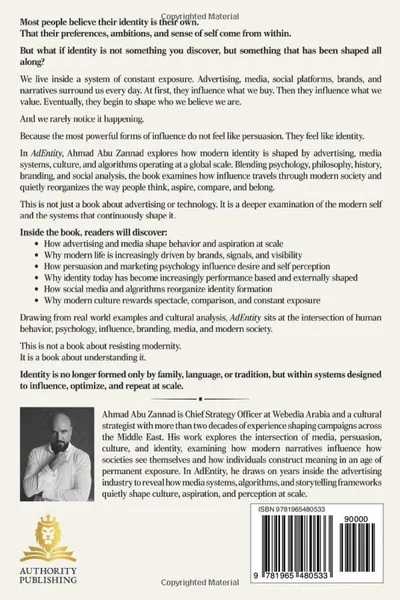
AdEntity: Advertising, Algorithms, and the Fate of Modern Identity by Ahmad Abu Zannad back cover

The Reassessment of Advertising's Historical Role

One of the book's more counterintuitive moves, as described across its available commentary, is its refusal to condemn advertising. Where much media criticism treats advertising as an inherently corrosive force, AdEntity offers a reassessment of its historical role, positioning it as one of the forces that contributed to shaping modern civilization itself. This is not a defense of advertising's excesses but a recontextualization of its function — an argument that the systems now under scrutiny did not emerge as parasites on culture but were constitutive of it. The book traces this arc across more than a century of advertising's evolution from commercial practice to cultural institution.

The Algorithm Argument and Its Stakes

The book's most urgent claims concern artificial intelligence, recommendation systems, and algorithm-driven media. Abu Zannad argues, as noted by entarabi.com, that these systems are no longer simply influencing patterns of consumption — they are determining which identities survive and which ones fade. The book frames this as a civilizational threshold: tools that once distributed culture are now, increasingly, deciding what culture looks like and who gets to belong to it. The stakes Abu Zannad assigns to this shift are high, and the book is designed to make that urgency legible to a broad audience of readers — not only specialists in media theory or advertising but anyone navigating a hyperconnected world.

Who This Book Is For and Where It Challenges Readers

AdEntity is structured for readers who want to understand the systems shaping contemporary life — marketers, brand strategists, cultural critics, and general readers drawn to questions of identity, technology, and power. Its interdisciplinary architecture means the book covers substantial intellectual ground across 399 pages, moving between psychology, anthropology, economics, and media theory. Readers seeking a narrowly practical advertising manual or a step-by-step guide to campaign strategy will find the book operates at a different register: it is an analytical and philosophical work, not a tactical one. Those who engage most productively with it will be readers comfortable with argument-driven nonfiction that spans multiple disciplines and builds its case incrementally across a long form.

Sources & Further Reading

The key facts and claims in this review are grounded in the retrieved, verified sources listed below.

  1. 1
  2. 2