BOOKS
Published

Read Time

7 min read

Reader rating

4.6

· 1,245 Amazon ratings
reader ratings, not a LuvemBooks score
Curated & edited by

LuvemBooks Editorial

How we create our reviews →
Share This Review

Think Like a Cat by Pam Johnson-Bennett Review: The Definitive Cat Behavior Handbook

Think Like a Cat: How to Raise a Well-Adjusted Cat—Not a Sour Puss is Pam Johnson-Bennett's comprehensive guide to understanding feline instincts, covering everything from kitten selection and veterinary care to litter box management and behavior troubleshooting. Originally published in 2000 and revised, updated, and expanded in a 2011 Penguin Books edition, it is widely regarded as one of the most thorough cat ownership resources available, earning Johnson-Bennett the title "the queen of cat behavior" from author and pet expert Steve Dale. This review covers the book's content and published reception, not hands-on use.

LuvemBooks Verdict

Best for

New or frustrated cat owners who want a science-grounded, cradle-to-grave reference that explains the behavioral instincts behind feline "misbehavior" rather than offering surface-level fixes.

Worth it if

You want a single, authoritative volume — written by a credentialed veterinary technician and internationally recognized behavior consultant — that covers everything from kitten acquisition and veterinary care to scratching, litter box problems, and inter-cat tension in genuine behavioral depth.

Skip if

You need a quick, targeted answer to one specific problem and don't want to navigate a 400-plus-page reference to find it — or you need the most current veterinary guidance, given that the revised edition dates from 2011.

AbeBooks surfaces a critical coverage note describing the book as "more comprehensive than Johnson-Bennett's earlier works, with excellent insight into feline behavior, humor, and common sense," while BooksRun carries a reader account calling it "insightful and a great source of information," particularly praising its evidence-based treatment of the indoor-versus-outdoor cat debate.

Sources: AbeBooks, BooksRun
4.6from 1,245 Amazon ratings— reader ratings, not a LuvemBooks score
In This Review
  • What Works & What Doesn't
  • What the Book Is and What It Covers
  • Author Credentials and the Book's Place in the Field
  • Strengths: Breadth, Empathy, and Practical Structure
  • Limitations and Ideal Audience Fit
  • Who This Book Is For

What Works & What Doesn't

What Works
  • Encyclopedic in scope, covering kitten acquisition, veterinary care, health issues, scratching, and litter box management in a single volume
  • Written by a former veterinary technician and internationally recognized cat behavior consultant, lending the guidance professional credibility
  • Designed to serve owners at every experience level, from first-time kitten adopters to long-time cat companions dealing with behavioral challenges
  • Revised, updated, and expanded in 2011, reflecting more than a decade of refinement beyond the original 2000 edition
  • Steve Dale, author of My Pet World, has called Johnson-Bennett 'the queen of cat behavior,' signaling strong peer recognition within the field
What Doesn't
  • At over 400 pages, the book demands a significant time commitment and is less suited to owners seeking a quick, targeted answer to a single problem
  • The 2011 revision date means some veterinary and product information may predate current developments in feline medicine and enrichment research
A thorough, empathetically structured cat behavior and ownership guide from one of the field's most credentialed experts, this revised edition stands as a benchmark reference for cat owners at every level of experience.

What the Book Is and What It Covers

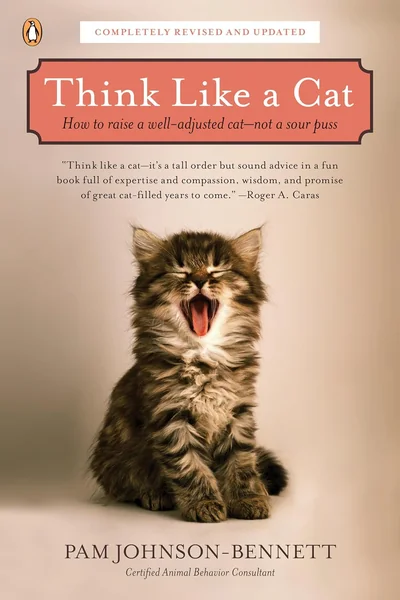
Think Like a Cat: How to Raise a Well-Adjusted Cat--Not a Sour Puss by Pam Johnson-Bennett front cover
Think Like a Cat is a comprehensive cat ownership and behavior guide built around a single organizing premise: that most feline "misbehavior" is the result of owners not understanding their cat's needs, instincts, and psychology. Rather than framing cats as inscrutable or untrainable, Pam Johnson-Bennett walks owners through the instincts that drive feline behavior—positive and negative—and shows how recognizing those instincts makes living with a cat far more manageable. The scope is genuinely encyclopedic: the book addresses where to obtain a kitten, how to choose a veterinarian, basic health care, more serious medical issues, scratching post selection, and litter box problems, among other topics. This is not a narrow training manual but a cradle-to-grave resource designed to accompany an owner through every stage of a cat's life.
veteran cat lover[s], a brand-new owner of a sweet kitten, or the frustrated companion of a feline whose driving you crazy

Author Credentials and the Book's Place in the Field

Johnson-Bennett's authority is not self-declared. A former veterinary technician who went on to build a private cat-consulting practice in Nashville, she also lectures on feline behavior at veterinary and animal welfare conferences internationally and has appeared on Animal Planet UK and Canada. Think Like a Cat is the flagship title in a body of work that includes Catwise, Cat vs. Cat, and Twisted Whiskers, and she is described by Biblio's summary of the book as "a seasoned therapist." Steve Dale, author of My Pet World, has called her "the queen of cat behavior"—a designation that reflects her standing among pet professionals, not just general audiences. The book's revised, updated, and expanded Penguin Books edition signals that the core text proved durable enough to warrant substantive revision more than a decade after its original 2000 publication, rather than replacement.

Strengths: Breadth, Empathy, and Practical Structure

The book's defining strength is its combination of behavioral science and practical, actionable guidance delivered without condescension. According to Biblio's description, Johnson-Bennett "offers welcome advice in a straightforward manner"—a characterization that aligns with the book's design intent: to be accessible to first-time kitten owners and experienced cat companions alike. The publisher positions it explicitly for "veteran cat lover[s], a brand-new owner of a sweet kitten, or the frustrated companion of a feline whose driving you crazy," and the structure reflects that breadth, moving logically from acquisition through ongoing care and behavior management. One reader note surfaced in available sources describes finding the book "insightful and a great source of information," particularly praising Johnson-Bennett's treatment of the indoor-versus-outdoor cat debate, where she lays out everyday risks with documented arguments rather than assumptions.

Limitations and Ideal Audience Fit

At more than 400 pages, Think Like a Cat is an investment in reading time, and owners seeking a quick-reference pamphlet or a narrow solution to a single behavioral problem will find the format less immediately efficient than a targeted resource. The book's comprehensiveness is its core value proposition, which means readers who want depth will be well served, while those wanting a fast answer to one specific issue may need to navigate to the relevant section rather than read linearly. Additionally, because this edition was revised in 2011, readers should be aware that some veterinary guidance and product references may predate more recent developments in feline medicine and enrichment research, and consulting a current veterinarian alongside this text remains advisable for health-specific concerns.

Who This Book Is For

The publisher's own framing captures the audience well: whether a cat is old or young, newly adopted or a long-standing family member, Think Like a Cat is designed to serve as an ongoing reference rather than a one-time read. It is particularly well-suited to new owners who want to build a foundational understanding of feline behavior from the start, as well as to owners struggling with a specific problem—scratching, litter box avoidance, inter-cat tension—who benefit from understanding the behavioral context around that issue rather than just a surface fix. Johnson-Bennett's background as both a veterinary technician and a behavior consultant means the book bridges the clinical and the practical in a way that more anecdotal guides do not, making it a reasonable first stop for cat owners who want science-grounded guidance written in plain language.

Sources & Further Reading

The key facts and claims in this review are grounded in the retrieved, verified sources listed below.

  1. Cited in this review
  2. 1
  3. 2
  4. 3
  5. Further reading
  6. 4
  7. 5
  8. 6