
7 min read
Share This Review
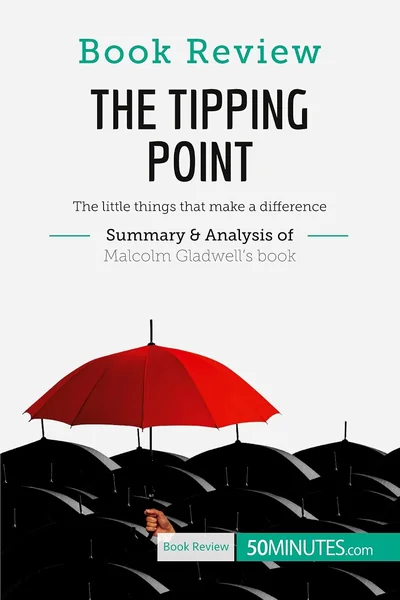
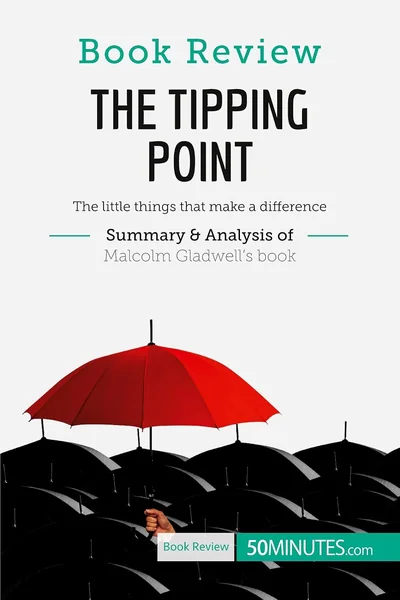
Book Review: The Tipping Point by Malcolm Gladwell by 50Minutes.com Review: A Compact Summary for Busy Readers
50Minutes.com's Book Review: The Tipping Point by Malcolm Gladwell is a 30-page summary and analysis guide designed to distill Malcolm Gladwell's bestselling work on social epidemics and the butterfly effect into a fast, accessible read. This review covers the guide's content and structure as described by its publisher and available sources, not hands-on application.
 Tap to enlarge
LuvemBooks Verdict
Best for
Time-pressed readers — students, marketers, or curious generalists — who want a structured, balanced overview of Gladwell's Tipping Point framework without committing to the full original book.
Worth it if
You want a quick, clearly segmented entry point into Gladwell's ideas about social epidemics, rare birds, and context — especially if you're new to the material or need a revision tool.
Skip if
You already have grounding in sociology or behavioural science, or you're seeking the narrative richness, extended case studies, and rhetorical depth that made Gladwell's original book a cultural event — none of which a 30-page summary can replicate.
Ask LuvemBooks
Was this helpful?
- Is it worth reading?
- For readers who want a fast, structured introduction to Gladwell's ideas without committing to the full original book, this guide delivers solid value: it covers all the major concepts — rare birds, adherence, context, the tipping point itself — and adds the useful touch of a criticisms section. That said, it is explicitly a summary product and cannot replicate the extended case studies and storytelling that define Gladwell's original work. Readers who have already read The Tipping Point may find it most useful as a revision tool or quick reference rather than a source of fresh insight. Those with existing academic grounding in sociology or behavioural science are unlikely to find it sufficiently challenging.
- Similar books
- Readers drawn to this guide will likely enjoy the broader ecosystem of popular social-science writing it sits within. Gladwell's own Blink: The Power of Thinking Without Thinking and Outliers: The Story of Success extend his characteristic style of applying multidisciplinary thinking to everyday phenomena. For adjacent perspectives on why ideas and behaviours spread, Jonah Berger's Contagious: Why Things Catch On and Chip Heath and Dan Heath's Made to Stick: Why Some Ideas Survive and Others Die are natural companions. Steven D. Levitt and Stephen J. Dubner's Freakonomics: A Rogue Economist Explores the Hidden Side of Everything offers a similarly contrarian, data-driven lens on hidden social forces.
- Who should read this?
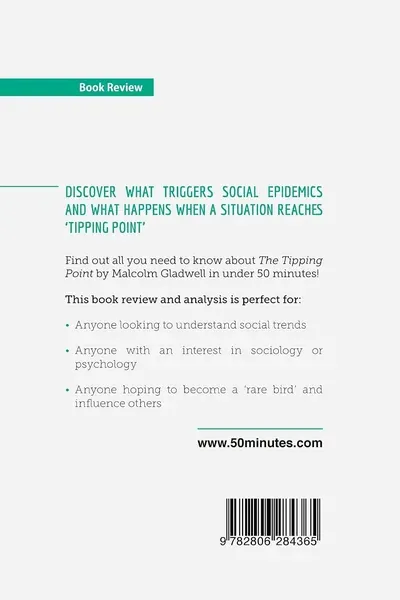
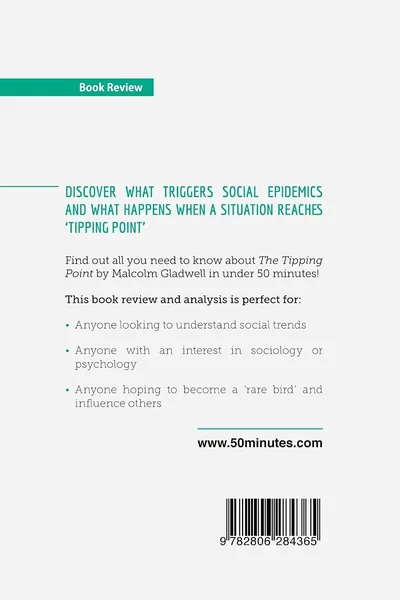
- The guide is positioned by its publisher as suitable for anyone looking to understand social trends, anyone with an interest in sociology or psychology, and anyone hoping to become a 'rare bird' and influence others. LuvemBooks identifies its strongest fit as time-pressed generalists — particularly those encountering Gladwell's ideas for the first time, or returning to them after years away. It is also noted as relevant to practitioners in marketing, public health, and sociology who want a fast structured overview of a framework that has shaped discourse in those fields.
- What is Gladwell's framework in this guide?
- The guide tracks four major pillars of Gladwell's thinking as presented in The Tipping Point: the concept of 'rare birds' — the connectors, mavens, and salesmen who drive the spread of ideas and behaviours — the principle of adherence (what makes a message or idea 'sticky'), the critical role of context in determining whether something reaches its tipping point, and the butterfly effect itself, which holds that small, seemingly minor factors can tip a trend into viral momentum. The guide also addresses the broader consequences Gladwell draws from this framework and rounds out with related approaches and extensions.
- What format is this guide and how long is it?
- This is a 30-page paperback published by 50Minutes.com in July 2017 as part of the publisher's Book Review series — a line designed to help readers engage with influential texts quickly and efficiently. The guide is organised into clearly delineated sections: background on Gladwell and the origins of The Tipping Point, the core summary of his framework, a section on criticisms of his approach, and a look at related extensions. Its segmented structure means readers can navigate directly to specific concepts without reading cover to cover.
- Why does Gladwell's original book matter?
- The guide unpacks source material of genuine cultural weight: Gladwell's The Tipping Point has sold over 1.7 million copies, and Time magazine named Gladwell one of its 100 most influential people in 2005. The book's commercial significance was signalled early — the publisher notes that Gladwell and his co-partner received an advance estimated at US$1–1.5 million. Its ideas have shaped how practitioners in marketing, public health, and sociology talk about change, making it one of the defining popular social-science works of its era.
Summarize this book
Follow up
Synthesized from verified book data & published reviews · How we review
Press Enter to ask. Answers come from our editorial Q&A — start typing to see related questions.
Age & Reading Level
Recommended age
Adult
Reading level
Adult
Skip if you want the narrative depth, extended case studies, and storytelling richness of Gladwell's original book rather than a structured summary.
Our Review
What This Guide Actually Is
The Subject Matter: Gladwell's Core Ideas
The Book Being Summarised: Why It Matters
Structure and Intended Audience
Genuine Limitations to Consider
Related reading
Adjacent titles worth exploring. We haven't reviewed these yet, so they link out to Amazon.