
Mark Windschitl
Jessica Thompson
Melissa Braaten
8 min read
4.6
· 380 Amazon ratingsShare This Review
Ambitious Science Teaching by Mark Windschitl, Jessica Thompson & Melissa Braaten Review: A Rigorous Framework for Equitable Science Instruction
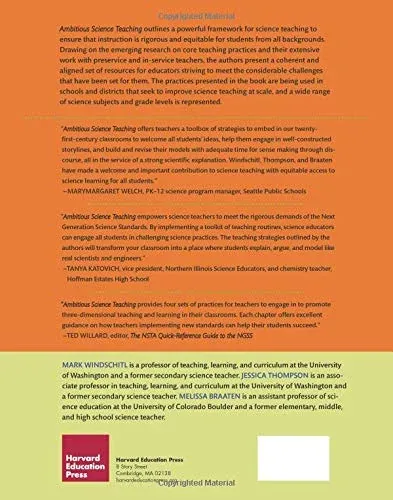
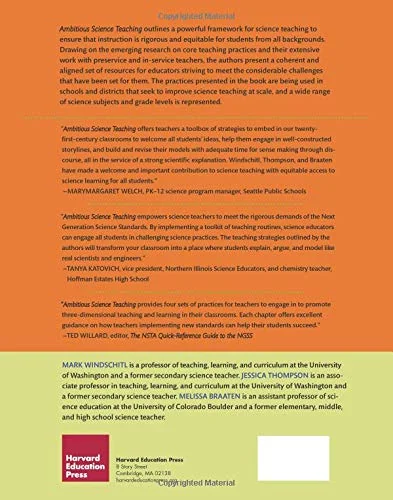
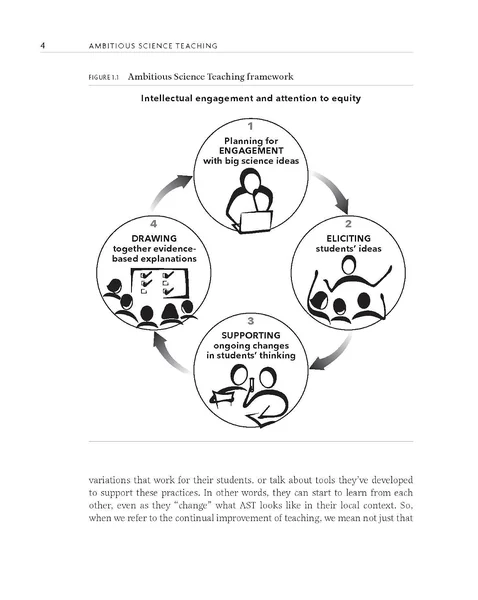
Published by Harvard Education Press in 2018 and recognized as a Choice Outstanding Academic Title that same year, Ambitious Science Teaching presents a research-grounded framework designed to make science instruction both rigorous and equitable across a wide range of subjects and grade levels. Co-authored by three university-based science education scholars, the book targets practicing and pre-service teachers seeking a coherent, practice-centered approach to science pedagogy — and it has seen adoption in schools and districts pursuing science teaching improvement at scale. This review is based on published sources and the book's documented contents; hands-on classroom application has not been independently tested by LuvemBooks.
 Tap to enlarge
LuvemBooks Verdict
Best for
Science teacher educators, university instructors, and professional development leaders who want a research-grounded, equity-embedded framework for transforming science instruction across subjects and grade levels.
Worth it if
You're invested in developing principled, sustainable teaching practice — whether leading a university course, designing district-wide professional learning, or working in a heterogeneous classroom where equitable participation is a daily priority.
Skip if
You need quick, ready-to-deploy lesson plans or highly specific guidance for a single discipline or grade band, as the framework's generality requires meaningful translation work that may feel demanding for an individual teacher working without institutional support.
What readers & critics say
ERIC notes that the practices presented in the book "are being used in schools and districts that seek to improve science teaching at scale," suggesting the framework has achieved meaningful uptake beyond academia. The book earned Choice's designation as a 2018 Outstanding Academic Title, a distinction confirmed by both the Harvard Education Press page and ERIC's record, signalling strong standing within the academic education community.
Sources: ERIC, Harvard Education Press, Science Outside, SAGE Journals (Theory Into Practice)In This Review
- What Works & What Doesn't
- What the Book Is and What It Argues
- The Authors' Credentials and the Book's Standing
- How the Book Is Structured and What It Contains
- Strengths: Equity as a Design Principle, Not an Add-On
- Limitations and Who May Find It Demanding
What Works & What Doesn't
What Works
- Named a 2018 Outstanding Academic Title by Choice, reflecting strong standing in the academic education community
- Equity is embedded structurally into each teaching practice rather than treated as a separate add-on
- Includes transcripts of real student-teacher dialogue, examples of student work, and descriptions of teacher thinking — grounding the framework in observable classroom reality
- Covers a wide range of science subjects and grade levels, making the framework broadly applicable
- Co-authored by scholars who combine years of K–12 classroom experience with university-level research expertise
What Doesn't
- The framework approach demands sustained, deliberate engagement — not suited to readers seeking quick, ready-to-use lesson plans
- Discipline-specific or grade-specific application requires readers to do meaningful translation work from general principles to their particular context
What the Book Is and What It Argues
The Authors' Credentials and the Book's Standing
How the Book Is Structured and What It Contains
Strengths: Equity as a Design Principle, Not an Add-On
Limitations and Who May Find It Demanding
Frequently Asked Questions
Sources & Further Reading
The key facts and claims in this review are grounded in the retrieved, verified sources listed below.
- Cited in this review
- 1
- 2
- Further reading
- 3
hep.gse.harvard.edu
- 4
- 5
scienceoutside.org
- 6
journals.sagepub.com
- 7
- 8
Related reading
Adjacent titles worth exploring. We haven't reviewed these yet, so they link out to Amazon.
Making Thinking Visible
David Perkins, Ron Ritchhart
Provides classroom protocols for making student thinking visible, directly supporting ambitious science teaching's focus on eliciting and building on student ideas.
Culturally Responsive Teaching and the Brain
Zaretta Hammond
Explains how cultural and cognitive factors influence learning, helping teachers design inclusive science instruction that reaches diverse student populations.

The Skillful Teacher
Jon Saphier, Robert Gower
Covers instructional techniques and classroom management essential for implementing the complex, discussion-based practices central to ambitious science teaching.

A Framework for K-12 Science Education
National Research Council
Establishes K-12 science standards emphasizing practices and disciplinary core ideas that align with ambitious science teaching's constructivist approach.
Reader Comments
No comments yet
Be the first to share your thoughts!