BOOKS
Published

Read Time

3 min read

Curated & edited by

LuvemBooks Editorial

How we create our reviews →
Share This Review

A Full Life: Reflections at Ninety by Jimmy Carter Review: An Uneven but Historically Significant Memoir

Jimmy Carter's memoir A Full Life: Reflections at Ninety is a wide-ranging retrospective from the 39th President of the United States that covers his Georgia upbringing, naval service, political career, presidency, and post-White House humanitarian work. A New York Times bestseller, the book is candid and historically rich in places, but critics — most pointedly Publishers Weekly — have flagged it as an uneven, surface-level treatment that frustrates readers seeking deeper analysis of the defining events it references.

LuvemBooks Verdict

Best for

Readers already familiar with the Carter record — particularly those who have read Keeping Faith — who want a personal, reflective capstone covering his values, post-presidential humanitarian work, and candid self-assessments rather than a comprehensive political history.

Worth it if

You approach it as a companion memoir to Carter's earlier work, are drawn to the extraordinary arc from rural Georgia poverty to the presidency and decades of global advocacy, and value moments of personal candor over deep political analysis.

Skip if

You're seeking a substantive, standalone account of Carter's presidency or a rigorous diplomatic history — Publishers Weekly warns it is "largely a superficial treatment of events and personalities covered elsewhere in more depth," and major moments are gestured at rather than genuinely explored.

What readers & critics say

Publishers Weekly calls it "an uneven volume" that is "largely a superficial treatment of events and personalities covered elsewhere in more depth, including by the former president himself," flagging elisions around key personal and diplomatic moments. Kirkus Reviews characterises it as a memoir that "reads like an epilogue to a life of accomplishment," noting Carter is "at peace" with little score-settling, while the Star Tribune frames it as best viewed as a supplement to Keeping Faith rather than a standalone account.

This uneven volume is largely a superficial treatment of events and personalities covered elsewhere in more depth, including by the former president himself.

Publishers Weekly

A memoir that reads like an epilogue to a life of accomplishment — notes at 90 from a former president at peace.

Kirkus Reviews
Sources: Publishers Weekly, Kirkus Reviews, Star Tribune, Library Journal
4.4from 1,952 Amazon ratings— reader ratings, not a LuvemBooks score

Look inside the book

Preview the actual pages, via Google Books
Trending Now
Author News/Event

A Full Life: Reflections at Ninety by Jimmy Carter is Trending

Jimmy Carter Passed Away in December 2024, Renewing Interest in His Life and Legacy

Jimmy Carter died on December 29, 2024, at age 100, prompting readers to revisit his memoir for a closer look at the man behind the presidency. His reflections on leadership, faith, and service feel especially meaningful now that he's gone.

Jimmy Carter passed away on December 29, 2024, at the age of 100, making him the longest-lived U.S. president in history. His death brought an outpouring of reflection on his legacy — both as a president and as a humanitarian who spent decades after leaving office working with Habitat for Humanity, monitoring elections, and advocating for peace through the Carter Center. Naturally, readers turned to his own words to understand the man more fully.

A Full Life, published in 2015, is one of the most honest and self-aware memoirs any president has written. Carter doesn't shy away from his failures in office, but he also makes a compelling case for why his post-presidential years were just as meaningful — if not more so — than his time in the White House. That candor resonates strongly right now, when people are processing what his life actually meant.

If you've been curious about Carter but never quite got around to reading this, the moment feels right. It's a relatively short, accessible book — less a political deep-dive and more a genuine reflection from someone who spent a century trying to live according to his values.

Read more
Updated Jun 17, 2026
In This Review
  • What Works & What Doesn't
  • What the Memoir Actually Contains
  • Historical Significance and Place in the Record
  • Strengths: Candor, Scope, and Self-Reflection
  • Limitations: Depth, Specificity, and the Weight of Omission
  • Who This Book Is For

What Works & What Doesn't

What Works
  • A New York Times bestseller that charts an extraordinary arc from rural Georgia poverty to the presidency and sustained post-presidential humanitarian leadership
  • Praised by Wikipedia-cited critics and readers for Carter's honesty and directness in sharing personal reflections
  • Offers candid moments of self-criticism, including Carter's acknowledgment that he made major life decisions without consulting Rosalynn
  • Library Journal singles out the naval service passages and the account of his family living in a housing project as especially compelling
  • Covers a genuinely wide scope — Georgia Senate, the White House, Camp David, The Carter Center, and personal life — in a single accessible volume
What Doesn't
  • Publishers Weekly calls it 'an uneven volume' and 'largely a superficial treatment of events and personalities covered elsewhere in more depth, including by the former president himself'
  • Major life moments — including the suicide of a close Navy friend and the emotional story of falling in love with Rosalynn — are referenced but left unexplored, frustrating readers seeking genuine depth
  • Publishers Weekly notes that Carter's account of the Camp David Accords, his most significant presidential achievement, is framed around a personal gesture rather than substantive diplomatic analysis
  • The Star Tribune frames it as best read as a supplement to Carter's earlier Keeping Faith rather than as a standalone definitive account, limiting its value for readers seeking comprehensive political history
A New York Times bestseller, A Full Life: Reflections at Ninety is a memoir that deserves a measured assessment: genuinely valuable as a record of one of America's most consequential post-presidential lives, yet limited by the shallowness with which it treats many of its own central moments.

What the Memoir Actually Contains

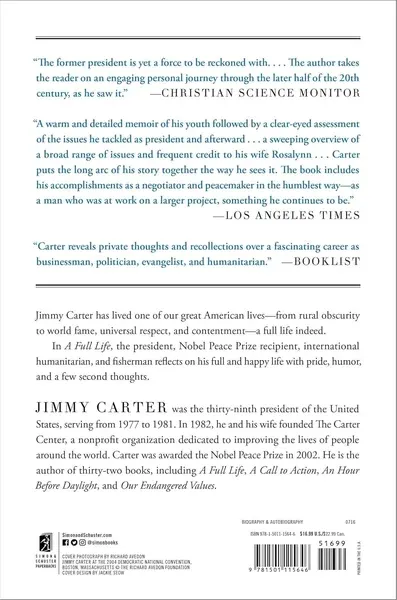
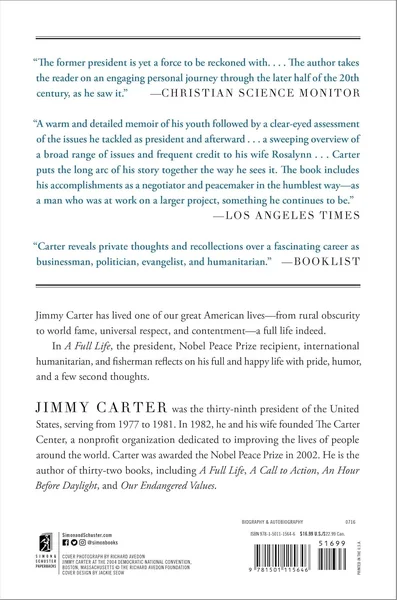
Back cover with review quotes praising Carter's memoir and biographical information about the author.
Published by Simon & Schuster, originally in July 2015 and subsequently in a paperback reprint edition, A Full Life is structured as a chronological sweep through Jimmy Carter's nine decades. The memoir opens with Carter's childhood in the Georgia countryside, traces his early political career through the Georgia Senate and his gubernatorial campaign, and moves into his White House years. Carter organizes the challenges of his presidency into two categories — "Issues Mostly Resolved" and "Problems Still Pending" — the first encompassing subjects such as Rhodesia, the B-1 bomber, the rescue of New York City and Chrysler, and the SALT II Treaty; the second covering enduring concerns including drug policy, nuclear proliferation, special interests, and intelligence agencies. The memoir also addresses Carter's post-presidential decades: his work with The Carter Center, his efforts toward peace and global health, and personal pastimes including painting, fishing, and woodwork. Booklist, as quoted by Barnes & Noble, describes the book as revealing "private thoughts and recollections over a fascinating career as businessman, politician, evangelist, and humanitarian."

Historical Significance and Place in the Record

Carter arrives at this memoir as a Nobel Peace Prize laureate and the author of nearly thirty other books, which shapes both the appeal and the limitations of A Full Life. Wikipedia notes that the book was commended upon release for its historical significance and its contributions to understanding modern American politics, with many observers praising Carter's honesty and directness. The Star Tribune frames the book as best understood as a supplement to Carter's earlier Keeping Faith: Memoirs of a President, noting that it offers more on his personal life and values than on U.S. politics and public policy. That positioning matters: readers approaching A Full Life as a standalone political history will find less than those who treat it as a personal capstone to a long public record. The account of Carter's naval service and his family's time living in a housing project in the mid-1950s draws particular notice from Library Journal as especially compelling.

Strengths: Candor, Scope, and Self-Reflection

Where the memoir earns genuine credit is in its moments of personal candor. Carter acknowledges, for instance, that he decided to leave the Navy and later to enter politics without consulting Rosalynn — and that he is, in retrospect, appalled by those choices. The memoir also reflects on the profound influence of his mother and his complicated admiration for his father. These admissions give the book a texture of honest self-examination. The sheer arc Carter traces — from poverty in rural Georgia to the Oval Office to decades of international humanitarian leadership — is, as Publishers Weekly concedes, an inspiring story. Wikipedia records broad reader and critical praise for Carter's straightforwardness, and the book's New York Times bestseller status (described as such by Barnes & Noble) reflects genuine public appetite for this kind of reflective presidential voice.

Limitations: Depth, Specificity, and the Weight of Omission

Publishers Weekly offers the most pointed critique of A Full Life, calling it "an uneven volume" that is "largely a superficial treatment of events and personalities covered elsewhere in more depth, including by the former president himself." The review raises specific examples of what the memoir leaves unexamined: Carter offers no account of how he processed the suicide of a close Navy friend following a hazing incident, no exploration of what drew him so immediately to Rosalynn, and no substantive reflection on why a weekend with the dying Hubert Humphrey was among the most memorable of his life. These are not minor elisions — they are precisely the moments where a memoir of ninety years promises revelation and delivers a passing reference instead. Publishers Weekly also notes that Carter's treatment of the 1978 Camp David Accords — a landmark diplomatic achievement brokered between Menachem Begin and Anwar Sadat — attributes its success largely to a personal gesture Carter made toward Begin's grandchildren, a framing the outlet finds insufficient for an achievement of that magnitude.

Who This Book Is For

A Full Life finds its most natural audience among readers who already have some familiarity with the Carter record and are looking for a personal, reflective coda rather than a definitive political analysis. Those new to Carter's story may find the breadth of his life genuinely illuminating, though Publishers Weekly cautions that even first-time readers are likely to encounter frustration at events gestured toward but not fully explored. The Star Tribune's framing — as a companion to Keeping Faith rather than a replacement — is perhaps the most practically useful guidance: readers who bring prior context will get the most from Carter's retrospective voice, his self-assessments, and his account of the values that shaped a career spanning farming, the Navy, the statehouse, the White House, and decades of global advocacy.

Sources & Further Reading

The key facts and claims in this review are grounded in the retrieved, verified sources listed below.

  1. 1
    Jimmy Carter — author profileHigh-authority source

    Jimmy Carter, Wikipedia

  2. 2
  3. 3
  4. 4

    en.wikipedia.org

  5. 5
  6. 6
  7. 7
  8. 8
  9. 9