

7 min read
4.6
· 15,930 Amazon ratingsShare This Review
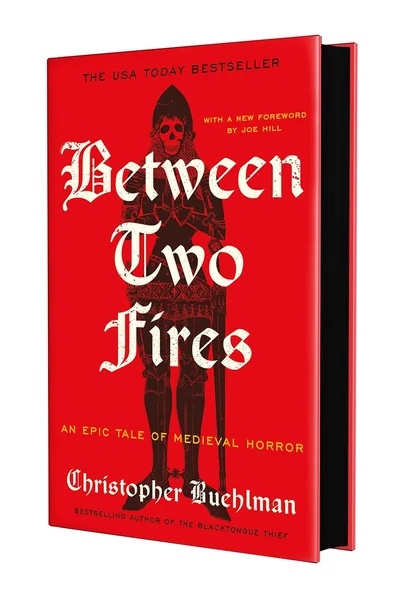
Between Two Fires by Christopher Buehlman Review: Dark Medieval Horror of Devastating Ambition
Originally published in 2012 and now reissued by Tor Nightfire, Between Two Fires is a historical horror novel set during the Black Death, following a disgraced French knight, a visionary girl, and a fallen priest on a harrowing journey across plague-ravaged France — a book that blends cosmic theological warfare with earthy, lyrical prose to powerful effect.
 Tap to enlarge
LuvemBooks Verdict
Best for
Readers of literary dark fiction who want medieval history treated as lived reality — Heaven, Hell, and the Black Death as cosmological fact — and who are drawn to flawed, disgraced protagonists navigating both human vengeance and cosmic warfare.
Worth it if
The sustained brutality and theological density pay off richly for readers willing to engage with medieval Catholic cosmology on its own terms and who prize prose that balances lyrical writing with dark, gallows humor even amid unspeakable horror.
Skip if
Those who find unrelenting grimness — plague, violence, sexual assault, and the deaths of central characters rendered without softening — punishing rather than cathartic, or who prefer horror that keeps its supernatural stakes at an ironic distance, should approach with caution.
What readers & critics say
Kirkus Reviews called Buehlman "an author to watch," praising him as "two for two in delivering eerie, offbeat novels with admirable literary skill" and comparing the novel to "Cormac McCarthy's The Road meets Chaucer's Canterbury Tales." HorrorDNA called it "simply an incredible novel," praising Buehlman's rich, prosaic prose and the novel's hard-won emotional core: "hope exists and it's worth fighting for."
“An author to watch — two for two in delivering eerie, offbeat novels with admirable literary skill.”
— Kirkus ReviewsAge & Reading Level
Recommended age
Adult
Reading level
Adult
5 content notes · who it suits
Content to know about
Best for: Adults — graphic violence, sexual assault, and the on-page deaths of all three central characters make this unsuitable for younger readers.
Skip if you want horror that withholds its supernatural stakes or prefer escapist, comfort-oriented dark fiction.
Between Two Fires by Christopher Buehlman is Trending
Between Two Fires Gets the Netflix Treatment — And Readers Are Going Back to the Book
Christopher Buehlman's medieval horror novel is getting fresh attention thanks to a Netflix TV adaptation. The 2026 Tor Nightfire reissue means new readers can easily pick up the hardcover that's generating all the buzz.
Between Two Fires has been quietly beloved since its original 2012 release, but it's having a real moment right now thanks to a Netflix adaptation. Readers on Reddit are finishing the book and heading straight to the show — exactly the kind of word-of-mouth cycle that pulls a title back into the spotlight fast. Tor Nightfire timed a 2026 hardcover reissue perfectly, so there's a fresh edition on shelves just as people are looking for it.
For anyone who missed it the first time around, this is a genuinely compelling read: a disgraced French knight, a girl who sees angels, and a burned-out priest making their way across plague-ravaged 14th-century France while what amounts to a cosmic war between heaven and hell plays out around them. It's dark fantasy and horror wrapped together, with lyrical prose and real theological weight — the kind of book that gets compared to classics for good reason. Collider recently named it one of the best-written dark fantasy novels out there, and blurbs from Victoria Aveyard and Mark Lawrence don't hurt either.
If you're the type who likes to read the book before watching the adaptation, now's the time. The hardcover reissue is readily available, and this is one of those stories that genuinely rewards the investment.
In This Review
- What Works & What Doesn't
- What the Novel Is and What It Does
- The Scope of Its Horror
- Craft, Reception, and Significance
- Genuine Limitations to Consider
- Who This Novel Is For
What Works & What Doesn't
What Works
- Fuses rigorous Black Death historical setting with full-scale cosmic horror — Lucifer's war against Heaven is rendered literally, not as allegory
- Critically praised prose that balances lyrical writing with earthy, dark humor, as noted by both critical coverage and Tor.com's Alyx Dellamonica
- A compelling three-person ensemble — disgraced knight Thomas, visionary girl Delphine, and fallen priest Matthieu — grounds an epic supernatural conflict in human stakes
- Engages seriously with medieval theodicy and the question of why God permits mass catastrophe, giving the horror genuine thematic depth
What Doesn't
- The novel's sustained brutality — plague, violence, and the deaths of central characters — makes it demanding rather than escapist reading
- The dense theological and cosmological machinery of the final act requires readers to engage with medieval Catholic cosmology on its own terms
What the Novel Is and What It Does
The Scope of Its Horror
Craft, Reception, and Significance
Genuine Limitations to Consider
Who This Novel Is For
Frequently Asked Questions
Sources & Further Reading
The key facts and claims in this review are grounded in the retrieved, verified sources listed below.
- Cited in this review
- 1
barnesandnoble.com
- 2
- Further reading
- 3
Christopher Buehlman, Wikipedia
- 4
en.wikipedia.org
- 5
kirkusreviews.com
- 6
- 7
mypagebypaige.com
- 8
- 9
horrordna.com
- 10
grimdarkmagazine.com
- 11
joesnotesblog.com
- 12
Reader Comments
No comments yet
Be the first to share your thoughts!