Skip to content
Reviewed

Read Time

6 min read

Age & reading levelAdult
Reader rating
4.2 · 276 Amazon ratings, as of Oct 2026
reader ratings, not a LuvemBooks score
Curated & edited by

LuvemBooks Editorial

How we create our reviews →
Share This Review
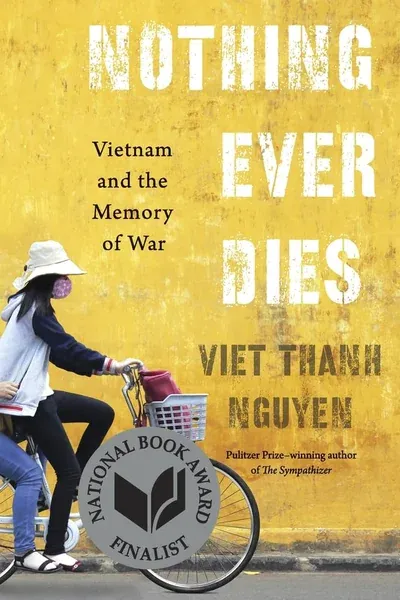
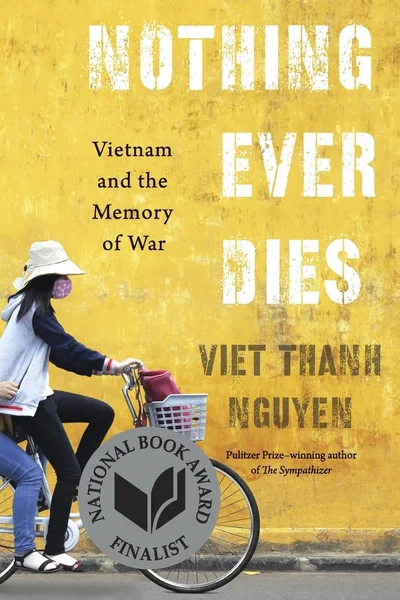
Nothing Ever Dies: Vietnam and the Memory of War by Viet Thanh Nguyen front cover

Our review

Nothing Ever Dies

Nothing Ever Dies: Vietnam and the Memory of War by Viet Thanh Nguyen Review: A Demanding but Rewarding Study of Remembered War

Viet Thanh Nguyen's Nothing Ever Dies: Vietnam and the Memory of War examines how the conflict is remembered across novels, memorials, films and museums in the US, Southeast Asia and Korea. It earns attention for its argument for a "just memory", though it is dense going.

Adultdiscussion of wartime violence and atrocity · civilian suffering and refugee displacement

LuvemBooks Verdict

Best for

Readers who want a demanding, argument-driven study of how the Vietnam War is remembered across novels, monuments, films and museums, rather than a narrative history of the fighting.

Worth it if

Worth reading if you can take on a dense, theory-inflected argument and want a framework for thinking about war memory that applies well beyond Vietnam.

Skip if

Skip it if you want battlefield history or a single storyline, or if you will find a scholarly, sweeping argument heavy going; one academic reviewer judged its theoretical sweep less than ideal for all but advanced undergraduates.

Kirkus Reviews calls it a powerful reflection on how we choose to remember and forget, and H-Net's reviewer David Kieran calls it thoughtful, comprehensive and important, while questioning whether 'forgetting' is the right term for some refugee silences.

“Essentially a critical study, Nguyen’s work is a powerful reflection on how we choose to remember and forget.”

— Kirkus Reviews
Sources: Kirkus Reviews, H-Net Reviews (H-Amstdy)
4.2from 276 Amazon ratings, as of Oct 2026— reader ratings, not a LuvemBooks score

Ask LuvemBooks

Was this helpful?

Nothing Ever Dies is Viet Thanh Nguyen's study of how the Vietnam War lives on in memory through novels, extending to Laotian, Cambodian, Korean and Southeast Asian American perspectives. It is a demanding, argument-driven book best suited to patient readers.
Is it worth reading?
It is worth it for readers who want a framework for thinking about war memory that extends beyond Vietnam. Reviewer David Kieran of Washington & Jefferson College, writing for H-Net, called it important and credited the thoroughness of its research. The cost is density: the same reviewer judged its theoretical depth challenging for all but advanced undergraduates.
Similar books
For Nguyen's own fiction on the same war, start with The Sympathizer, which is the novel that frames much of his thinking about memory and divided loyalties. Tim O'Brien's The Things They Carried approaches how soldiers remember Vietnam through story rather than analysis. Clint Smith's How the Word Is Passed offers a different national case of how public memory and commemoration are contested.
Who should read this?
It suits graduate students, scholars and committed general readers interested in public memory, war commemoration or Southeast Asian American history. Kieran recommended it as required reading for graduate courses on the Vietnam War and on public memory. Readers drawn to Laotian, Cambodian or South Korean perspectives, which national memorials often omit, will find the wider lens especially useful.
About Viet Thanh Nguyen
Viet Thanh Nguyen is a South Vietnamese-born American professor and novelist.
What are the main themes?
The book returns to how memorials tend to honor one's own people while demonizing the enemy or ignoring the other side's combatants and civilians. It sets this against ideas of unbounded empathy, forgiveness and self-deception, as Literary Review's Jonathan Mirsky noted in a line reproduced on the publisher's page. A central question is what reconciliation would require of both former foes and ourselves.
How does this compare to The Sympathizer?
The Sympathizer is a novel; this is an analytic study, so the experience differs sharply in pace and form. Readers who enjoyed the novel's ideas about memory and divided allegiance can see them argued directly here, but should expect scholarly prose in place of a spy narrative.
Summarize this book

Summarize this book

Nguyen holds that every war is fought twice, on the battlefield and again in memory, and he traces the second fight through cemeteries, memorials, films, photography, museum exhibits, video games and souvenirs. He visits sites across the United States, Southeast Asia and Korea, and he builds toward a proposal for a 'just memory' that honors both shared humanity and the inhumanity of war. It is a work of cultural analysis rather than an account of campaigns.

Follow up

Where does the book travel?
Is the book personal as well as scholarly?

Synthesized from verified book data & published reviews · How we review

Ask LuvemBooks

What would you like to know about Nothing Ever Dies?

Answers come from our editorial notes on this book. If we haven't covered something, we'll say so.

Readers often ask

Our Review

We review the evidence: published critics, reader verdicts and BookTube reviews, gathered and weighed with AI assistance and edited by LuvemBooks, rather than one reader's first-hand take.
Worth it, for readers who want a serious, demanding book about how wars are remembered rather than a history of the fighting itself. Viet Thanh Nguyen's study is an argument as much as a survey, and it rewards patience more than it offers easy takeaways.
This review draws on the publisher's description, the book's own front matter and published reviews, not on hands-on use of the book.
Nothing Ever Dies: Vietnam and the Memory of War by Viet Thanh Nguyen front cover

What Nothing Ever Dies: Vietnam and the Memory of War sets out to do

The book's premise is stated in its first lines: all wars are fought twice, once on the battlefield and again in memory. Nguyen, author of the Pulitzer Prize-winning novel The Sympathizer, examines the conflict Americans call the Vietnam War and Vietnamese call the American War.
He draws on novels, memoirs, cemeteries, monuments, films, photography, museum exhibits, video games and souvenirs, per the publisher's description. The book also reaches beyond the two main antagonists to Laotians, Cambodians, South Koreans and Southeast Asian Americans, whose memories are often left out of national commemoration.

The ethics of memory at the book's core

The central claim is that memorials tend to honor one's own people while demonizing the enemy or ignoring the other side's combatants and civilians altogether. Nguyen pairs this with a proposal for what he calls a "just memory," a phrase that titles the first chapter.
The publisher's description frames the moral demand as recognizing both shared humanity and ever-present inhumanity, a step it presents as necessary for reconciliation with foes and with ourselves. Reviewer David Kieran, writing for H-Net's H-Amstdy list, summarized the book as an argument for a new politics of memory built on cosmopolitanism's call for an unbounded empathy that extends to all.

Range of evidence: sites, screens and souvenirs

Nguyen visits sites across the United States, Southeast Asia and Korea, and the publisher's description presents the survey as a central strength. Kieran of Washington & Jefferson College called the book thoughtful, comprehensive and important, and credited the thoroughness of its research throughout.
The breadth is also the point: a war's meaning, the book argues, is made in a Vietnamese roadside cemetery and a video game alike. Excerpts from the book's opening pages show a personal frame as well, with Nguyen describing repeated returns to what people call his homeland, where his parents were born.
The praise printed on the publisher's page includes Kate Tuttle, who called it a "gorgeous, multifaceted examination" of the war. Jonathan Mirsky of the Literary Review praised its "unusually thoughtful consideration of war, self-deception and forgiveness"; both lines come from the publisher's promotional material rather than the outlets' own pages.
The book was a finalist for the National Book Critics Circle Award and the National Book Award in Nonfiction, and was named a New York Times Book Review "Year in Reading" selection, according to the same page.
Kieran's review is the most useful counterweight. He was not persuaded that "forgetting is the right term for how Vietnamese refugees treat the southern regime's violence in public commemoration, and suggested that Jay Winter's work on calculated silence would have added complexity. He called these not, in the end, substantial criticisms."

Who Nothing Ever Dies suits, and who may struggle

Kieran judged the book's theoretical dimensions and vast sweep less than ideal for all but the most advanced undergraduate classes, while calling it required reading for graduate courses on the Vietnam War and on public memory. General readers should expect a scholarly argument at roughly 384 pages in the Harvard University Press reprint, not a narrative history.
For those willing to take on that density, the payoff lies in a framework that applies well beyond Vietnam. Readers hoping for battlefield history or a single storyline will find something different from what they came for.

Sources & Further Reading

The key facts and claims in this review are grounded in the retrieved, verified sources listed below.

  1. Cited in this review
  2. 1
  3. 2
  4. 3
  5. Further reading
  6. 4

    Viet Thanh Nguyen, LuvemBooks

  7. 5
  8. 6
  9. 7
  10. 8
  11. 9
  12. 10

    Kirkus Reviews

Age & Reading Level

Recommended age

Adult

Content to know about

discussion of wartime violence and atrocity
civilian suffering and refugee displacement

Skip if you want battlefield history or a single narrative storyline rather than a scholarly argument about memory

From our readers

Reader reviews

Be one of the first readers to answer.

Read it? Was it right for you?

Books like Nothing Ever Dies

Curated picks for readers who enjoyed Nothing Ever Dies, with our reasoning for each match.