BOOKS
Published

Read Time

9 min read

Reader rating

4.8

· 31,697 Amazon ratings
reader ratings, not a LuvemBooks score
Curated & edited by

LuvemBooks Editorial

How we create our reviews →
Share This Review

Lonesome Dove by Larry McMurtry Review: The Definitive American Cattle-Drive Epic

Larry McMurtry's Pulitzer Prize–winning Western follows two retired Texas Rangers driving a herd from south Texas to Montana. It was a bestseller, inspired an acclaimed 1989 miniseries, and remains the benchmark of the modern Western.

LuvemBooks Verdict

Best for

Readers of epic, character-driven historical fiction willing to commit to a long novel — including Western skeptics, fans of the 1989 miniseries curious about the source, and anyone wanting the original before the announced Netflix adaptation.

Worth it if

Worth it if you can give a long novel room to breathe — per its original critics and later reviewers alike, the slow build pays off in a mythic-scale story whose characters land as specific, funny, flawed individuals rather than archetypes.

Skip if

Skip it if you want a fast-moving genre read — at 864 pages with a deliberately slow, whiskey-soaked opening stretch, its momentum is earned slowly, and its frank frontier violence and period attitudes make some chapters rough going.

Kirkus Reviews called it a "large, stately, and intensely powerful" novel built around a quest "misplaced in history," praising McMurtry for keeping it mythic without sacrificing the characters' sympathetic power. Independent reviewers echo that verdict with caveats: Luke Harkness admits it initially read as a generic cowboy story before the characters' transformative arcs won him over, Book Thoughts from Bed describes a masterfully spun but deliberately slow first third, and Words and Dirt notes its retrograde race and gender politics alongside its nuanced examination of frontier life.

A large, stately, and intensely powerful novel — a quest misplaced in history, in a landscape bare of buffalo but still mythic.

Kirkus Reviews
Sources: Kirkus Reviews, Luke Harkness, Book Thoughts from Bed, Novel Notions, Words and Dirt, Nick Wisseman
4.8from 31,697 Amazon ratings— reader ratings, not a LuvemBooks score
Buy on Amazon

Age & Reading Level

Recommended age

Ages 16+

Reading level

Adult

Content to know about

graphic frontier violence, including shootings and hangings
racial slurs and period attitudes of the 1870s West
frank depiction of prostitution and sexual situations

Best for: Adults / mature teens 16+ — frank frontier violence and period attitudes and language rendered without sanitizing

Skip if you want a quick, fast-starting genre Western — this is 864 pages and earns its momentum slowly by design

Trending Now
Trending

Lonesome Dove by Larry McMurtry is Trending

Updated Sep 17, 2026
In This Review
  • What Works & What Doesn't
  • A Cattle Drive as Grand Narrative
  • Its Place in the American Canon
  • What It Does Exceptionally Well
  • Genuine Limitations
  • This Edition and Who It's For

What Works & What Doesn't

What Works
  • Winner of the 1986 Pulitzer Prize for Fiction and a bestseller, with praise quoted on the publisher's page from Stephen King and Nicholas Lemann of The New York Times Book Review
  • Critics called it 'a masterly novel,' praising its mythic scale, suspense, and the sympathetic power of its characters
  • Unforgettable central pair — retired Rangers Gus McCrae and Woodrow Call — anchoring an epic cattle drive from south Texas to Montana
  • A legacy spanning the acclaimed 1989 miniseries with Tommy Lee Jones and Robert Duvall and a newly confirmed Netflix series adaptation
  • Stands alone while opening a four-book saga including Streets of Laredo, Comanche Moon, and Dead Man's Walk
What Doesn't
  • At 864 pages with a deliberately slow opening stretch, it demands real patience before the drive gets underway
  • Frontier violence and period attitudes and language are rendered frankly, which some readers will find rough
  • Its dual position — first published but third in the saga's internal chronology — forces newcomers to choose a reading order
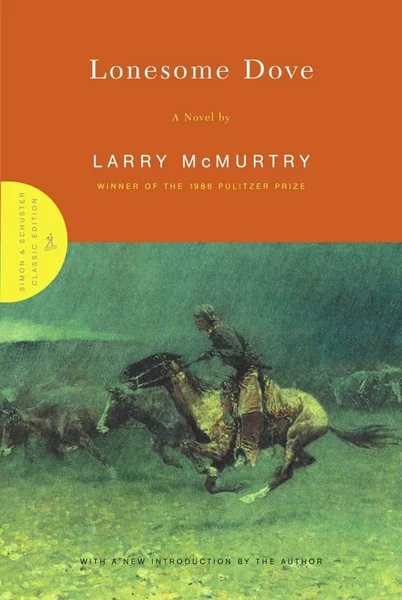
Lonesome Dove is one of the rare epics that lives up to its reputation: a Pulitzer Prize–winning Western whose sweep, humor, and human warmth have kept it in print and in readers' affections for four decades.
Lonesome Dove: A Novel by Larry McMurtry front cover

A Cattle Drive as Grand Narrative

Larry McMurtry's 1985 novel is built around one of the great journeys in American fiction. A band of retired Texas Rangers — most memorably Augustus "Gus" McCrae and Woodrow F. Call — has been living idly in dry, hard-drinking south Texas when they set out on a cattle drive to Montana, chasing the last days of the old, unsettled West. As critics described the construction, this is "an epic journey from dry, hard-drinking south Texas... To the last outpost and the last days of the old, unsettled West in rough Montana," a quest, in McMurtry's handling, "misplaced in history, in a landscape that is bare of buffalo but still mythic."
an epic journey from dry, hard-drinking south Texas... To the last outpost and the last days of the old, unsettled West in rough Montana
The novel announces its register from the first sentence. It opens, "WHEN AUGUSTUS CAME OUT on the porch the blue pigs were eating a rattlesnake-not a very big one." That dry, unhurried matter-of-factness — danger and comedy sharing a porch — is the book's signature: the frontier rendered not as legend but as a place where people actually lived, argued, ate, and bickered.

Its Place in the American Canon

Lonesome Dove won the 1986 Pulitzer Prize for Fiction and was a bestseller on publication. It is the first published book of the Lonesome Dove series, though it sits third in the series' internal chronology; McMurtry later extended the story with the prequels Dead Man's Walk and Comanche Moon and the sequel Streets of Laredo. McMurtry — the author of Terms of Endearment and The Last Picture Show, who died in 2021 — wrote twenty-nine novels, and the publisher describes this one as his loftiest and the grandest ever written about the last defiant wilderness.
The novel's standing is unusually broad. On the publisher's page, Nicholas Lemann critics is quoted saying that everything about it "feels true... These are real people, and they are still larger than life," and Stephen King is quoted naming it his pick for a favorite book. In 1989 it was adapted into a television miniseries starring Tommy Lee Jones and Robert Duvall that won both critical and popular acclaim, and Netflix has since confirmed a new ongoing series adaptation from co-showrunners Zoe Kazan and Jeb Stuart, with Diana Ossana, McMurtry's longtime creative partner, among the executive producers.

What It Does Exceptionally Well

The novel's great achievement, per its original reception, is marrying mythic scale to intimacy. Critics praised it as a "large, stately, and intensely powerful" work and called it "a masterly novel," singling out McMurtry's ability to keep the story mythic without "forfeiting a grain of the characters' sympathetic power or of the book's considerable suspense." That is the precise balance readers mean when they call it the Great American Novel of the West: an enormous canvas — a cattle drive spanning thousands of miles — populated by characters who register as specific, flawed, and funny individuals rather than archetypes.
The book also refuses easy nostalgia. The West Gus and Call ride into is already closing; the buffalo are gone, and the quest itself is an anachronism. McMurtry plays that elegy against the Rangers' very alive appetites and banter, which is why the novel reads as both celebration and elegy at once — the combination that has made it the standard against which subsequent Westerns, in print and on screen, are measured.

Genuine Limitations

The honest caveats are matters of form rather than quality. At 864 pages, this is a genuinely long book, and its first movement — the idle, whiskey-soaked life in Lonesome Dove before the drive begins — takes its time; readers expecting a fast start should know the novel earns its momentum slowly and by design. Its length also makes it a poor fit for anyone wanting a quick genre read, however rewarding the total arc is.
Readers should also be aware that the novel depicts frontier violence, and attitudes and language of its period, with the frankness of a book written about — rather than sanitized from — the 1870s West. That is part of the truthfulness its admirers praise, but it is not a gentle read in every chapter. And because it is the third book in the saga's internal chronology while being the first published, newcomers approaching the series today have to choose between publication order and chronological order; the novel itself, however, stands fully alone.

This Edition and Who It's For

The edition under review is Simon & Schuster's Classic hardcover (November 10, 2000), an 864-page volume with a durable shelf presence; the novel itself dates to 1985, and later printings have included anniversary editions with new forewords. Either way, the text being purchased is the complete Pulitzer-winning novel.
Who is it for? Readers of epic historical fiction who have somehow never gotten to it, first — it rewards the commitment the way few long novels do. It is equally suited to admirers of the 1989 miniseries curious about the source, to Western skeptics, since its humor and characterization routinely convert readers who think the genre is not for them, and to anyone anticipating the forthcoming Netflix adaptation who wants the original first. For readers who love character-driven storytelling on a vast canvas, Lonesome Dove is not merely recommended; it is close to required.

Sources & Further Reading

The key facts and claims in this review are grounded in the retrieved, verified sources listed below.

  1. Cited in this review
  2. 1
  3. 2
  4. Further reading
  5. 3
  6. 4
  7. 5
  8. 6
  9. 7
  10. 8
  11. 9
  12. 10
  13. 11
  14. 12