At a glance
LuvemBooks Verdict
Best for: Readers who want a single novel to satisfy both their literary and speculative fiction appetites — particularly those drawn to questions of art, memory, and what civilisation is actually for, rendered through interwoven human lives rather than genre mechanics.
Worth it? Skip it? Read the full verdict →Ask LuvemBooks
Was this helpful?
- Is it worth reading?
- Station Eleven has earned a genuinely rare double mandate: it won both the Arthur C. Clarke Award (the UK's premier science fiction prize) and the Toronto Book Award, was a finalist for the National Book Award, the PEN/Faulkner Award, and the Baileys Women's Prize for Fiction, and had sold 1.5 million copies as of 2020. Critics gave it a strong welcome upon publication, with Mandel's understated prose drawing particular and repeated praise. One blurb collected on the author's site describes it as reading 'like equal parts page-turner and poem,' and the Arthur C. Clarke Award committee specifically cited its focus on the survival of human culture — rather than survival itself — as what sets it apart. For readers willing to meet its quiet, contemplative register and nonlinear architecture, it represents a genuinely unusual achievement.
- Similar books
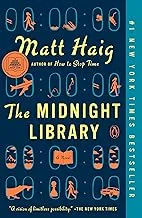
- Readers who respond to Station Eleven's blend of literary ambition and speculative premise will find strong company in several directions. Matt Haig's The Midnight Library shares the novel's meditation on alternative lives and what makes existence meaningful, while Donna Tartt's The Goldfinch — a National Book Award winner with a similarly sprawling ensemble and a central artwork that carries symbolic weight — rewards the same kind of patient, detail-attentive reading. Charles Yu's Interior Chinatown, another cross-genre literary prize winner, experiments with structure in ways that will appeal to readers who appreciated Mandel's nonlinear architecture. For those drawn to the family-spanning, time-shifting ensemble approach, Claire Lombardo's The Most Fun We Ever Had offers a comparably intricate web of interconnected lives. Mandel's own The Glass Hotel and Sea of Tranquility revisit overlapping themes and even some of the same characters, and Margaret Atwood's Oryx and Crake is a natural companion for the speculative-literary overlap.
- Who should read this?
- Station Eleven is built for readers who want literary fiction and speculative fiction to do the same work at the same time — those who find most post-apocalyptic fiction too bleak or too mechanical, and most literary fiction too uneventful. Its appeal spans readerships: it won the Arthur C. Clarke Award from the science fiction community while also being a finalist for the National Book Award and the Baileys Women's Prize for Fiction. Readers who enjoy structurally ambitious, ensemble-driven novels — particularly those with themes of memory, celebrity, art, and what civilization actually consists of — will find it rewarding. It is not the right fit for readers who prefer a single sustained protagonist, a linear narrative, or visceral survival action.
- About Emily St. John Mandel
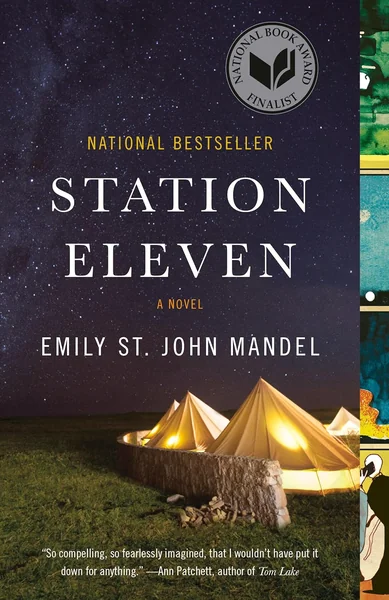
- Emily St. John Mandel is the author of Station Eleven.
- Tell me about the adaptation
- A ten-part HBO Max television series adaptation of Station Eleven premiered in December 2021. The series expands on the novel's world and has been credited with introducing Mandel's work to a significant new audience, contributing to the book's sustained sales trajectory. The novel's nonlinear, multi-timeline structure — one of its defining features on the page — was reimagined for the screen format.
- What are the main themes?
- Station Eleven is less interested in catastrophe's mechanics than in what catastrophe reveals about meaning, memory, and celebrity. Its central argument — made flesh through the Traveling Symphony's insistence on performing Shakespeare in a world stripped of electricity — is that civilization's worth lies in what it creates, not merely in who survives. The Arthur C. Clarke Award committee specifically cited this focus on the survival of human culture as what set the novel apart. Secondary threads explore how a world remade by collapse would still be haunted by the one that preceded it, and what we owe to the people who shaped us — embodied in the way Arthur Leander's legacy ripples through every character's post-collapse fate.
- Is this a good book club pick?
- Station Eleven is an exceptionally discussion-rich choice. Its themes — what art is for, what we owe to the people who shaped us, and what a civilization actually consists of — are explored through specific, concrete human lives that give groups plenty to debate. The novel's Canada Reads 2023 selection, championed by actor Michael Greyeyes, underscores its capacity to anchor wide, cross-demographic conversation. Its nonlinear structure and large ensemble cast also offer clubs the opportunity to discuss craft and form alongside content.
Summarize this book
Follow up
Synthesized from verified book data & published reviews · How we review
Press Enter to ask. Answers come from our editorial Q&A — start typing to see related questions.
Age & Reading Level
Recommended age
Adult
Reading level
Adult
2 content notes · who it suits
Content to know about
Skip if you want visceral survival action, relentless plot momentum, or a single linear protagonist carried through the narrative.
Editorial Review
Emily St. John Mandel's Station Eleven is a post-apocalyptic literary novel that traces interconnected lives before and after a devastating influenza pandemic, anchored by a quiet insistence that art and human culture are worth preserving at any cost.…
Read the Full ReviewBooks like Station Eleven
Curated picks for readers who enjoyed Station Eleven, with our reasoning for each match.