
BOOKS
Published
Read Time
8 min read
Share This Review
The Go-Giver by Bob Burg and John D. Mann Review: A Parable That Reframes Business Success
The Go-Giver is a business parable co-authored by Bob Burg and John D. Mann that uses the story of an ambitious young professional named Joe to argue that shifting one's focus from getting to giving is the true engine of lasting success. Originally published in December 2007 by Portfolio Hardcover, the book has since become a widely read title in the business self-help genre and ranked ninth on the 2008 Businessweek Best Seller list. This review is based on published sources and the book's documented content and reception — not hands-on application of its principles.
In This Review
- What Works & What Doesn't
- What the Book Actually Is and Does
- The Central Argument and Its Place in the Genre
- Reception and Cultural Reach
- Genuine Strengths: Accessibility and Narrative Drive
- Limitations and Who May Find It Wanting
What Works & What Doesn't
What Works
- Highly accessible parable format delivers its business philosophy through story rather than abstraction, making concepts memorable and easy to discuss
- Brief enough (144 pages) to be read in a single sitting, with no unnecessary padding
- The expanded edition adds a foreword by Arianna Huffington, a discussion guide, and a Q&A, extending its value for group and classroom use
- Ranked ninth on the 2008 Businessweek Best Seller list, reflecting broad, documented commercial and professional reach
- Introduces a clear, values-driven reframe of professional success that has resonated across sales, entrepreneurship, and leadership communities
What Doesn't
- The parable format prioritises inspiration over tactical depth — readers seeking data-backed frameworks or step-by-step implementation guidance will not find them here
- The book's optimistic narrative arc leaves little room for nuance, counterexamples, or discussion of when the 'go-giver' approach faces real-world friction
A business parable built around one quietly radical idea: that giving, not getting, is the foundation of real professional success.
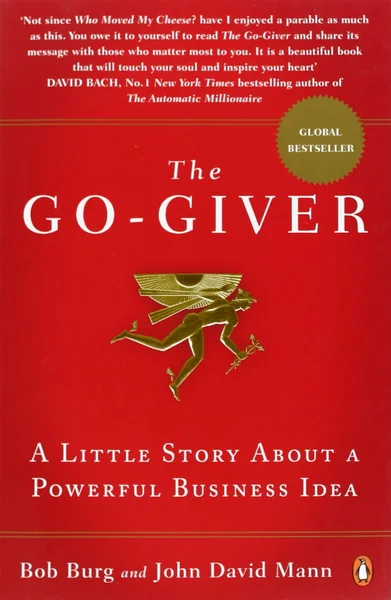
The Go-Giver: A Little Story about a Powerful Business Idea by Bob Burg front cover
What the Book Actually Is and Does
The Go-Giver is a business parable — a short, story-driven book that teaches principles through narrative rather than through conventional chapters of advice. Co-authored by Bob Burg and John D. Mann, it follows Joe, an ambitious young professional whose hard work has stopped translating into results following a disappointing sales quarter. Seeking help, he falls into the orbit of a figure known as The Chairman, who introduces him to a series of successful people — "Go-Givers" — each of whom teaches him one of the book's core principles about value, compensation, influence, authenticity, and receptivity. The parable format places it firmly in the tradition of books like Spencer Johnson's Who Moved My Cheese? — accessible, brief, and deliberately structured so that the lesson and the story reinforce each other. The book's own opening framing captures its central challenge directly: "Most people just laugh when they hear that the secret to success is giving… Then again, most people are nowhere near as successful as they wish they were."
The Central Argument and Its Place in the Genre
At its core, the book makes an argument that is at once simple and counterintuitive for a business audience: that the most effective path to professional achievement runs through generosity toward others, not through relentless self-promotion or transactional thinking. Joe's journey is designed to dramatize what Burg and Mann present as a series of interlocking "laws" — around creating value, building authentic relationships, and cultivating a mindset oriented toward what one can give rather than what one can extract. Since its first publication, the term "go-giver" has taken on a life of its own as shorthand for this philosophy, embraced across sales, entrepreneurship, and leadership communities. The book's enduring circulation and the expansion of its ideas into companion volumes and a curriculum suggest it struck a genuine chord in how a broad readership thinks about professional ethics and effectiveness.
Reception and Cultural Reach
The book ranked ninth on the 2008 Businessweek Best Seller list — a concrete early indicator of its commercial traction. Beyond sales, the book attracted notable endorsements: the authors' own site records praise from voices including the late Zig Ziglar, who connected its premise directly to his own long-held philosophy that helping others is the surest route to personal achievement. An expanded edition published in October 2015 added a foreword by Arianna Huffington, a new introduction, a discussion guide, and a Q&A with the authors — a package that signals both the book's staying power and the authors' intent to deepen its utility for groups and classrooms. A companion Teacher's Guide was released in December 2015. Across reader communities, the book is frequently cited as one that reshapes how people think about networking and sales — not merely as a motivational read, but as a reorientation of professional values.
Genuine Strengths: Accessibility and Narrative Drive
One of the most consistently noted qualities of the book is the efficiency with which it delivers its message. At 144 pages, it is designed to be completed in a single sitting, and the parable structure means readers absorb the principles through character and story rather than through abstraction. This makes the ideas unusually sticky — the format is engineered so that Joe's encounters with each Go-Giver give readers a human face to attach to each principle. The expanded edition's addition of a discussion guide extends this accessibility further, making the text usable in team, classroom, or book-club settings. For readers in sales or client-facing roles who find traditional business books dry or prescriptive, the narrative wrapper offers a distinct entry point.
Limitations and Who May Find It Wanting
The parable format that makes The Go-Giver broadly accessible is also its most frequently noted limitation. Readers who come to business books seeking data-backed frameworks, case studies, or granular implementation guidance will find the book deliberately light on those elements — its intent is inspirational and philosophical rather than tactical. The principles Joe learns are stated with clarity but are not broken down into step-by-step operational methods; the book trusts the reader to translate them into practice. Some readers comfortable with nuanced, research-grounded business literature — the kind that wrestles with failure modes or counterexamples — may find the parable's optimistic arc too smooth. The book is best understood as a values-setting read rather than a how-to manual, and readers approaching it with the latter expectation risk disappointment.
Frequently Asked Questions
What kind of book is The Go-Giver — is it a novel or a business book?
The Go-Giver is a business parable, meaning it delivers its lessons through a short narrative story rather than through conventional advice chapters. The review places it firmly in the tradition of books like Spencer Johnson's Who Moved My Cheese?, describing it as accessible, brief, and deliberately structured so that the lesson and the story reinforce each other.
Who wrote The Go-Giver?
The Go-Giver is co-authored by Bob Burg and John D. Mann. While Bob Burg's name appears most prominently on the cover, the review notes that both authors contributed to the work and are featured in a Q&A included in the expanded 2015 edition.
What is the central argument of The Go-Giver?
The book argues that the most effective path to professional achievement runs through generosity toward others, not through relentless self-promotion or transactional thinking. The review describes this as a simple but counterintuitive idea for a business audience — that giving, not getting, is the foundation of real professional success.
Who is Joe and what is his role in the story?
Joe is the book's protagonist, described in the review as an ambitious young professional whose hard work has stopped translating into results following a disappointing sales quarter. His journey through the parable serves as the vehicle through which the book's core principles about value, compensation, influence, authenticity, and receptivity are introduced.
Who is The Chairman and what does he do in the story?
The Chairman is a figure Joe falls into the orbit of while seeking help with his stalled career. According to the review, The Chairman introduces Joe to a series of successful people — called Go-Givers — each of whom teaches Joe one of the book's core principles through their own example and experience.
What are the five principles or laws taught in the book?
The review describes the principles as interlocking laws centered on creating value, building authentic relationships, and cultivating a mindset oriented toward what one can give rather than what one can extract. The specific principles are associated with the themes of value, compensation, influence, authenticity, and receptivity, each taught by a different Go-Giver character Joe meets.
What does the term go-giver mean?
The review explains that since the book's first publication, the term go-giver has taken on a life of its own as shorthand for a philosophy of professional generosity and service. It has been embraced across sales, entrepreneurship, and leadership communities as a way of describing someone whose approach to business is oriented around what they can give rather than what they can extract.
How long is The Go-Giver and can you read it in one sitting?
At 144 pages, The Go-Giver is designed to be completed in a single sitting, according to the review. Its brevity is cited as one of its genuine strengths, allowing readers to absorb the full arc of Joe's journey and all five principles in one focused read.
Is The Go-Giver good for book clubs or team reading?
The review highlights this as a practical strength of the book, particularly the expanded 2015 edition, which added a discussion guide that extends the text's accessibility for team, classroom, or book-club settings. A companion Teacher's Guide was also released in December 2015, further supporting group use.
What was added in the expanded 2015 edition of The Go-Giver?
The expanded edition, published in October 2015, added a foreword by Arianna Huffington, a new introduction, a discussion guide, and a Q&A with the authors. The review notes this package signals both the book's staying power and the authors' intent to deepen its utility for groups and classrooms.
Sources & Further Reading
The key facts and claims in this review are grounded in the retrieved, verified sources listed below.
- 1
en.wikipedia.org
- 2
- 3
- 4
- 5
- 6
Reader Comments
No comments yet
Be the first to share your thoughts!