
How Robert Moses Reshaped New York City's Infrastructure Forever
Robert Moses built 13 bridges, 416 miles of parkways, and hundreds of parks without ever winning an election. Here's how he physically remade New York City.
6 min read
Between roughly 1924 and 1968, one man — never elected to any office — decided where New York's highways would run, which neighborhoods would be bulldozed for housing projects, where working-class families could swim, and how the city would grow outward into its suburbs. Robert Moses held as many as twelve public positions simultaneously, wielding a bureaucratic authority so carefully constructed that mayors, governors, and even presidents found themselves unable to dislodge him. The physical New York that exists today — its expressways, its bridges, its park system, and much of its public housing — is largely his invention.
The Infrastructure of Leisure: Parks and Beaches
Moses's career began not with concrete and steel but with sand. Appointed president of the Long Island State Park Commission in 1924, he set about acquiring shoreline that wealthy landowners had kept off-limits to ordinary New Yorkers for generations. Jones Beach State Park, which opened in 1929, became his signature early achievement — a meticulously designed public beach stretching nearly seven miles, capable of accommodating hundreds of thousands of visitors on a summer weekend. The parkways Moses built to reach it were themselves architectural statements: gracefully landscaped, intentionally pleasant to drive. Moses understood that infrastructure is never just functional; it is also rhetorical.
Within New York City itself, Moses rebuilt or created 658 playgrounds, added acres to existing parks, and constructed public swimming pools in neighborhoods that had never had them. The pools — built largely between 1936 and 1938 using New Deal federal funds — were genuine feats of speed and scale. Eleven pools opened in a single summer. Whatever else Moses did with that power, his early park-building democratized outdoor recreation for millions of city residents who had no other access to it.
The Highway Network That Defined — and Divided — the City
Moses was a convert to the automobile at a moment when most urban planners still thought in terms of streetcars and rail. From the 1930s onward he designed a road network that privileged the car with a completeness that no other American city had yet attempted. The Belt Parkway, the Henry Hudson Parkway, the Saw Mill River Parkway, the Cross Bronx Expressway — each project reorganized the city's geography around the movement of private vehicles. By the time he was finished, Moses had overseen the construction of 13 bridges and 416 miles of parkway.
The Cross Bronx Expressway, completed in 1963, demonstrated the human cost of this vision most nakedly. To push a six-lane highway through the densely populated South Bronx, Moses's workers demolished apartment buildings that housed roughly 60,000 people. Relocation assistance was minimal and largely ineffective. The neighborhoods on either side of the new road — Tremont, East Tremont — went into a decline from which some have never fully recovered. Critics, most notably the urbanist Jane Jacobs, argued that Moses treated displacement as an administrative inconvenience rather than a moral problem. Jacobs successfully organized community opposition to Moses's proposed Lower Manhattan Expressway in the 1960s, one of the few times he was stopped.
Moses understood that once concrete was poured, politics became nearly irrelevant — the road was the argument, and it had already won.
Public Housing and the Architecture of Segregation
As chairman of the New York City Housing Authority — a post he held starting in 1946 — Moses shaped the construction of vast public housing projects that concentrated poverty in specific boroughs, and specifically in nonwhite neighborhoods. He favored high-rise towers set in open superblocks, a design philosophy borrowed from Le Corbusier that stripped away the street-level commercial life Jacobs and others identified as essential to safe, functioning neighborhoods. The projects were not incidentally segregated; evidence assembled by historians suggests Moses actively steered Black and Puerto Rican tenants toward certain developments and away from others.
His influence over Title I urban renewal funds — federal money meant to clear 'slums' and spur redevelopment — gave him additional leverage over who lived where in the postwar city. Critics charged that 'slum clearance' was a euphemism for removing minority communities from land developers wanted. Lincoln Center for the Performing Arts, completed in stages during the 1960s, was built on the site of a neighborhood called San Juan Hill, home to a large Puerto Rican population that was displaced without meaningful consultation. The irony that one of the city's great cultural monuments sits on that erasure has never quite faded.
The Source of His Power — and Its Limits
Moses accumulated authority through a specific legal mechanism: the public authority. These bodies — the Triborough Bridge and Tunnel Authority being the most powerful — issued bonds to finance construction and then collected tolls to repay them. Because they were technically independent of city and state government, Moses could argue they were insulated from political interference. Over time, the revenue streams they generated made him nearly self-funding. He could commission projects, hire engineers, and break ground without waiting for annual budget appropriations. The result was a power base that outlasted governors and mayors alike.
His eventual fall, when it came, was almost anticlimactic. Governor Nelson Rockefeller, himself no stranger to institutional power, forced Moses out of the Triborough Authority in 1968 by merging it into the newly created Metropolitan Transportation Authority — an entity Moses did not control. Moses was 79. He had spent more than four decades remaking the physical landscape of the world's most complex city, and he left it permanently marked by his preferences: his love of the car over the train, his contempt for the street grid, his willingness to treat displacement as a cost of doing business.
A Legacy Still Being Reckoned With
The debate over Moses's legacy has intensified as cities confront the consequences of mid-century car-centric planning. Several of his expressways are now candidates for removal or redesign — the BQE (Brooklyn-Queens Expressway), which he routed along the Brooklyn waterfront in a way that cut off neighborhoods from the harbor, has been a subject of reconstruction discussions for years. Meanwhile, the parks, the pools, and Jones Beach remain genuinely beloved. The difficulty is that both things are true: Moses built infrastructure that gave millions of New Yorkers access to recreation and mobility, and he did so by destroying neighborhoods, entrenching segregation, and subordinating democratic accountability to technocratic will.
His story is ultimately about how much a single person can shape a city when institutional design allows concentrated authority — and how the structures built in one era outlast both the politics and the people that created them. New York is still, in measurable ways, the city Moses wanted it to be. Whether that is a triumph or a tragedy depends almost entirely on which part of the city you're standing in.
Where to Read More
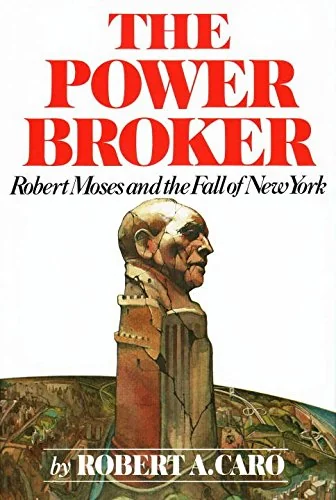
For the most thorough account of how Moses built and wielded this power, Robert A. Caro's The Power Broker (1974) remains the definitive source — a 1,300-page biography that is also one of the most penetrating studies of American political power ever written.
Frequently asked questions
How many projects did Robert Moses build in New York?
Moses oversaw the construction of 13 bridges, 416 miles of parkways, 658 playgrounds, hundreds of parks, and dozens of public housing projects over roughly four decades. He also shaped major cultural institutions, including Lincoln Center, through his control of federal urban renewal funding.
Why was Robert Moses so powerful if he was never elected?
Moses built his power through public authorities — quasi-independent agencies like the Triborough Bridge and Tunnel Authority — that issued bonds and collected tolls without needing annual government approval. This financial independence made him nearly impossible for elected officials to control or remove.
How did the Cross Bronx Expressway affect the Bronx?
Construction of the Cross Bronx Expressway, completed in 1963, displaced an estimated 60,000 residents and destroyed established neighborhoods like East Tremont. The resulting disruption accelerated population flight and economic decline in the South Bronx that persisted for decades.
Did Robert Moses intentionally segregate New York City?
Evidence compiled by historians, including Robert Caro, indicates Moses directed Black and Puerto Rican residents toward specific housing projects and used urban renewal programs to displace minority communities from desirable land. Most scholars consider the segregationist outcomes of his policies to have been deliberate rather than incidental.
When did Robert Moses lose his power?
Moses was effectively removed from power in 1968 when Governor Nelson Rockefeller merged the Triborough Bridge and Tunnel Authority into the new Metropolitan Transportation Authority, an agency Moses did not lead. Moses was 79 at the time and never regained significant institutional authority.