A Voice That Demands to Be Heard
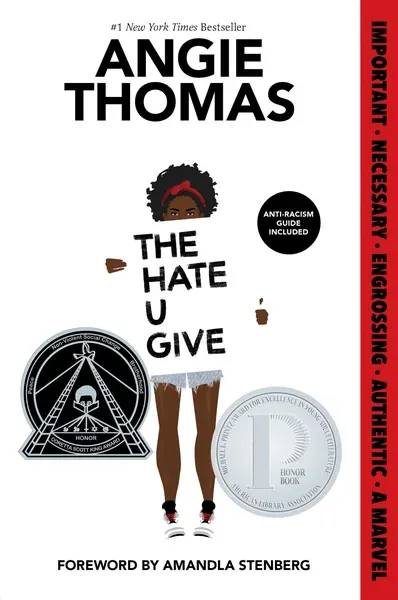
Angie Thomas didn't just write a young adult novel—she created a cultural phenomenon that bridges the gap between teen fiction and urgent social commentary. The Hate U Give tackles police brutality, systemic racism, and the exhausting reality of code-switching with a directness that many adult novels avoid. The question isn't whether this Printz Honor winner is well-written (it undoubtedly is), but whether its unflinching examination of violence and injustice makes it appropriate for middle schoolers seeking their next read.
Readers familiar with Dear Martin by Nic Stone will recognize similar themes, though Thomas approaches the subject through the lens of community activism rather than philosophical questioning. Where Jason Reynolds's All American Boys focuses on the immediate aftermath of police violence, Thomas expands the scope to examine how trauma ripples through families and neighborhoods.
Starr's World: Garden Heights Meets Williamson Prep
The brilliance of Thomas's character development lies in her refusal to simplify Starr Carter's experience. Starr isn't just a teenager who witnesses a tragedy—she's a young woman constantly navigating between her authentic self in Garden Heights and the version of herself that feels safe at Williamson Prep. This code-switching, the exhausting practice of altering speech patterns and behavior to fit different environments, becomes one of the novel's most powerful themes.
Khalil Harris, whose death catalyzes the entire narrative, emerges as more than a victim through Starr's memories. Thomas skillfully reveals his complexity—a young man caught between family loyalty, economic necessity, and the limited choices available in his community. The supporting characters, from Starr's activist parents to her boyfriend Chris who struggles to understand her reality, feel authentic rather than constructed to serve the plot.
Prose That Punches Without Preaching
Thomas writes with the rhythm of authentic teen speech while maintaining literary sophistication that earned the novel its critical acclaim. Her dialogue captures the natural flow of conversation without falling into stereotypes or overexplained exposition. The narrative voice stays true to Starr's perspective—angry, confused, hopeful, and devastated in turns—without becoming preachy or didactic.
The author's background shows in her understanding of what resonates with young readers. She doesn't shy away from harsh realities, but she also doesn't exploit trauma for emotional manipulation. The violence is present but not gratuitous, described with enough detail to convey impact without becoming graphic for shock value.
Themes That Transcend Age Categories
The novel's exploration of police brutality themes extends beyond individual incidents to examine systemic issues. Thomas weaves in discussions of respectability politics, the school-to-prison pipeline, and economic inequality without turning the narrative into a sociology textbook. The famous "THUG LIFE" acronym—"The Hate U Give Little Infants F***s Everybody"—borrowed from Tupac Shakur, becomes a lens for understanding how societal neglect creates cycles of violence.
More importantly, the book demonstrates how young people can find their voice in the face of injustice. Starr's journey from silence to activism feels earned rather than imposed, showing the messy, non-linear process of finding courage to speak truth to power.
Content Considerations for Young Readers
Here's where parents and educators need to carefully consider their audience. The Hate U Give contains strong language, including racial slurs used in context to demonstrate their impact. The central incident involves a fatal police shooting, and while not graphically described, the emotional trauma is unflinching. Drug dealing appears as part of the community reality, presented as both economically motivated and morally complicated.
The novel also addresses teen sexuality in age-appropriate ways and touches on domestic violence within families. These elements serve the story's authenticity rather than existing for sensationalism, but they require mature readers who can process complex social issues.
Where It Soars and Where It Stumbles
Thomas's greatest strength lies in creating characters who feel like real teenagers rather than adult projections of adolescent concerns. Starr's relationships with family and friends ring true, and her internal conflicts about identity and belonging resonate beyond racial lines.
However, some plot elements feel slightly constructed to serve thematic purposes. Certain confrontations seem designed to create teaching moments rather than emerging organically from character motivations. The resolution, while emotionally satisfying, perhaps wraps up some complex issues more neatly than real-world activism typically allows.
The novel's impact occasionally overshadows its craft—it's become such a symbol of important conversations that critical analysis can feel inappropriate. Yet honest assessment reveals a strong debut that occasionally shows its seams, particularly in pacing during the middle sections.
My Take: A Necessary Voice with Caveats
The Hate U Give succeeds as both compelling fiction and social commentary, a difficult balance that many novels attempt but few achieve. For mature middle schoolers and high school students, it offers an accessible entry point into crucial conversations about race, justice, and civic engagement.
The age appropriateness question depends heavily on individual maturity and family values around discussing police violence and systemic racism. The book works best with adult guidance for younger readers, not because the content is inappropriate, but because the themes deserve thoughtful discussion rather than solitary processing.
This isn't light entertainment—it's literature that demands engagement with difficult realities. But for readers ready to grapple with these issues, Thomas provides both emotional catharsis and a framework for understanding how individual actions can contribute to broader change.
Where to Buy
You can find The Hate U Give: A Printz Honor Winner at Amazon, your local bookstore, or directly from HarperCollins Publishers.