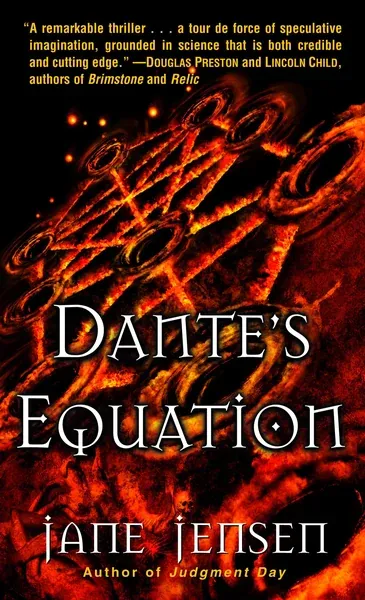
A Mind-Bending Journey Through Time and Consequence
Jane Jensen's "Dante's Equation" stands as a compelling entry in speculative fiction, weaving together quantum physics, religious mysticism, and moral philosophy into a narrative that challenges readers' perceptions of causality and choice. Published in 2003, this Jane Jensen novel demonstrates the author's ability to craft intellectually ambitious science fiction that doesn't sacrifice character development for theoretical complexity. For readers seeking thought-provoking alternatives to mainstream time travel stories like Timeline or 11/22/63, Jensen offers a uniquely philosophical approach to the genre's familiar themes.
The story operates on multiple timelines and locations, centering around a mysterious equation that appears to hold the key to understanding the relationship between good, evil, and the universe itself. Set primarily in Washington State during the 2000s, the narrative follows several interconnected characters whose lives become entangled with forces beyond their comprehension.
Characters Caught Between Science and Faith
Jane Jensen populates her novel with a diverse cast that bridges the gap between scientific inquiry and spiritual seeking. The story features women scientists navigating both professional skepticism and personal revelation, demonstrating Jensen's commitment to creating believable female characters who face realistic challenges in their field.
The novel also includes religious figures who provide spiritual anchoring, bringing Jewish mystical traditions into dialogue with cutting-edge physics. Their presence adds theological depth without falling into simplistic science-versus-religion debates. Instead, Jensen uses these characters to explore how ancient wisdom might inform contemporary scientific understanding.
The interplay between the various characters drives much of the novel's emotional weight, grounding its high-concept elements in recognizable human concerns about purpose, morality, and connection.
Jensen's Ambitious Narrative Structure
The novel's greatest strength lies in Jane Jensen's willingness to tackle genuinely complex ideas about time, causality, and moral responsibility. Rather than using time travel as a simple plot device, she constructs a narrative framework where temporal manipulation carries genuine philosophical weight. The equation itself becomes more than a MacGuffin—it represents humanity's eternal struggle to understand its place in the cosmos.
Jensen's prose style balances accessibility with sophistication, making dense theoretical concepts comprehensible without oversimplifying them. Her background in game design becomes apparent in the novel's intricate plotting, where seemingly disparate elements eventually coalesce into a unified whole. The pacing builds steadily, allowing readers time to absorb the story's scientific and philosophical implications.
The author demonstrates particular skill in handling the novel's multiple storylines without losing narrative focus. Each character's journey contributes meaningfully to the overall themes, avoiding the scattered feeling that can plague ensemble narratives.
Where Ambition Meets Execution
While "Dante's Equation" succeeds in its intellectual aspirations, it occasionally struggles under the weight of its own complexity. Some readers may find the philosophical discussions overwhelming, particularly when Jensen delves deep into quantum mechanics and Kabbalistic interpretations. This Jane Jensen book demands active engagement from its audience—this isn't light entertainment but serious speculative fiction that requires concentration and patience.
The religious elements, while thoughtfully handled, may feel heavy-handed to readers seeking pure science fiction. Jensen's integration of Jewish mysticism with quantum physics creates fascinating parallels, but the execution sometimes feels forced rather than organic. Additionally, certain plot developments in the latter half feel rushed compared to the careful buildup of the opening sections.
The novel's ending, while thematically appropriate, may leave some readers wanting clearer resolution. Jensen prioritizes thematic coherence over conventional narrative satisfaction, a choice that works for the story's purposes but might frustrate those expecting traditional genre payoffs.
A Unique Voice in Speculative Fiction
Despite its flaws, "Dante's Equation" offers something genuinely distinctive in the science fiction landscape. Jane Jensen crafts a story that takes both its scientific and spiritual elements seriously, refusing to dismiss either perspective in favor of easy answers. The novel's exploration of moral responsibility across time creates genuinely thought-provoking scenarios that linger after reading.
The book works best for readers who appreciate hard science fiction with philosophical depth, particularly those interested in how religious traditions might inform scientific understanding. Fans of authors like Greg Bear or Kim Stanley Robinson will find familiar territory here, though Jensen brings her own unique perspective to these themes.
For readers of Jensen's other work, particularly her Gabriel Knight series, "Dante's Equation" demonstrates her ability to translate her storytelling skills from interactive media to traditional narrative fiction. This science fiction book review concludes that the novel stands as proof that speculative fiction can tackle serious ideas without sacrificing entertainment value.