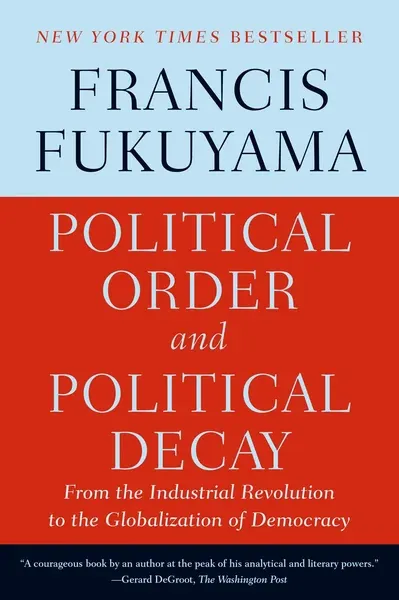
The Architecture of Institutional Decay
Fukuyama structures his analysis around three pillars of political order: the state, rule of law, and democratic accountability. His central thesis argues that political decay occurs when these institutions become rigid, captured by special interests, or misaligned with social and economic realities. The book traces this dynamic across centuries, from Britain's parliamentary evolution to America's contemporary gridlock.
The author's approach combines historical sweep with contemporary urgency. He examines how successful democracies like Denmark developed strong institutions while others, including the United States, face what he terms "political decay" - the gradual deterioration of governmental effectiveness. Fukuyama's analysis of American politics proves particularly sharp, arguing that the system has become "vetocracy" where too many veto points prevent necessary adaptation.
His methodology draws heavily on comparative historical analysis, examining cases from Europe, Asia, Latin America, and Africa. This global perspective distinguishes the work from more parochial analyses of democratic crisis, though it also contributes to the book's considerable length and complexity.
Dense Academic Prose Demands Commitment
Francis Fukuyama writes with the precision of an academic but lacks the narrative flair that makes complex political theory accessible to general readers. His sentences tend toward the lengthy and clause-heavy, packed with qualifications and subclauses that can obscure rather than illuminate his points. While this thoroughness serves scholarly accuracy, it creates a reading experience that feels more like graduate coursework than popular political commentary.
The book's organizational structure follows a logical progression, but individual chapters often feel disconnected from the broader argument. Fukuyama has a tendency to get lost in historical detail, spending pages on specific cases that illustrate his points but bog down the narrative momentum. Readers expecting the punchy analysis of The End of History will find this a more laborious read.
Despite these stylistic limitations, Fukuyama's insights reward careful attention. His analysis of how democratic institutions can become self-defeating - creating so many checks and balances that effective governance becomes impossible - offers valuable perspective on contemporary political frustrations.
Rather than focusing on individual personalities, Francis Fukuyama examines institutional actors and systemic forces. He traces how bureaucratic development in Prussia created a model that influenced global administrative practices, while analyzing how American political parties evolved from instruments of democratic participation into vehicles for special interest capture.
The book pays particular attention to reform movements and their leaders, from Progressive Era reformers who professionalized American government to contemporary figures attempting to modernize democratic institutions. Fukuyama's treatment of these figures emphasizes their institutional context rather than personal characteristics, fitting his broader theoretical framework.
His analysis of failed states and successful democratic transitions illuminates how leadership matters less than institutional design. This systemic focus provides valuable perspective but sometimes feels bloodless compared to more personality-driven political narratives.
Themes of Adaptation and Institutional Sclerosis
The book's central theme concerns the tension between institutional stability and adaptive capacity. Fukuyama argues that successful political systems must balance continuity with flexibility, maintaining legitimacy while evolving to meet new challenges. Political decay occurs when this balance tips too far toward rigidity or instability.
His concept of "political decay" goes beyond simple corruption or inefficiency to encompass institutional misalignment with social reality. American democracy, in Fukuyama's analysis, suffers not from lack of democratic values but from institutional structures designed for an 18th-century agrarian society struggling to govern a 21st-century complex economy.
The book also explores how different cultural and historical contexts shape institutional development. Fukuyama's comparative approach reveals why certain democratic models succeed in some contexts but fail in others, challenging universal prescriptions for democratic development.
Where Ambition Exceeds Execution
Political Order and Political Decay succeeds as a comprehensive survey of institutional development but struggles to maintain narrative coherence across its sweeping scope. Francis Fukuyama's ambition to cover centuries of political evolution in dozens of countries results in analysis that often feels superficial despite its length. Individual case studies rarely receive sufficient depth to fully support his theoretical claims.
The book's contemporary relevance proves both a strength and weakness. While Fukuyama's analysis of American political dysfunction resonates strongly, his prescriptions for reform remain disappointingly vague. After extensively diagnosing institutional problems, his solutions feel underdeveloped and overly theoretical.
Fukuyama also tends to underestimate the role of economic inequality and technological change in driving political transformation. His institutional focus, while valuable, sometimes obscures how material conditions shape political possibilities.
A Worthwhile Challenge for Serious Readers
Political Order and Political Decay rewards readers willing to engage seriously with complex political theory, but it demands significant intellectual investment. The Francis Fukuyama book works best as a reference text for understanding institutional development rather than a compelling narrative about democratic crisis.
Academics, policy professionals, and deeply engaged citizens will find valuable insights in Fukuyama's comparative analysis and theoretical framework. General readers seeking accessible commentary on contemporary politics should consider starting with more approachable works before tackling this academic tome.
The book's enduring value lies in its systematic approach to understanding how political institutions develop, adapt, and decay over time. While not an easy read, it provides essential perspective for anyone seeking to understand democracy's contemporary challenges beyond partisan talking points.