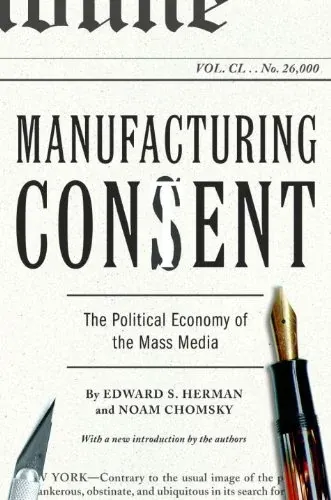
Herman and Chomsky construct their argument around five "filters" that shape news content before it reaches the public. These aren't conspiracy theories but observable economic and institutional pressures: ownership concentration, advertising dependence, sourcing relationships with official institutions, organized criticism campaigns, and ideological frameworks.
The authors demonstrate how these filters work not through heavy-handed censorship but through subtler mechanisms—story selection, sourcing patterns, and framing choices that consistently favor establishment perspectives. Their analysis of how stories about U.S.-supported versus enemy atrocities receive dramatically different treatment remains one of the book's most compelling sections.
What makes this framework particularly powerful is its predictive capability. Rather than cherry-picking examples, Herman and Chomsky argue their model should generate testable hypotheses about news coverage patterns—a scientific approach to media criticism that sets it apart from more impressionistic analyses.
Academic Rigor Meets Accessible Outrage
The writing successfully balances scholarly methodology with righteous indignation. Herman's background in economics brings systematic analysis to media industry structure, while Chomsky's linguistic precision ensures arguments stay tightly focused. They present extensive documentation—hundreds of citations support their claims—without drowning readers in academic jargon.
Their case studies, particularly the contrasting coverage of atrocities in Cambodia versus East Timor, showcase meticulous research. They don't just assert bias; they quantify column inches, analyze headline language, and track story placement over time. This empirical approach lends credibility to arguments that could otherwise seem conspiratorial.
However, the prose can feel relentlessly prosecutorial. The authors rarely acknowledge complexity or competing explanations, presenting their model as comprehensively explanatory rather than one useful lens among many.
Rather than focusing on individual journalists or editors, Herman and Chomsky analyze structural roles within the media ecosystem. Walter Lippmann's theories are referenced as historical context, his concept of the "bewildered herd" providing background for their contemporary analysis.
The authors examine how sources like government officials and corporate spokespeople shape coverage not through explicit direction but through routine access patterns. They show how "expert" commentators from think tanks funded by corporate interests become regular voices, while perspectives challenging fundamental assumptions rarely receive platform space.
Their treatment of journalists themselves is notably nuanced—they're portrayed not as conscious propagandists but as professionals operating within constraining institutional frameworks that reward certain types of stories and sourcing patterns while penalizing others.
The Propaganda Model Under Digital Pressure
Written before the internet transformed media consumption, Manufacturing Consent focuses heavily on traditional gatekeepers—newspapers, television networks, and newsmagazines. This creates both limitations and unexpected relevance for contemporary readers.
The five-filter model anticipated many digital-age developments: platform monopolization, surveillance-based advertising models, and algorithm-driven content curation. Yet it didn't foresee how social media would democratize both information distribution and misinformation creation, potentially undermining some assumptions about centralized control.
The book's emphasis on manufactured consensus feels particularly relevant amid contemporary debates about "cancel culture" and ideological conformity, though readers across the political spectrum will find different lessons in its analysis.
Where Academic Theory Meets Activist Practice
Manufacturing Consent succeeds brilliantly as institutional analysis but struggles more as a guide for action. Edward S. Herman and Noam Chomsky excel at diagnosing systemic problems but offer limited prescriptions beyond general calls for alternative media and critical media literacy.
Their focus on structural constraints can feel deterministic, leaving little room for agency among journalists, audiences, or activists seeking change. The relentless critique, while intellectually powerful, sometimes veers toward hopelessness about possibilities for reform within existing institutional frameworks.
The book also reflects its era's assumptions about audience passivity. Contemporary research on active audience interpretation and participatory media culture suggests more complex relationships between media messages and public understanding than the somewhat mechanistic model implies.
A Foundational Text That Demands Wrestling
Manufacturing Consent remains essential reading for anyone serious about understanding media power, despite its limitations. The propaganda model provides analytical tools that remain relevant across changing technological and political contexts, even if specific applications require updating.
The book works best when readers approach it as one influential framework rather than a complete explanation. Its greatest contribution lies not in definitive answers but in systematic questions about how democratic discourse gets shaped by institutional pressures that operate largely outside public awareness.
Students, activists, and media critics will find invaluable analytical tools in this political economy media analysis, though they'll need to grapple seriously with the model's limitations and blind spots. The writing demands active engagement rather than passive consumption—fitting for a book arguing against manufactured consent.
You can find Manufacturing Consent at Amazon, independent bookstores, or directly from academic publishers who keep this influential media criticism book in print.