Haidt's Scientific Approach to Moral Psychology
Haidt brings rigorous academic credentials to this exploration—he's a social psychologist at New York University's Stern School of Business, with decades of research in moral psychology. His approach combines laboratory experiments, cross-cultural studies, and evolutionary psychology to build his argument systematically.
The book's strength lies in its empirical foundation. Rather than philosophical speculation, Haidt presents data from studies across cultures and political orientations. He demonstrates how moral intuitions vary dramatically between societies and even between liberals and conservatives within the same culture. This scientific grounding distinguishes the work from typical political analysis, offering readers evidence-based insights rather than ideological arguments.
Haidt's writing strikes an accessible balance, translating complex psychological concepts into clear prose. He avoids academic jargon while maintaining intellectual rigor, making the book readable for general audiences without sacrificing depth for specialists.
The Moral Foundations Framework
Central to Haidt's argument is his moral foundations theory, which identifies six psychological systems underlying moral judgment: care/harm, fairness/cheating, loyalty/betrayal, authority/subversion, sanctity/degradation, and liberty/oppression. This framework provides a structured way to understand moral disagreements.
The theory's power lies in its explanatory capacity. Haidt demonstrates how liberals and conservatives literally inhabit different moral universes—liberals prioritize care and fairness while conservatives draw more evenly from all six foundations. This isn't a value judgment but an empirical observation with profound implications for political discourse.
The framework helps explain why certain moral arguments fail to persuade across political lines. When liberals appeal solely to harm reduction or fairness, they're speaking a moral language that resonates with only part of the conservative moral spectrum. Conversely, conservative appeals to loyalty, authority, or sanctity often fail to register with liberal moral sensibilities.
Where Psychology Meets Politics
Haidt's analysis extends beyond individual psychology to examine group dynamics and political behavior. He explores how moral psychology shapes voting patterns, policy preferences, and political identity formation. The book offers particularly insightful analysis of how moral foundations manifest differently in American liberal and conservative thought.
The political implications are significant but Haidt resists partisan conclusions. Instead, he argues that both liberal and conservative moral perspectives offer valuable insights that societies need. Liberal emphasis on care and fairness drives social progress and protection of vulnerable groups, while conservative attention to loyalty, authority, and sanctity provides social stability and group cohesion.
This balanced approach makes the book valuable for readers across the political spectrum, though it may challenge strongly held beliefs on both sides. Haidt's willingness to critique liberal assumptions (from his position as a self-described liberal) lends credibility to his analysis of conservative moral reasoning.
Evolutionary Foundations and Group Selection
The book's most ambitious section explores the evolutionary origins of moral psychology. Haidt argues that humans evolved as groupish creatures, with moral intuitions shaped by both individual and group selection pressures. This evolutionary perspective provides a foundation for understanding why moral psychology includes seemingly contradictory impulses—individual compassion alongside tribal loyalty.
While fascinating, this section requires more careful reading. Haidt's arguments about group selection remain scientifically controversial, and he acknowledges the ongoing debates. Readers should approach these chapters as compelling hypotheses rather than settled science. The evolutionary framework enriches the analysis but isn't essential to the book's core insights about moral psychology and political behavior.
Limitations and Blind Spots
Despite its strengths, The Righteous Mind has notable limitations. The moral foundations theory, while useful, may oversimplify the complexity of moral reasoning. Critics argue that Haidt's framework reflects Western psychological categories and may not capture moral reasoning in all cultures adequately.
The book also shows its 2012 publication date in some political examples and references. While the core insights remain relevant, specific political analyses feel somewhat dated given the dramatic shifts in American politics over the past decade. Future editions would benefit from updated examples reflecting contemporary political dynamics.
Haidt's focus on American liberal-conservative differences, while illuminating, may not fully capture the moral psychology underlying other political movements or ideological frameworks that have gained prominence since publication.
Essential Reading for Understanding Political Division
The Righteous Mind succeeds as both scientific exploration and practical guide for navigating political differences. Haidt's insights offer tools for more effective political communication and deeper understanding of moral disagreement. In our current climate of political polarization, these tools feel particularly valuable.
The book's empirical approach provides a welcome alternative to purely ideological analysis of political behavior. Rather than dismissing opposing viewpoints as ignorant or malicious, Haidt offers a framework for understanding how reasonable people can reach dramatically different conclusions based on different moral priorities.
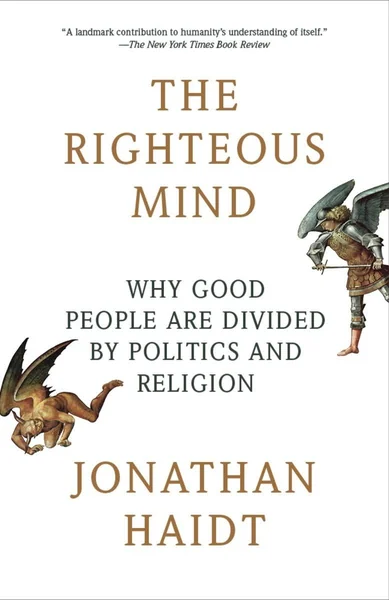
For readers seeking to understand political psychology beyond surface explanations, The Righteous Mind delivers substantial insights backed by rigorous research. While some sections require careful consideration and the political examples feel dated, the core framework remains highly relevant for anyone trying to understand why good people disagree so fundamentally about politics and morality.