From Bicycle Shop to Flight Pioneers
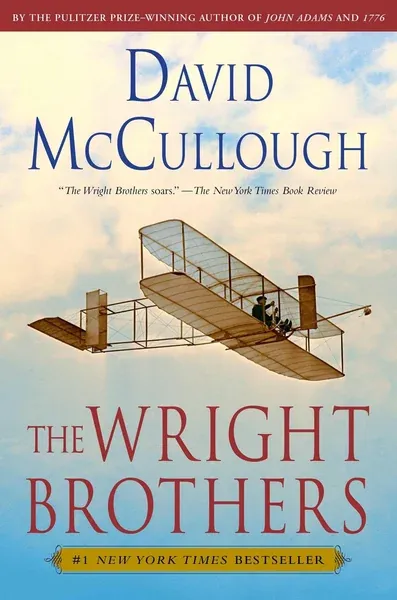
David McCullough's The Wright Brothers transforms what could have been a dry historical account into a riveting exploration of determination, ingenuity, and the audacity to dream of flight. This 2015 biography doesn't just chronicle Orville Wright and Wilbur Wright's path to Kitty Hawk—it reveals the methodical brilliance behind aviation's most famous breakthrough. For readers wondering is The Wright Brothers by David McCullough worth reading, the answer lies in McCullough's remarkable ability to make technical innovation feel intensely human.
Unlike Walter Isaacson's approach in Einstein or Ron Chernow's exhaustive treatment in Alexander Hamilton, McCullough keeps his focus laser-sharp on the Wright brothers themselves, their family dynamics, and the practical challenges they faced. The result is a biography that feels intimate despite covering one of history's most public achievements.
McCullough's Masterful Storytelling Craft
McCullough's prose style here exemplifies why he's considered one of America's premier narrative historians. He avoids the dense technical jargon that bogs down many aviation histories, instead crafting scenes that pulse with tension and discovery. His description of the brothers' methodical approach to solving the problem of flight reads like a detective story, with each experiment building toward the inevitable breakthrough.
The author's background as a Pulitzer Prize winner shows in his careful pacing and scene construction. He knows when to zoom in on personal details—like the brothers' devotion to their sister Katharine—and when to pull back for the broader historical context. The writing never feels rushed, allowing readers to appreciate both the technical challenges and the human cost of pursuing an impossible dream.
While Orville Wright and Wilbur Wright remain the central focus, McCullough skillfully introduces the supporting cast that made flight possible. Their father, Bishop Milton Wright, emerges not as a stern Victorian patriarch but as an unexpectedly supportive figure who encouraged his sons' mechanical curiosities. Their sister Katharine proves equally fascinating—a college-educated woman who managed the family's affairs and later became crucial to the brothers' European demonstrations.
The book also captures the rivalry with other aviation pioneers, particularly Samuel Langley, whose well-funded but ultimately failed attempts provide a stark contrast to the Wright brothers' methodical approach. McCullough presents these competitors not as villains but as fellow dreamers whose different methods highlight what made the Wright approach unique.
Perhaps most compellingly, McCullough reveals how the brothers complemented each other perfectly. Where Orville brought mechanical intuition, Wilbur provided the theoretical framework. Their partnership becomes a case study in collaborative innovation.
The Science Made Accessible
One of McCullough's greatest achievements here is making the technical aspects of early aviation comprehensible without dumbing them down. He explains the three-axis control problem that stymied other inventors in terms any reader can grasp, showing how the Wright brothers' background in bicycles gave them unique insights into balance and control.
The book traces their progression from initial glider experiments through the breakthrough moments that led to the Wright Flyer's success on December 17, 1903. McCullough doesn't just describe what happened—he explains why each innovation mattered and how it built on previous discoveries. The development of their wind tunnel, for instance, becomes a thrilling sequence about the power of systematic experimentation.
What emerges is a portrait of the scientific method in action, complete with dead ends, breakthrough moments, and the painstaking work that bridges the gap between theory and practice.
Where It Shines and Where It Limits
McCullough's greatest strength—his focus on the Wright brothers as individuals—occasionally becomes a limitation. Readers seeking a broader history of early aviation or detailed technical specifications might find the scope too narrow. The book touches on the brothers' post-Kitty Hawk struggles with patents and business ventures, but these later chapters feel less compelling than the buildup to flight.
The author also makes some curious omissions. The role of Charlie Taylor, the mechanic who built the Wright brothers' revolutionary engine, receives only brief attention. Similarly, the broader context of turn-of-the-century American innovation culture could have been explored more deeply.
However, these limitations pale beside McCullough's achievement. He takes a story everyone thinks they know and reveals layers of complexity and human drama that make it feel fresh. His research, drawing on the Wright family's extensive correspondence and diaries, provides insights unavailable to earlier biographers.
A Biography That Soars
The Wright Brothers succeeds because McCullough understands that the best biographies aren't just about their subjects—they're about the universal human qualities those subjects embody. Through Orville Wright and Wilbur Wright, he explores themes of perseverance, methodical thinking, and the courage to attempt the impossible.
The book works equally well for aviation enthusiasts seeking technical insight and general readers drawn to stories of American ingenuity. McCullough's gift lies in making both audiences feel they're discovering something new about these familiar figures. For anyone interested in how innovation actually happens—beyond the mythology of sudden inspiration—this biography offers a compelling case study in patience, preparation, and systematic problem-solving.
Where to Buy
You can find The Wright Brothers at Amazon, Barnes & Noble, your local independent bookstore, or directly from Simon & Schuster.