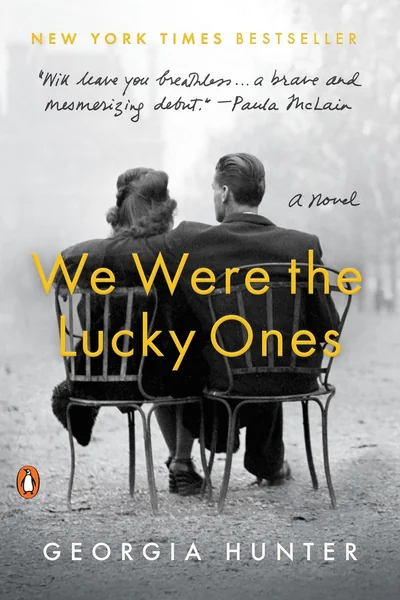
A Family Torn Apart by History
The novel opens in Radom, Poland, where the Kurc family enjoys their last peaceful Passover before the Nazi invasion changes everything. Hunter structures the narrative around multiple family members, each facing their own harrowing journey of survival. The parents remain in occupied Poland, while their adult children scatter across Europe, Siberia, and eventually South America.
Hunter's approach of alternating between different family members creates a panoramic view of how war destroys lives in countless ways. Rather than focusing on concentration camps, the novel explores the lesser-known stories of those who fled, hid, or were deported to Soviet labor camps. This broader perspective makes the Holocaust experience more comprehensive than many historical novels in this genre.
The author's decision to follow multiple storylines simultaneously means readers experience the war from various angles - the uncertainty of parents left behind, the desperation of refugees, and the grinding hardship of labor camps in Siberia.
Characters Forged by Impossible Choices
While the large cast of family members could have become overwhelming, Hunter develops each character with distinct voices and motivations. The family members face moral complexities that go beyond simple survival - they must decide whether to help strangers, how much to risk for family, and what compromises they're willing to make.
Hunter avoids the trap of making her characters either completely heroic or completely victimized. Instead, she shows how ordinary people adapt to extraordinary circumstances, sometimes making questionable decisions in the name of survival. The characters feel authentically human rather than idealized representations.
The relationships between family members evolve throughout the war years, with some bonds strengthening and others straining under pressure. Hunter particularly excels at showing how separation affects family dynamics and how people change when faced with extreme circumstances.
Themes of Resilience and Connection
The novel explores how families maintain emotional bonds across vast distances and years of separation. Hunter examines the role of hope in survival, showing how the possibility of reunion motivates characters to persevere through seemingly impossible conditions. The title itself reflects this theme - the recognition that survival often depends as much on chance as on personal strength.
Unlike many Holocaust novels that focus primarily on suffering, We Were the Lucky Ones emphasizes the human capacity for adaptation and the power of family connections to transcend physical separation. Hunter shows how letters, memories, and faith in eventual reunion sustain her characters through their darkest moments.
The novel also addresses the complex aftermath of survival - how those who escape carry guilt about those who didn't, and how families must rebuild relationships after years of separation and trauma.
Where the Narrative Struggles
Despite its emotional power, the novel faces structural challenges inherent in its multi-perspective approach. With so many characters and storylines, some sections feel rushed while others drag. The pacing becomes uneven, particularly in the middle sections where certain characters' experiences receive less development than others.
Hunter's prose, while clear and accessible, occasionally relies too heavily on exposition to convey historical context. Some scenes feel more like historical documentation than lived experience, which can distance readers from the emotional impact.
The novel's scope sometimes works against its intimacy. By trying to encompass so many experiences and perspectives, certain crucial moments don't receive the depth they deserve. The ending feels somewhat rushed considering the complexity of reuniting a family after such trauma.
A Powerful Addition to Holocaust Literature
We Were the Lucky Ones succeeds in bringing lesser-known aspects of Holocaust experience to light, particularly the stories of those who survived through flight rather than liberation from camps. Hunter's personal connection to the story adds authenticity to the historical details and emotional weight to the family dynamics.
The novel works best for readers who appreciate character-driven historical fiction and can handle multiple storylines. Those seeking a single, focused narrative might find the structure challenging, but readers interested in the broader scope of Holocaust experience will find valuable perspectives here.
The bottom line: We Were the Lucky Ones transforms family history into compelling fiction that honors both the specific experiences of one family and the broader tragedy of the Holocaust. While it has structural weaknesses, the emotional authenticity and historical insight make it a worthwhile read for those interested in World War II fiction that extends beyond the concentration camp narrative.