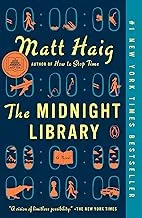
Matt Haig's The Midnight Library arrives with considerable fanfare—a GMA Book Club selection that promises profound insights about life's infinite possibilities. But does this metaphysical journey fall short of its ambitious premise? After analyzing Haig's approach to regret, choice, and alternate realities, the answer is more nuanced than the book's widespread popularity might suggest.
For readers drawn to philosophical fiction that tackles life's biggest questions, The Midnight Library occupies similar territory to books like Klara and the Sun by Kazuo Ishiguro, though with a more direct approach to existential themes. Where Ishiguro uses subtle allegory, Matt Haig opts for explicit metaphor—a choice that both clarifies and constrains his narrative.
A Library Between Life and Death
The central conceit is elegantly simple: Nora Seed finds herself in a mystical library that exists between life and death, where each book represents a different life she might have lived. Under the guidance of her former school librarian, Nora can experience alternate versions of herself—as a rock star, glaciologist, philosopher, or mother—searching for a life worth living.
Haig constructs this metaphysical space with careful attention to its rules and limitations. The library operates on a kind of cosmic logic: books disappear when their corresponding lives become impossible, and Nora's time is limited by her will to live. This framework provides structure for what could easily become an unfocused exploration of infinite possibilities.
The author's background in mental health advocacy informs the book's sensitive handling of depression and suicidal ideation. Rather than treating these as plot devices, Matt Haig presents them as genuine struggles that can't be solved simply by changing external circumstances.
Philosophical Ambition Meets Accessible Prose
Matt Haig writes with deliberate clarity, making complex philosophical concepts accessible to a broad readership. His prose avoids literary flourishes in favor of direct emotional impact. This approach serves the book's themes well—the language never obscures the ideas, and readers can focus on the ethical and existential questions Haig raises.
The pacing alternates between contemplative passages in the library and more dynamic sequences as Nora experiences different lives. Some transitions feel abrupt, but this mirrors the disorienting nature of sliding between realities. Haig maintains narrative tension through Nora's internal conflict rather than external plot mechanics.
Nora's Journey Through Infinite Possibilities
Nora Seed emerges as a genuinely sympathetic protagonist whose regrets feel authentically human. Her alternate selves reveal different facets of her personality while highlighting how circumstances shape identity. The rock star Nora possesses confidence the root Nora lacks, while the mother Nora experiences fulfillment tinged with different sorrows.
The librarian serves as both guide and philosophical sounding board, though this role occasionally feels more functional than fully developed. The character represents wisdom and acceptance, but the depth doesn't quite match the symbolic importance to the narrative.
The various alternate lives Nora experiences range from profound to mundane, and this variety strengthens the book's central argument about the complexity of happiness and fulfillment.
Exploring Regret and Radical Acceptance
The Midnight Library themes and meaning center on the dangerous seduction of "what if" thinking and the necessity of accepting our actual lives. Haig argues that every life contains both joy and suffering, success and failure, and that the search for a "perfect" life is ultimately futile.
The book explores how regret can paralyze us, preventing engagement with our present circumstances. Through Nora's journey, Matt Haig suggests that meaning comes not from having made different choices, but from making peace with the choices we did make. This message resonates particularly strongly in an era of social media comparison and endless possibility.
However, the philosophical framework sometimes feels overly neat. Real depression and existential crisis rarely resolve as tidily as Nora's does, and the book's optimistic conclusion, while emotionally satisfying, may oversimplify complex psychological struggles.
Where Philosophy Meets Popular Fiction
The Midnight Library succeeds as accessible philosophical fiction but stumbles when it veers toward self-help territory. Haig's earnest desire to provide comfort and insight occasionally overwhelms the narrative, resulting in passages that read more like motivational text than literary fiction.
The book's treatment of mental health, while well-intentioned, sometimes lacks the nuance such topics demand. The suggestion that perspective shifts can resolve deep psychological pain, while hopeful, may feel insufficient to readers experiencing genuine crisis.
The ending provides resolution that feels both inevitable and somewhat unearned. Nora's transformation occurs primarily through observation rather than action, which aligns with the book's passive protagonist but limits its emotional impact.
A Worthwhile Read Despite Its Limitations
Despite these criticisms, The Midnight Library offers genuine value for readers seeking thoughtful entertainment that engages with life's fundamental questions. Matt Haig's sincerity shines through every page, and his commitment to exploring difficult topics with compassion makes the book's flaws forgivable.
This Matt Haig book works best for readers who appreciate philosophical fiction without demanding literary complexity. Those seeking profound psychological insight might find it superficial, while readers wanting pure entertainment might find it too contemplative. It occupies a middle ground that will satisfy many without fully challenging anyone.
Where to Buy
You can find The Midnight Library: A GMA Book Club Pick: A Novel (The Midnight World) at Amazon, your local bookstore, or directly from the publisher.