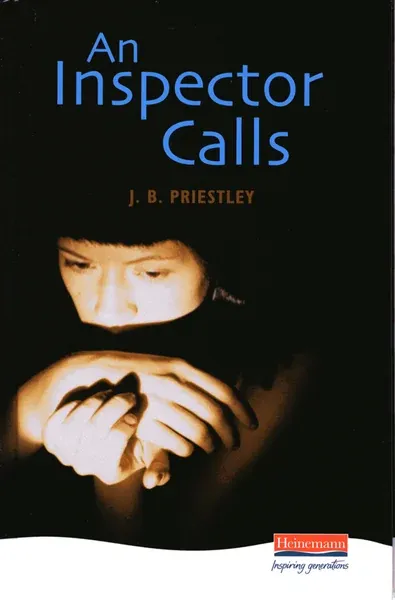
J.B. Priestley's An Inspector Calls delivers one of the most powerful critiques of social responsibility ever written for the stage. This Heinemann edition, specifically designed for students aged 14-16+, presents the complete 1945 play with supporting materials that illuminate why this drama remains fiercely relevant nearly eight decades after its premiere. For readers wondering is An Inspector Calls appropriate for teens, the answer is an emphatic yes—this play doesn't just entertain; it challenges young readers to examine their own moral compass and social obligations.
The cover design of this edition, featuring a young person's face cast in shadow, perfectly captures the play's exploration of hidden guilt and moral awakening. It's a visual metaphor that prepares readers for the psychological excavation they're about to witness.
A Night of Reckoning in Edwardian England
Priestley constructs his drama around a deceptively simple premise: a mysterious Inspector Goole arrives at the Birling family's comfortable home to investigate the suicide of a young working-class woman, Eva Smith. What unfolds is a masterful unraveling of middle-class complacency, as each family member discovers their role in driving Eva to despair.
Set in 1912 but written in 1945, the play operates on multiple temporal levels. Priestley uses dramatic irony brilliantly—characters speak confidently about the Titanic's safety and dismiss the possibility of war, while audiences know the catastrophes that await. This technique transforms what could be a preachy social message into sophisticated dramatic storytelling.
The Heinemann edition's educational apparatus helps teen readers navigate these layers without overwhelming them. The supporting materials explain the historical context essential for understanding Priestley's socialist critique of capitalism and class division.
Priestley's Theatrical Craft
The playwright demonstrates remarkable economy in his dramatic construction. The entire play unfolds in real time over a single evening, maintaining classical unities that intensify the psychological pressure. Priestley's dialogue crackles with subtext—characters rarely say exactly what they mean, forcing readers to decode the social and emotional currents beneath polite conversation.
The Inspector himself functions as both realistic character and symbolic force. His methodical questioning strips away the Birlings' respectability layer by layer, revealing the moral bankruptcy beneath their social success. Priestley walks a careful line here—the Inspector must seem plausible as a real police officer while serving as an agent of social justice and moral awakening.
For teen readers, this dual nature provides an excellent introduction to theatrical symbolism without sacrificing narrative engagement. The Inspector's final speech about collective responsibility reads as naturally arising from the investigation rather than feeling like inserted propaganda.
The Birling Family Under the Microscope
Each family member represents a different facet of bourgeois society's failures. Arthur Birling, the pompous businessman, embodies capitalist ruthlessness disguised as respectability. His wife Sybil represents the moral blindness of inherited privilege, while their children Eric and Sheila show different possibilities for redemption or moral awakening.
The character of Gerald Croft, Sheila's fiancé, adds another layer as someone from an even higher social class. His relationship with Eva Smith reveals the casual cruelty with which the wealthy treat working-class women as disposable objects.
What makes these characters compelling rather than mere types is Priestley's attention to psychological realism. Each person's response to the Inspector's revelations feels individually motivated while serving the play's larger themes. The younger generation's capacity for change contrasts sharply with their parents' defensive entrenchment.
Themes of Responsibility and Social Justice
The play's central argument—that we are all responsible for each other's welfare—emerges organically from the dramatic action. Priestley doesn't simply assert this principle; he demonstrates through the Birlings' interconnected cruelties how individual selfishness creates collective tragedy.
The theme of generational conflict runs parallel to the class critique. Sheila and Eric show potential for moral growth, while their parents retreat into justification and denial. This dynamic particularly resonates with teen readers navigating their own relationships with adult authority and inherited values.
The Inspector's famous final speech about "fire and blood and anguish" gains power from Priestley's historical perspective—writing after two world wars, he presents social responsibility not as idealistic sentiment but as practical necessity for civilization's survival.
Educational Value and Accessibility
This Heinemann edition succeeds in making classic drama accessible without dumbing it down. The play's structure—a mystery that gradually reveals deeper truths—naturally engages young readers while introducing sophisticated themes about morality, politics, and social change.
The language, while formal by contemporary standards, remains clear and powerful. Priestley writes in naturalistic dialogue that doesn't alienate modern readers, unlike some period dramas that feel museum pieces. Teen readers can focus on the moral and social questions rather than struggling with archaic vocabulary.
For classroom use, the play's manageable length and compelling central mystery make it ideal for sustained analysis. Students can examine how Priestley constructs dramatic tension, develops character through dialogue, and uses theatrical techniques to serve thematic purposes.
Why It Endures
An Inspector Calls transcends its specific historical moment because its fundamental questions remain urgent. How do we balance individual success with social responsibility? What obligations do we have to people outside our immediate circle? How do wealth and privilege blind us to others' suffering?
The play's structure—a comfortable family forced to confront uncomfortable truths—provides a template that works across cultures and historical periods. The Inspector's role as moral catalyst rather than conventional detective creates a drama that's simultaneously realistic and symbolic.
For contemporary teen readers, the play offers a powerful introduction to political theater that doesn't sacrifice dramatic effectiveness for ideological messaging. Priestley proves that social drama can be both intellectually rigorous and emotionally compelling.
You can find An Inspector Calls (Heinemann Plays For 14-16+) at major bookstores, online retailers like Amazon, or directly from Heinemann Educational Publishers.