When Life Gets Complicated, Laughter Becomes Essential
The Bed and Breakfast Star proves that Jacqueline Wilson understands something crucial about childhood: sometimes the only way to survive difficult circumstances is to find the humor in them. This 1994 gem follows Elsa, a joke-loving protagonist whose family finds themselves homeless and living in the Royal Hotel, a run-down bed and breakfast that's far from royal.
What strikes me most about this book is how Wilson refuses to sugarcoat the realities of homelessness while simultaneously celebrating the resilience of children. Elsa's situation—displaced with her mum and trying to maintain normalcy while dealing with family struggles—reflects experiences many families face. Yet rather than wallowing in despair, Elsa transforms herself into a comedic performer, earning the "star" designation through her relentless joke-telling and entertaining antics.
The genius lies in Wilson's double meaning of "star." Elsa isn't just the star of her temporary home at the Royal Hotel; she's genuinely developing into a performer who uses comedy as both shield and sword against life's uncertainties.
Nick Sharratt's Visual Comedy Gold
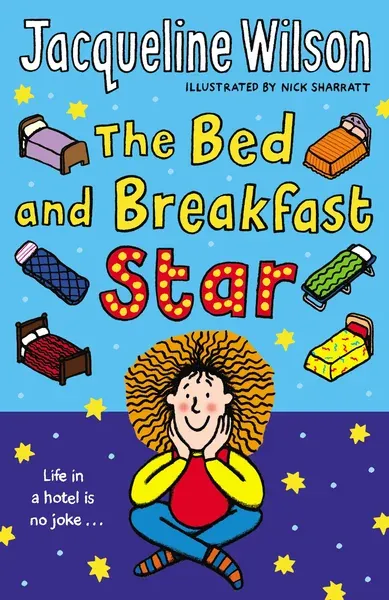
You simply cannot discuss a Jacqueline Wilson book without acknowledging Nick Sharratt's illustrations. His distinctive artwork doesn't just complement the text—it amplifies Elsa's comedic personality through every visual detail. The cover alone captures the theatrical nature of Elsa's character, while interior illustrations bring her jokes and family dynamics to vivid life.
Sharratt's style perfectly matches Wilson's blend of serious themes with lighthearted presentation. The illustrations make this book accessible to younger readers while adding layers of visual humor that enhance the reading experience. For children's literature, this collaboration demonstrates how text and image can work in perfect harmony.
Elsa's Comedy as Survival Mechanism
What makes Elsa such a compelling protagonist is how authentically Wilson portrays her use of humor as a coping mechanism. Rather than depicting comedy as mere entertainment, the story reveals how Elsa's jokes serve multiple purposes: they deflect uncomfortable questions about her living situation, boost morale, and give her a sense of control when everything else feels chaotic.
The relationship dynamics within Elsa's family feel genuine without becoming overly sentimental. The family's struggles with housing and relationships, and their different responses to upheaval all ring true. Wilson never suggests that humor solves everything, but she does demonstrate how it can make the unbearable bearable—a lesson that resonates far beyond childhood.
Addressing Homelessness Without Preaching
One of Jacqueline Wilson's greatest strengths is tackling serious social issues without turning her stories into heavy-handed lessons. The Bed and Breakfast Star addresses homelessness, family instability, and economic uncertainty through Elsa's eyes, making these complex topics accessible to young readers without overwhelming them.
The Royal Hotel serves as more than just a setting—it becomes a character in its own right, representing the liminal space between having a home and being truly homeless. Wilson captures the specific challenges of temporary accommodation: the lack of privacy, the uncertainty about duration, and the social stigma attached to living in such circumstances.
Yet she also shows how people adapt, form unexpected communities, and find dignity in difficult situations. The other residents of the Royal Hotel aren't just background characters; they're part of Elsa's expanded world, each dealing with their own circumstances while contributing to the temporary community they've all joined.
A Timeless Story of Resilience
Nearly three decades after publication, The Bed and Breakfast Star remains painfully relevant. Housing insecurity affects families across socioeconomic levels, and children today still need models for resilience in the face of family upheaval. Elsa's story provides exactly that—not false optimism, but genuine strategies for maintaining hope and humor when circumstances feel overwhelming.
The book works equally well for children currently experiencing housing instability and those who need greater understanding of what their classmates might be facing. Jacqueline Wilson's gift lies in creating empathy without exploitation, showing rather than telling readers how to respond to difficult circumstances.
For readers familiar with Wilson's other works like the Tracy Beaker series, The Bed and Breakfast Star demonstrates her consistent ability to find light in dark situations while respecting both her characters' intelligence and her readers' emotional maturity.
Who Should Pack Their Bags for This Journey
The Bed and Breakfast Star works best for readers aged 8-12 who are ready to engage with more complex family dynamics. The humor makes serious themes approachable, but parents should be prepared for conversations about homelessness, family relationships, and economic inequality.
This book particularly suits children who appreciate character-driven stories over action-packed plots. Elsa's internal journey and relationships provide the narrative engine, making this ideal for readers who enjoy psychological depth in their fiction.
Teachers and librarians will find this valuable for discussions about empathy, resilience, and social awareness. The combination of serious themes with accessible presentation makes it perfect for bridging entertainment and education.
You can find The Bed and Breakfast Star at most bookstores or order it through Amazon for quick delivery to start this journey of humor and heart.