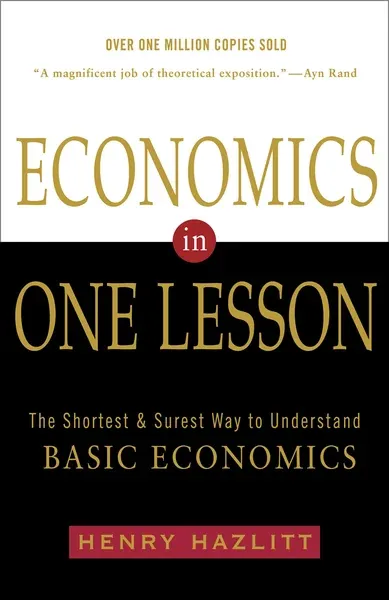
Nearly eight decades after its initial publication in 1946, Henry Hazlitt's Economics in One Lesson continues to serve as many readers' introduction to economic thinking. But is Economics in One Lesson worth reading in 2026, given how much the economic landscape has changed? The answer lies not in the book's predictions about specific policies, but in its enduring framework for economic analysis that remains as relevant today as it was in the post-war era.
Readers familiar with modern economic primers like Freakonomics or The Undercover Economist will find Hazlitt's approach refreshingly direct and systematic. Where contemporary books often rely on entertaining anecdotes, Hazlitt builds his entire analysis around a single, powerful principle that cuts through economic complexity with surgical precision.
The Central Lesson That Changes Everything
Hazlitt's "one lesson" forms the backbone of clear economic thinking: "The art of economics consists in looking not merely at the immediate but at the longer effects of any act or policy; it consists in tracing the consequences of that policy not merely for one group but for all groups." This deceptively simple statement becomes a lens through which Hazlitt examines everything from public works projects to rent control to international trade.
The genius of this approach lies in its universality. Rather than memorizing dozens of economic theories, readers learn a single analytical tool that applies across virtually every economic question. Hazlitt demonstrates this by systematically working through common economic fallacies, showing how policies that seem beneficial to one group often impose hidden costs on others, or how short-term gains frequently create long-term problems.
Hazlitt's Clear and Accessible Style
What sets Economics in One Lesson apart from academic economics texts is Hazlitt's commitment to plain English. Writing as a journalist rather than an academic, he avoids jargon and mathematical formulas in favor of concrete examples and logical progression. Each concept builds naturally on the previous one, creating a coherent framework rather than a collection of isolated ideas.
Hazlitt's prose remains remarkably crisp and engaging despite the book's age. His examples, drawn from 1940s America, translate easily to contemporary situations. The principles he illustrates through discussions of wartime price controls apply just as clearly to modern debates about rent stabilization or minimum wage laws.
The Broken Window and Beyond
The book opens with Frédéric Bastiat's parable of the broken window, which becomes Hazlitt's template for economic analysis. When a shopkeeper's window is broken, the immediate visible effect is positive—the glazier gets work, spends his earnings, and stimulates economic activity. The hidden effect is negative—the shopkeeper cannot spend that money on new shoes or books, representing lost opportunities that remain invisible.
Hazlitt applies this seen-versus-unseen framework to dozens of economic scenarios. Public works projects create visible jobs but divert resources from private investments that would have created different jobs. Tariffs protect visible domestic industries while imposing invisible costs on consumers and export industries. This analytical approach trains readers to ask not just "who benefits?" but "who pays?" and "what alternatives are being sacrificed?"
Where the Analysis Shows Its Age
While Hazlitt's core framework remains sound, some applications reflect the economic assumptions of his era. His discussion of international trade, written during the Bretton Woods system, doesn't fully account for the complexities of modern global supply chains and currency markets. His treatment of technological displacement, while prescient in its optimism about long-term job creation, doesn't grapple with the speed and scale of contemporary automation.
The book also reflects the limited role of government in 1946 America. Hazlitt's analysis of social programs and public goods, while logically consistent, doesn't engage seriously with market failures, externalities, or the information problems that modern economists recognize as justifications for government intervention.
The Austrian School Foundation
Hazlitt wrote from within the Austrian school of economics, emphasizing individual choice, spontaneous order, and skepticism toward government planning. This philosophical foundation shapes his analysis throughout the book, leading to consistently free-market conclusions. Readers should understand this perspective as one valuable lens among many, not as the final word on economic policy.
The Austrian influence appears most clearly in Hazlitt's treatment of entrepreneurship and market processes. He excels at explaining how markets coordinate information and incentives, but gives less attention to situations where markets might fail or where collective action could improve outcomes.
Practical Wisdom for Economic Thinking
Despite its theoretical framework, Economics in One Lesson offers intensely practical guidance for understanding economic news and policy debates. The analytical tools Hazlitt provides help readers cut through political rhetoric and interest-group pleading to identify the real economic effects of proposed policies.
The book's enduring value lies not in its specific policy recommendations but in its methodology. Learning to trace the full consequences of economic actions, to identify hidden costs alongside visible benefits, and to think systematically about trade-offs creates a foundation for economic literacy that transcends particular ideological positions.
Where to Buy
You can find Economics in One Lesson at Amazon, your local bookstore, or directly from major publishers who continue to keep this classic in print.