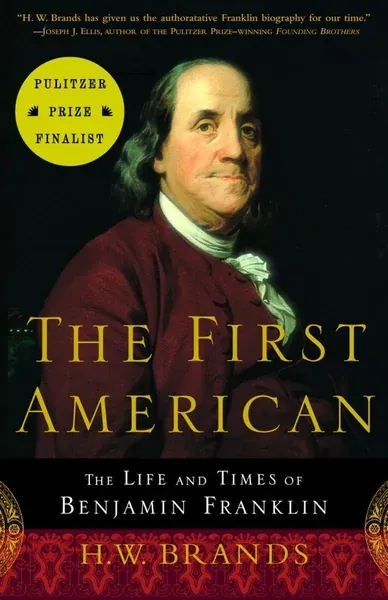
H.W. Brands accomplishes something remarkable in The First American: he makes Benjamin Franklin feel human rather than mythical. While readers familiar with Benjamin Franklin: An American Life by Walter Isaacson might wonder if another Franklin biography is necessary, H. W. Brands proves there's still fresh ground to cover in understanding America's most versatile founding father.
The Man Behind the Lightning Rod
H. W. Brands doesn't simply chronicle Franklin's achievements; he excavates the contradictions that made Franklin fascinating. The author presents a Franklin who could champion liberty while owning slaves, preach frugality while living lavishly in Paris, and advocate for American independence while remaining emotionally tied to Britain for decades. Rather than glossing over these inconsistencies, Brands uses them to reveal the complexity of Franklin's character and the evolving nature of his political philosophy.
The biography traces Franklin's transformation from a Boston candlemaker's son to an international diplomat, but H. W. Brands pays particular attention to the psychological drivers behind Franklin's relentless self-improvement and public service. The famous thirteen virtues aren't presented as quaint historical curiosities but as evidence of Franklin's lifelong struggle with his own nature and ambitions.
Brands' Accessible Scholarship
What distinguishes H. W. Brands' approach is his ability to make Franklin's scientific and political achievements comprehensible without dumbing them down. The sections on Franklin's electrical experiments avoid both oversimplification and technical jargon, explaining the genuine innovation of Franklin's work within the context of 18th-century natural philosophy. Similarly, Brands navigates the complex diplomatic negotiations leading to the French alliance with clarity that makes the stakes and strategies apparent.
The author draws extensively from Franklin's correspondence, almanacs, and published works, but he contextualizes these primary sources effectively. Rather than simply quoting Franklin's witticisms, H. W. Brands demonstrates how Franklin's public persona was carefully crafted and how it served his political objectives. The research is thorough without being ostentatious, building a comprehensive portrait through accumulated detail rather than dramatic revelation.
Brands populates his narrative with the politicians, scientists, and thinkers who shaped Franklin's world. The tensions with proprietary governors illuminate Franklin's growing frustration with colonial governance, while his relationships with French intellectuals like Voltaire reveal Franklin's role in transatlantic Enlightenment networks. The author particularly excels in depicting Franklin's complex relationship with his son William, whose loyalty to Britain created a permanent rift between father and son.
The portrait of Deborah Franklin, Benjamin's wife, acknowledges the limitations of available sources while avoiding the trap of either idealizing or dismissing her contributions to Franklin's success. H. W. Brands recognizes that much of Franklin's public life was possible because of Deborah's management of their domestic and business affairs, even as their relationship remained emotionally distant for long periods.
Making Sense of Franklin's Contradictions
The biography's central strength lies in Brands' treatment of Franklin's inconsistencies as features rather than bugs of his character. The man who wrote "Those who would give up essential Liberty, to purchase a little temporary Safety, deserve neither Liberty nor Safety" also advocated for the Stamp Act before opposing it. H. W. Brands demonstrates how Franklin's positions evolved through experience rather than adhering to rigid ideology, making him both more pragmatic and more genuinely American than his more doctrinaire contemporaries.
The sections on Franklin's gradual shift from loyal British subject to American patriot are particularly well-crafted. Brands shows how Franklin's humiliation before the British Privy Council in 1774 crystallized decades of growing frustration with imperial policy, transforming personal slight into political conviction. This psychological insight elevates the biography beyond mere chronicle into genuine historical analysis.
Where the Portrait Loses Focus
Despite its many strengths, The First American occasionally suffers from its comprehensiveness. Some sections, particularly those dealing with Franklin's early business ventures, feel more dutiful than illuminating. The chronological structure, while logical, sometimes fragments thematic development, making it harder to trace the evolution of Franklin's thinking on specific issues like slavery or religious tolerance.
H. W. Brands also struggles with the inherent challenge of Franklin biography: Franklin was so prolific and varied in his interests that no single narrative can do justice to all aspects of his life. The scientific achievements, diplomatic career, and literary output each deserve fuller treatment than a single volume allows, leading to some sections feeling rushed or superficial.
A Franklin Biography for Modern Readers
The First American succeeds as both historical scholarship and engaging narrative. H. W. Brands writes with the authority of a professional historian but avoids academic jargon that might intimidate general readers. The book review shows this work functions particularly well for readers seeking to understand Franklin's role in American founding mythology and how that mythology both illuminates and obscures the historical figure.
While not as psychologically penetrating as some biographical portraits, Brands' Franklin emerges as recognizably human: ambitious, pragmatic, occasionally hypocritical, but ultimately committed to the radical experiment in self-governance that became the United States. For readers interested in understanding how American national character was forged, The First American provides essential insight into the man who helped define what it meant to be American.
Where to Buy
You can find The First American: The Life and Times of Benjamin Franklin at Amazon, your local bookstore, or directly from Anchor Books.