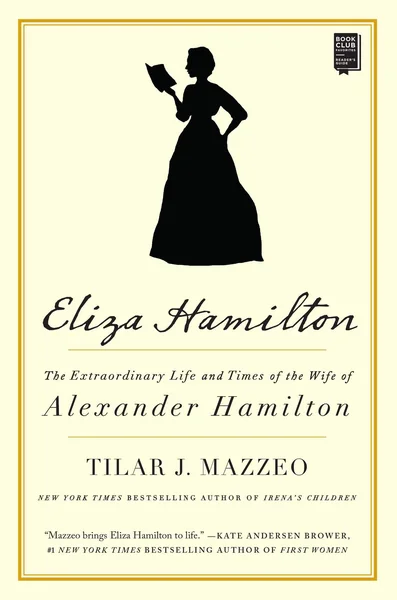
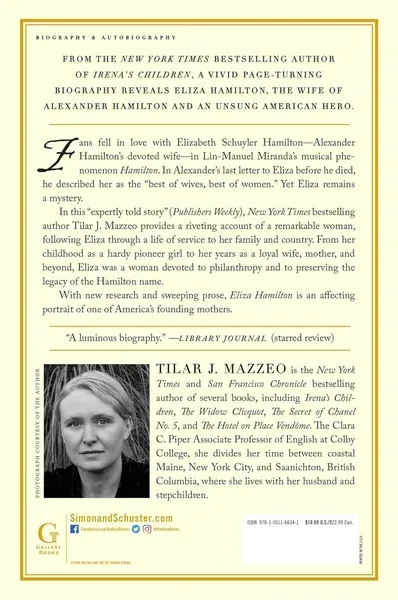
Is Eliza Hamilton biography worth reading? In a literary landscape saturated with Alexander Hamilton studies, Tilar J. Mazzeo's 2018 biography attempts something bold: centering Elizabeth Schuyler Hamilton as the protagonist of her own remarkable story rather than merely the grieving widow of America's first Treasury Secretary. The result is a meticulously researched portrait that succeeds in illuminating a woman whose influence extended far beyond her famous marriage, though it occasionally struggles under the weight of limited source material.
Readers familiar with Alexander Hamilton by Ron Chernow will find a fascinating counterpoint here. Where Chernow's Pulitzer Prize-winning biography painted Eliza primarily through Alexander's perspective, Mazzeo works to reconstruct her subject's inner life and independent achievements. This biographical approach faces inherent challenges—18th-century women left fewer documentary traces—but Mazzeo navigates these limitations with scholarly rigor and narrative creativity.
The Woman Behind the Founding Father
Mazzeo's central thesis positions Eliza Hamilton not as a passive historical figure but as an active participant in early American society. The author traces Eliza's evolution from privileged Schuyler daughter to political wife to pioneering social reformer. The book's greatest strength lies in its detailed examination of Eliza's post-widowhood decades, a period often compressed into footnotes in other Hamilton biographies.
The narrative reveals how Eliza's work with the Orphan Asylum Society represented genuine innovation in American charitable organizations. Mazzeo demonstrates that these weren't merely genteel volunteer activities but sophisticated institutional building that required political acumen and administrative skill. The author's background in cultural history serves her well here, providing context for how women of Eliza's class navigated public influence within domestic sphere constraints.
Mazzeo's Research and Methodology
The biographical craft on display reflects thorough archival work, with Mazzeo drawing from Schuyler family papers, contemporary letters, and institutional records. Her sourcing feels particularly strong when documenting Eliza's later charitable work, where organizational records provide concrete evidence of her activities and influence. The author's approach to evidence is generally conservative, acknowledging gaps in the historical record rather than fabricating psychological insights.
However, the biography occasionally reveals the limitations of its source base. Mazzeo sometimes relies on inference and contextual detail to fill narrative gaps, a common challenge in biographical writing about 18th-century women. When direct evidence about Eliza's thoughts or motivations remains elusive, the author wisely pivots to examining the broader social and political contexts that shaped her choices.
Beyond Alexander Hamilton himself, Mazzeo populates her narrative with the social and political networks that defined Eliza's life. The Schuyler family dynamics receive careful attention, particularly Eliza's relationships with her sisters and her father's political connections. The book excels at showing how elite family networks functioned in early American society, with marriages serving as political and economic alliances.
The author also illuminates Eliza's relationships with other prominent women of her era, though these connections sometimes feel underdeveloped due to source limitations. Mazzeo works effectively with available evidence to suggest the importance of female friendships and collaborations in Eliza's charitable work, even when the documentary record remains thin.
Historical Context and Social Analysis
Mazzeo's background in cultural history shines in her analysis of how gender expectations shaped and constrained Eliza's public activities. The biography thoughtfully examines how elite women in the early republic created space for meaningful public engagement while maintaining social respectability. This historical framework proves illuminating for understanding both Eliza's achievements and their limitations.
The author's treatment of the Hamilton marriage itself feels balanced and nuanced. Rather than romanticizing or pathologizing the relationship, Mazzeo presents it as a partnership shaped by its historical moment—emotionally intense but also pragmatic, complicated by Alexander's political ambitions and personal flaws. The analysis of how Eliza managed public scandal, including Alexander's affair, demonstrates her political sophistication.
Where the Biography Falls Short
Despite its scholarly merits, the biography suffers from pacing issues that reflect its source material constraints. The book's middle sections occasionally feel padded, with Mazzeo providing extensive background context to compensate for limited direct evidence about Eliza's experiences. While this historical contextualization proves valuable, it sometimes overwhelms the biographical narrative.
The author's prose, while competent, lacks the narrative drive that distinguished Ron Chernow's Hamilton biography. Mazzeo writes clearly and informatively, but her academic background shows in a tendency toward careful qualification that can diffuse dramatic tension. Readers seeking the page-turning quality of popular biography may find the pacing deliberate to a fault.
A Necessary Corrective
For readers interested in early American history, Eliza Hamilton represents essential reading despite its limitations. Mazzeo's biography succeeds in its primary goal: establishing Elizabeth Schuyler Hamilton as a significant historical figure deserving independent study. The book's detailed examination of women's charitable work and social networks fills important gaps in our understanding of how elite women exercised influence in the early republic.
The biography works best for readers already familiar with the broader Hamilton story through Chernow's work or the musical phenomenon. Those seeking an introduction to the Hamilton family saga might find Mazzeo's focus too narrow, but readers interested in women's history and social reform will discover valuable insights throughout.
Where to Buy
You can find Eliza Hamilton at Amazon, Barnes & Noble, your local independent bookstore, or directly from Gallery Books.