A direct, series-first conspiracy thriller whose clearest promises are on the cover copy rather than in a detailed public record.
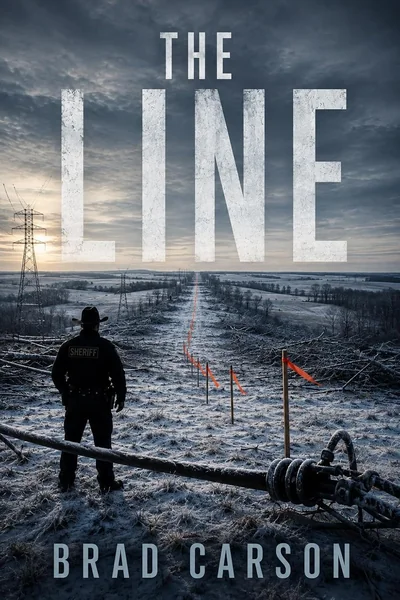
The Line: A Small-Town Land Conspiracy Thriller (Still Standing Book 3) by Brad Carson front cover
What It Is
The Line: A Small-Town Land Conspiracy Thriller is a Kindle-edition thriller by Brad Carson, listed as the first edition with an English-language text and a publication date of August 12, 2026. The most concrete statement of premise comes from the book’s own subtitle: this is a thriller built around a land conspiracy in a small town. That framing matters because it sets expectations without overreach. The title does not present itself as a courtroom epic, a technothriller, or a cosmopolitan spy story; it announces a local conflict with stakes rooted in place, property and secrecy.
That makes the book easy to shelve mentally. Readers drawn to small-town pressure cookers — where everyone knows the landscape, loyalties are personal and a dispute over land can widen into something more dangerous — will recognise the intended territory from the packaging alone. The reviewable facts stop well short of named characters or a scene-by-scene plot, so the responsible way to describe the book is by its declared form and series position rather than by invented incident.
Series Position and Structure
The listing places The Line as Book 3 of 6 in the Still Standing sequence. That is a meaningful structural fact. A third volume in a six-book run sits in the middle of an ongoing design: it is neither an opening handshake nor a concluding reckoning. For continuing readers, that can be an advantage, because the series has room to develop consequences across multiple instalments. For a newcomer, the same fact argues for beginning at the first book rather than treating this as a convenient standalone.
The listed print length is 260 pages, which is compact for a thriller and suggests a tight page count rather than a sprawling ensemble saga. That should not be mistaken for a judgment about pace or quality; it is simply the stated scale of the edition. In practical terms, the book presents itself as a mid-series entry with a defined arc ahead and behind it, and its value will be clearest to readers already committed to Still Standing or prepared to commit from the beginning.
Kindle Edition and Accessibility
The Amazon/Canopy record is unusually specific about the digital build. The Kindle edition lists Enhanced typesetting, Page Flip and Word Wise as enabled, Screen Reader as supported, and X-Ray as not enabled. The file size is listed at 780 KB. Those are not literary virtues, but they shape the reading experience for buyers comparing formats.
Screen Reader support and Word Wise broaden the edition’s usefulness: the former matters for accessibility, the latter can help younger readers, English-language learners or anyone who prefers quick vocabulary support. Enhanced typesetting and Page Flip are conveniences rather than necessities, while the absence of X-Ray means the edition does not offer Amazon’s in-book reference layer for characters and terms. None of this proves anything about suspense, prose or plotting; it simply defines the container in which the story is sold.
Strengths and Frictions
The book’s strongest card is clarity of category. Many thrillers hide behind vague jacket language; this one names its small-town land-conspiracy engine in the subtitle. It also sits inside an explicit six-book plan, which can reassure series readers who prefer a continuing world over one-off premises. The modest listed length may appeal to readers who want a thriller that does not demand a long commitment per instalment.
The frictions are equally concrete. A third volume is not the natural doorway into Still Standing, and readers who insist on full self-contained resolution should treat the series label as a warning to start elsewhere. The digital feature set is mixed rather than comprehensive: useful aids are present, but X-Ray is switched off. Finally, the available facts are thin on named characters and reception, so readers who need extensive pre-purchase detail beyond the declared premise will find the public presentation restrained.
Who It Is For
This is for thriller readers who like their conspiracies local before they turn large: land, town politics, buried interests and the kind of conflict where the map matters. It is best suited to readers already inside the Still Standing sequence, or to those willing to begin with Book 1 so the third volume lands in context. Readers shopping primarily for accessible Kindle functionality get several helpful features, though not the full Amazon reference suite.
As an editorial assessment, The Line earns attention for what it plainly claims to be rather than for elaborate promises it does not make: a mid-series small-town conspiracy thriller with a compact listed length and a serviceable, accessibility-minded Kindle package. The sensible recommendation is simple — series readers proceed, new readers start earlier, and format-focused buyers should note the present-but-not-complete Kindle extras.


Reader Comments
No comments yet
Be the first to share your thoughts!